The Socialist Joy of Langston Hughes
A Review of Jonathan Scott's New Book
by Seth Sandronsky
"Hughes seeded a transformative dialogue about the living and working conditions of regular women and men."
Socialist Joy in the Writing of Langston Hughes by Jonathan Scott (Columbia, University of Missouri Press, 2006), 272 pp. Hardcover, $39.95.)
 Langston Hughes (1902-1967) was a great American poet. But he did not stop there. Jonathan Scott's new Socialist Joy in the Writing of Langston Hughes helps us to take pleasure in his originality and productivity.
"I've been obsessed by the relation between the individual and the collective," writes Scott, a Detroit native who teaches English in Jerusalem. To this end, he illuminates Hughes' patterns of poetry and prose as organic ingredients of social actions in the United States and abroad at that time in history. Our repressive era lacks a similar writer or politics.
Scott's book has four parts. Part one looks at Hughes and his work on African-American culture that sees society from a unique point of view informed by a daily struggle for justice. This vision, Scott writes, also is open to unity with others who labor for a living.
For instance, in the body of literature that Hughes produced, the blues constituted a culture that was more than art by, of and for blacks. Rather, the blues were a canvas for the lives of oppressed working people of all hues, voicing a socialist joy of potential human liberation.
"I'm so tired of waiting, aren't you," wrote Hughes as a 20-something, "for the world to become good and beautiful and kind? Let us take a knife and cut the world in two and see what worms are eating at the rind."
"The blues were a canvas for the lives of oppressed working people of all hues."
Hughes' essays and poems placed daughters and sons of former slaves within a mass of wage earners bridled by the time clock and the workplace. Both restricted their full abilities. Readers here and abroad responded to Hughes' emancipatory writing, but mainstream critics were cold to his literary flair. In part two, Nicolás Guillén, the Cuban national poet, had a different reaction. He and Hughes met in 1930. Their union helped Guillén create new forms of popular poetry for Cubans who were struggling to free themselves from Western colonialism.
In part three, Scott turns to Hughes' journalism from the 1940s to the 1960s, "his most popular literary innovation since his blues poems of the 1920s and 1930s." In the Chicago Defender, a black-owned paper, Hughes penned "Here to Yonder," a column with a main character named Jesse B. Simple. He spoke with Hughes and other blacks about current events, including class conflict among and between them, while rejecting their shared second-rate citizenship. Readers loved this column, a community talking book. In it, Hughes seeded a transformative dialogue about the living and working conditions of regular women and men. As a columnist, Hughes urged social equality "through the popular language of the African-American laborer," Scott notes. This message was loud and clear in the Civil Rights movement.
"The connections between listening, seeing and writing blossomed in Hughes's able hands."
In part four, we read about Hughes, a pioneering author of children's literature. This, like his journalistic efforts, attracted new readers. The First Book of Rhythms flowed from his time as a writing teacher for Chicago students in the eighth grade. Hughes emphasized their use of drawing to describe movement, a process which has animated the natural world from the days of the ancient Greeks and Egyptians.
"Hughes' method is an ingenious way of getting students to think in terms of the rhythms of prose writing; of lyrical flow; of word sequences, transitions, cadences and caesuras," Scott writes.
"Already there is the room to start and stop as suits the writer, but in a disciplined, rhythmized way." The connections between listening, seeing and writing blossomed in Hughes's able hands. Parents and classroom teachers of middle and high-school students, take note!
Currently, Hughes has a larger stature outside the United States than inside of it. Here, he is largely a writer studied during Black History Month and otherwise ignored. That is a shame and a trend to end. Scott's book may be a move in that direction.
Seth Sandronsky lives and writes in Sacramento. He can be reached at: ssandronsky@yahoo.com.

 After dozens died in stampedes, Nigerian President Bola Tinubu remarked, “We should just get on with it.” Tinubu’s IMF-prescribed policies have more than doubled food prices in the country,…
 Ajamu Baraka was a guest on the SOBH program on Press TV. He discussed his history of political organizing and activism, human rights, and the importance of the Black Radical Peace Tradition.
 We talk about the killing of Robert Brooks by prison corrections officers and the need to close Rikers Island. We also discuss a recent Cuban conference dedicated to ending racism in that country.
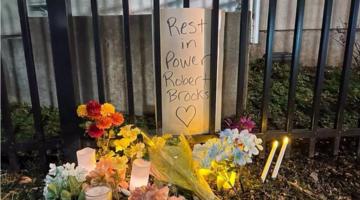 Darren Mack, co-founder and co-director of Freedom Agenda, talks to us about the killing of Robert Brooks, who died after being beaten by corrections officers in a New York state prison, and the need…
 The National Program against racism and racial discrimination conference was held in Cuba as part of the UN declared International Decade of People of African Descent.


