 by Lee A. Daniels
Media repeat the pared down, sanitized jobless figures, even though they know the stats are misleading. “A truer picture of unemployment is to be drawn from including those involuntarily working part-time jobs, those who only sporadically find work and the long-term unemployed who have given up looking for work.”
Whitewashing the Jobs Statistics
by Lee A. Daniels
This article originally appeared on TheDefendersOnline, a publication of the NAACP Legal Defense and Educational Fund.
“The actual joblessness predicament among all Americans is significantly worse than the official figures indicate.”
Why is it that significant sectors of the mainstream media no longer acknowledge the continued, alarming racial difference in the national unemployment rate?
Wall Street, many independent economists and the White House all cheered July’s unexpected one-tenth-of-a-percentage-point decline in the unemployment rate, to 9.4 percent. Their standard line was that it is further evidence the economy is finally stabilizing and beginning to turn upwards.
Fair enough.
But shouldn’t the mainstream media be telling us more about that rate? Should they be delineating the race-driven disparity in U.S. unemployment? That bitter reality is plainly put in the jobs report the federal Bureau of Labor Statistics issues at the beginning of every month. There in stark numbers exists the raw statistical portrait of the racially-disparate suffering caused by the loss of 6.7 million jobs in the last 19 months. It shows that the white unemployment rate last month was 8.6 percent, the Hispanic rate was 12.3 percent – and the unemployment rate for blacks was 14.5 percent.
“The black-white gap holds true even where one least expects it – among college graduates.”
Those gaps in rough terms reaffirm the historical relationship of the white, Hispanic and black unemployment rates. Overall, the Hispanic unemployment rate is usually about 1.5 times that of whites; the black unemployment is typically about twice that of whites. Revealingly, according to the Economic Policy Institute, a progressive Washington, D.C.-based think tank, this black-white gap holds true even where one least expects it – among college graduates[2]. EPI found in its own analysis of federal labor statistics for March that, while the unemployment rate for white college graduates was 3.8 percent, it was 7.2 percent for blacks.
One consequence of that structural face-of-life for black would-be workers is that in only one of the last nine years has blacks’ annual unemployment rate been below what the white unemployment rate is now. In other words, if the unemployment predicament whites are enduring signals a “severe recession,” as is widely acknowledged, what have black Americans been enduring this decade and what’s the proper term for what they’re enduring now?
By and large, that’s not a question that seems to interest the mainstream media. Instead, there seems to be a common agreement to obscure the racial disparity with a thick coat of whitewash.
“If the unemployment predicament whites are enduring signals a 'severe recession,' as is widely acknowledged, what have black Americans been enduring this decade?”
Perhaps there’s no deliberate racial intent involved. After all, the media have also largely stopped explaining another critically important fact about the official overall unemployment rate. That is that a truer picture of unemployment is to be drawn from including those involuntarily working part-time jobs, those who only sporadically find work and the long-term unemployed who have given up looking for work. Factoring those groups in can push the real unemployment rate up by from 4 to 7 percent.
In those terms, then, the actual joblessness predicament among all Americans is significantly worse than the official figures indicate. And, whichever way you slice it, black Americans as a group have it worse off than any other group of workers.
Why isn’t this reality a central part of the mainstream discussion of joblessness? Perhaps because some of those most prominent in the public discourse don’t want to frighten or discourage the public with the truth of how bad things are. Perhaps because some others are so enamored of lecturing blacks about “personal responsibility,” they can’t bring themselves to acknowledge a particular truth.
“Institutional as well as individual racism has always insured that black Americans are saddled with a high rate of unemployment.”
The first part of that truth is that the black unemployment predicament has always been a structurally-driven phenomenon: institutional as well as individual racism has always insured that black Americans are saddled with a high rate of unemployment. The second part of that truth is that now, given the relentless dynamic of globalization, it’s likely that even during an economic recovery blacks at every level of the class and occupational ladder will continue to lose their jobs at rates disproportionate to whites.
The implications, obviously, are dire. A downward slide toward the poverty line of even a relatively small cohort of blue-collar and white-collar black families could substantially destabilize Black America, completely wiping out its already meager chances to accumulate significant economic resources. One strategy black Americans should press on the Obama administrations and the state legislatures is to take inspiration from an achievement forged in 1999-2000 by that most maligned group of Americans: poor, poorly-educated black males. I call it the Seven-Percent Solution, and I will discuss it in detail in a forthcoming article.
Lee A. Daniels is Director of Communications for The NAACP Legal Defense and Educational Fund, Inc., and Editor-in-Chief of TheDefendersOnline.

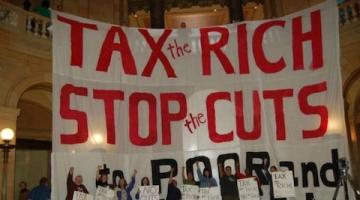 Together, we can demand that one of the wealthiest nations on earth upholds its responsibility to provide the basic necessities for its people.
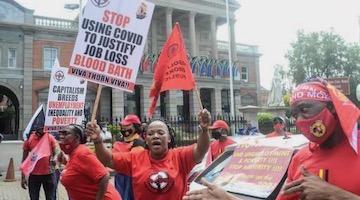 Millions of workers took part in the general strike on February 24, according to the South African Federation of Trade Unions which called for the labor action.
 Jamal Journal: Mumia Says He Has Covid
 “We should not expect any fundamental alteration” in US foreign policy under President Joe Biden, said Ajamu Baraka, national organizer of the Black Alliance for Peace, at a joint
 The question of fascism emerges “when one sector of the ruling class introduces measures that bear some resemblance to the colonial condition that Africans and other oppressed peoples live with all



