 by Robert Jensen
A frequent lecturer on race and politics, the author was confident that he was reasonable well acquainted with the workings of racism in the United States. Attuned to the pervasiveness of white privilege, he believed himself both sophisticated and sensitive on matters of race. Then, as often happens, he was humbled by the arrival of another teachable moment.
Encounters with Police: Teachable Moments
by Robert Jensen
This article previously appeared inOpEdNews.
“These teachable moments are an important reminder that white supremacy is woven deeply into the fabric of this country.”
Honoring President Obama's request that the controversy involving a black Harvard University professor and a white Cambridge police officer become "a teachable moment," here's my contribution to an old lesson that we white people tend to be slow to learn.
In lectures about the United States' system of white supremacy and the privileges that white people have in that system, I have sometimes told a story about being stopped by police in Austin, TX.
I was driving home in a dilapidated old Volkswagen Beetle on a busy street, late at night after a long day at work. I was dressed in shorts and a t-shirt, feeling rather cranky and looking rather raggedy. Eager to get home, I saw the yellow light and gunned it. Next I saw the flashing red lights of a police car.
“I was opening the glove compartment to get the vehicle registration when out popped a small knife I keep for emergencies.”
I turned off onto a dark side street and dug in my wallet for my license. Just as the officer got to my car, I was opening the glove compartment to get the vehicle registration when out popped a small knife I keep for emergencies. I looked at the knife, looked at the white officer, and wondered what he would say.
"Sir, would you mind if I held that knife while we talked?" he asked politely. I handed him the knife and my documents, and he walked back to his car. When he returned he handed me those documents, along with a ticket, and my knife, without comment. "Please drive safely," he said. And safely I drove home.
When I told that story to illustrate white privilege, I asked people of color in the room what they imagined might have happened to them in such a situation. The black and Latino men, especially, laughed. "Do you mean before or after I'm on the ground with a gun at my head?" one of them said.
My point was not that every cop is out to harass or brutalize every person of color, but that people of color could never be sure a routine traffic stop would play out routinely. I could be reasonably sure that, barring unusual circumstances, such a stop would be uneventful. Even when the knife popped out, I didn't feel at risk.
“People of color could never be sure a routine traffic stop would play out routinely.”
I was feeling proud of myself for making this point to the mainly white audience, when I saw a hand go up. I called on the young black man, assuming he would endorse my analysis.
"You really don't get it, do you?" he said. "You think your privilege started when the cop came up to the car and saw you were white. Has it ever occurred to you that when you turned onto a dark side street you were taking your privilege for granted?"
My first response was to explain: I had been on a busy street and turned to avoid blocking traffic. I was trying to be considerate of other drivers, I said.
"I know why you did it. My point is that I would never turn onto an unlit street with a cop behind me," the young man said. "I would have pulled over and blocked traffic. I'm not going to take myself out of public view with a cop."
My next response was to feel appropriately foolish for my unwarranted self-righteousness, and then to be grateful to the man for using that teachable moment.
“'I would never turn onto an unlit street with a cop behind me,' the young man said.”
He wasn't suggesting that I be ashamed of myself, only that I recognize the burden he carries in the world that I don't. The story was one more example of the privilege that comes with being a member of the dominant group in an unjust hierarchical system. It's the same lesson men should learn about the sexual violence women face. Heterosexuals should learn it about the condemnation that lesbians and gays endure. The wealthy should learn it about the insecurity that poor and working people cope with. U.S. citizens should learn it about the fear of arbitrary authority that haunts immigrants no matter what their status.
I still tell that story when I lecture, now emphasizing that the man's comments had reminded me no one with privilege ever fully "gets it." It doesn't mean we whites -- or men, or heterosexuals, or the well off, or citizens -- are consigned to perpetual stupidity, but rather that we should never think we have it all figured out.
In this allegedly "post-racial" era, these teachable moments are an important reminder that white supremacy is woven deeply into the fabric of this country. A system as perverse and pervasive as white racism -- in all its forms, conscious and unconscious, brutal and subtle, personal and institutional -- will not end simply because we appoint black professors or elect a black president.
In this moment, we white folks should ask ourselves, after so many teachable moments, why we still have so much to learn.
Robert Jensen is a journalism professor at the University of Texas at Austin and board member of the Third Coast Activist Resource Center. His latest book, All My Bones Shake: Seeking a Progressive Path to the Prophetic Voice, was published in 2009 by Soft Skull Press. He also is the author of Getting Off: Pornography and the End of Masculinity (South End Press, 2007); The Heart of Whiteness: Confronting Race, Racism and White Privilege (City Lights, 2005); Citizens of the Empire: The Struggle to Claim Our Humanity (City Lights, 2004); and Writing Dissent: Taking Radical Ideas from the Margins to the Mainstream (Peter Lang, 2002). Jensen's articles can be found online at http://uts.cc.utexas.edu/~rjensen/index.html.

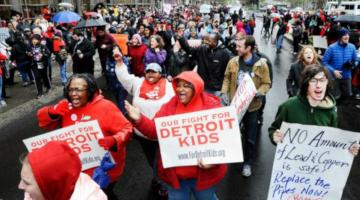 The corporate narrative on the Detroit teacher’s sick-out is that the public schools are “failing,” just as the city has “failed” to manage its own finances. But the state has intervened in Detroit’s…
 by BAR editor and senior columnist Margaret Kimberley President Obama’s remaining days in office may be short, but “there is no reason to mourn or rejoice Obama’s departure because he will be…
 A Black Agenda Radio commentary by executive editor Glen Ford President Obama likes to point to the killing of Osama bin Laden as a proud part of his legacy. Actually, the “hit” on bin Laden allowed…
 by BAR editor and columnist Dr. Marsha Coleman-Adebayo Barack Obama has expressed concern for any number of human tragedies in the nation and world, and waged wars under the banner of “humanitarian”…
 by Ann Garrison The Green Party has been around for two decades as an alternative to the two corporate parties. It's time some Greens paid attention to why it hasn't caught a mass following,…



