Click the flash player below to listen to or the mic to download an mp3 copy of this BA Radio commentary.
“R2P” is the latest American device to justify military aggression and regime-change in the developing world. “The doctrine is a warmed-over version of so-called 'humanitarian' military intervention – another excuse for big powers to make war on weaker nations.” The doctrine is “reminiscent of the term 'protectorate' – a legalism for a country that is run as a virtual colony of one of the big powers.”
“Responsibility to Protect” is Warmed-Over Imperialism
A Black Agenda Radio commentary by Glen Ford
“R2P allows Washington to act unilaterally whenever it decides that military intervention is in the best interest of humanity.”
The United Nations last week began what will become a protracted debate over the doctrine “Responsibility to Protect,” or R2P. The doctrine is a warmed-over version of so-called “humanitarian” military intervention – another excuse for big powers to make war on weaker nations. Its primary champion in the Obama administration is UN ambassador Susan Rice, who would use the “Responsibility to Protect” doctrine to justify U.S. military action in Somalia, Sudan and elsewhere. One important opponent of R2P is Rev. Miguel D’Escoto, of Nicaragua, president of the UN General Assembly.
“Responsibility to Protect” is reminiscent of the term “protectorate” – a legalism for a country that is run as a virtual colony of one of the big powers. That’s how the UN’s predecessor, the League of Nations, took the colony of South West Africa away from the defeated Germans, after World War One, and gave it to white-ruled South Africa, under whom it would remain until emerging as the independent Republic of Namibia, in 1990.
A “protectorate” is what the British and French established in much of the Middle East on the ashes of the Ottoman Empire, also after World War One, so they could “protect” the oil and ports and other resources of the region from the people who lived there. Palestine was a British protectorate, but that didn’t protect the Arab majority from the Zionists, who stole the land in 1948.
Haiti is now a de facto “protectorate” of the United Nations, which fronts for the United States, France and Canada. In fact, the new version of protectorates – philosophically buttressed by the doctrine “Responsibility to Protect” – was refined specifically to deny Haitians sovereignty over their own country after the ouster of Haitian President Jean-Bertrand Aristide, in 2004.
“Africa has turned decisively against the notion of 'Responsibility to Protect.'”
UN General Assembly president D’Escoto rejects the doctrine of protectorates, under the guise of R2P. His country, Nicaragua, was viewed, like all of Central America, as a protectorate of the United States. The U.S. once considered Nicaragua as a dumping ground for freed Black American slaves, and in the 1980s funded Contra terrorists and mined Nicaraguan harbors in defiance of the World Court, which was unable to provide protection from the Americans.
Africa has turned decisively against the notion of “Responsibility to Protect,” as it has witnessed the lopsided protectionist “justice” of an International Criminal Court that indicts only Africans, but does nothing to protect Africa from U.S. and European neocolonialism.
Among those participating in the UN debate on R2P, is Noam Chomksy, who describes the doctrine as “humanitarian imperialism.” That certainly is what it would amount to in the hands of the United States. Susan Rice’s version of R2P allows Washington to act unilaterally whenever it decides that military intervention is in the best interest of humanity. In practice, that’s no different than the Bush doctrine, or all the other previous American doctrines that have justified regime change at Washington’s political whim.
What the planet really needs protection from, is the United States, which remains, as Dr. Martin Luther King said more than 40 years ago, “the greatest purveyor of violence in the world.”

 The Islamic Revolutionary Guard Corps (IRGC) has issued a letter addressed to the American people, outlining its views on recent developments and Iran-U.S. relations.
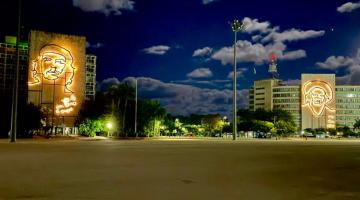 The Trump administration's new sanctions on Cuba, are part of a dual strategy to create unendurable hardship while simultaneously making Cuba financially dependent on the United States.
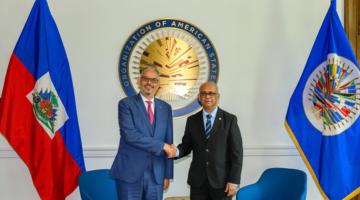 The armed groups in Haiti are not a spontaneous wave of banditry, but a scheme orchestrated by imperialist powers in concert with a reactionary and subservient Haitian political class. The…
 A coalition of Pan-African and socialist organizations has launched an international campaign to defend Cuba, arguing that African peoples must remember the sacrifices Cuban internationalists made…
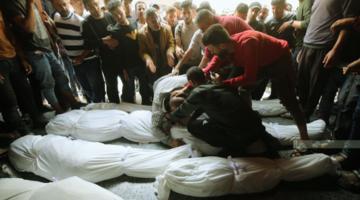 If international law and justice are buried in the rubble of Gaza, the global community will ultimately be digging its own grave.


