A Black Agenda Radio commentary by Glen Ford
Click the flash player below to listen to or the mic to download an mp3 copy of this BA Radio commentary.
Nearly a fifth of US oil imports come from West Africa and that proportion is only expected to grow. Western oil companies, chiefly Shell, BP and Chevron have pumped trillions of dollars worth of black gold from eastern Nigeria, but it remains the poorest and most polluted places on earth. Although oil company scofflaws have settled out of court with representatives of the families of a handful of the murdered the pitiless rape of eastern Nigeria continues.
Shell Oil Settles with 1995 Niger Delta Victims’ Families, But War Escalates
A Black Agenda Radio commentary by Glen Ford
“Shell executives made the obscene assertion that the settlement was a 'humanitarian gesture.'”
The Royal Dutch Shell oil corporation will pay $15.5 million to the families of the late Nigerian activist Ken Saro-Wiwa and others executed by a Nigerian military regime in 1995. The settlement ends a suit, that charged Shell oil with complicity in the torture and killing of the activists, who were protesting environmental and economic crimes against the people of the oil-rich Niger River Delta. The settlement is unusual, in that the dollar amount and other terms were made public. Most often, the parties in court settlements agree not to divulge how much money changed hands. But this was a profoundly political case, whose outcome was celebrated by the victim’s families and their lawyers at the New York-based Center for Constitutional Rights . Some of the fifteen and a half million will go to a fund for the Ogoni people. Shell oil may have believed it was purchasing some good will by settling with the Ogoni plaintiffs, but if so, the company spoiled the whole effect by continuing to claim it had nothing to do with the executions. Shell executives made the obscene assertion that the settlement was a “humanitarian gesture.” The company then called attention to the $240 million it claims to have contributed to so-called “community development” in the Delta, last year – which sounds more like a clever way to describe a chunk of the corporation’s massive bribery budget. $240 million dollars, whether in bribes or community development funds, might have gone a long way back in 1995, when Saro-Wiwa and his comrades were murdered by Shell’s partners in crime, the military government. Today, the payments are dwarfed by massive oil production losses due to a state of war between government and rebel forces in the region.
“Hundreds of civilians have been killed – no one knows precisely how many.”
Since May 15, the government has been engaged in a military offensive called Operation Cordon and Search , ostensibly aimed at rebels of the Movement for Emancipation of the Niger Delta, or MEND. The fighting has resulted in significant casualties among the combatants, but the greatest suffering has fallen on civilians. At least 20,000 people are thought to be hiding in the bush. Many thousands of others languish in refugee camps, short on food and medicines. Hundreds of civilians have been killed – no one knows precisely how many. Soldiers have burned villages to the ground, and even the palace of a local king was bombed by Nigerian air forces. The regional war has cost the oil industry at least 24 million barrels in production, causing Nigeria to fall to second place among African producers, behind Angola. However, that’s largely a loss among thieves: the same Nigerian and Big Oil conspirators that decided Ken Saro-wiwa and his comrades should be hanged 14 years ago for advocating fair distribution of oil profits, and respect for the land and people. Those chickens have come home to roost in the Delta, with a vengeance.
Time has shown that festering crimes produce bitter fruit. The issue in the Niger River Delta region has become one of national sovereignty affecting the whole of Nigeria. The lesson, is that no regime has the right to sell the national sovereignty and treasure out from under its people. For Black Agenda Radio, I’m Glen Ford. On the web, go to www.BlackAgendaReport.com .

 These remarks were made by the author at the Pan-Afrikan Society Community Forum (PASCF) Afrikan Liberation Day webinar held on Sat. May 27, 2023. The event was hosted by PASCF organizers in Britain…
 Venezuela's governing United Socialist Party of Venezuela, PSUV, has a complicated history with the Communist Party of Venezuela, PCV. A recent public dispute between the two parties has…
 African journalists strive to decolonize their work, and the struggle to free the Pendleton 2.
 The Pendleton 2: They Stood Up is a new documentary about political prisoners held in Indiana.
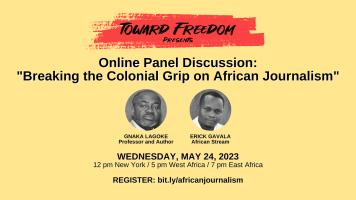 Decolonizing African journalism.



