The New Black Politics
by Jonathan D. Farley
This article originally appeared in the Harvard Crimson.
"Just because you are a first for blacks does not mean blacks are first for you."
As an African-American, people expect me to be excited by the inauguration of the first black president of the United States. Of course, symbols matter. A black man could not have ascended to the presidency 40 years ago. But the inauguration of President Barack Obama means considerably less than what the pundits say it means.
True, it indicates that racism is lessening in America. But the black unemployment rate will stay the same. The black poverty rate will stay the same. Policemen will still murder elderly black women with impunity. Confederate flags honoring those who killed to preserve slavery and racial segregation will still disgrace our public spaces. And Obama will not do or say anything about any of this.
Certainly, having a black president will be a first. But just because you are a first for blacks does not mean blacks are first for you. For example, Thurgood Marshall, the first black Supreme Court justice, informed on other blacks at the behest of the Federal Bureau of Investigation (FBI). He also hated black America's Saul of Tarsus and shining prince, Malcolm X.
While it would be absurd for blacks to practice "shadism"-the great Harvard graduate W. E. B. DuBois, intellectual and freedom fighter, had the blood of two continents in his veins-it would be naïve to ignore the weighty significance of the truth: that many black political "firsts" in America, such as Marshall, have been light-skinned mulattoes, like Obama.
"Obama can support giving $700 billion to corporate crooks and incompetents, but he cannot support reparations for slavery."
Admittedly, Obama represents a new type of African-American politician: He is not a minister, he did not march with Dr. King, he has no line item in his budget for pregnant mistresses and keeps food-not cash-in his refrigerator. Brotherman is no Uncle Sambo. He is not an embarrassment in that sense.
Yet he is an embarrassment in another sense. At least the misleaders and pied pipers who came out of the bowels of the civil-rights movement paid lip service to the idea of uplifting the race. Obama and the new generation of black policy-makers, such as Newark, New Jersey, mayor Cory Booker, self-professed drug-dealer-cum-Harvard-professor Roland Fryer, and former Tennessee congressman Harold Ford, Jr., pay scant allegiance to the past or feel little obligation to their fellow blacks as blacks.
Unlike black conservatives, such as Supreme Court justice Clarence Thomas, whom the African-American community mostly derides, the new black politician does not usually declare openly that he is against the issues blacks support. He just never declares that he is for those issues. For instance, the issue of reparations for slavery is avoided. At one presidential debate, white congressman Dennis Kucinich said he was for it, while Obama dodged the question.
Blacks make the false assumption that, because the new black politicians have somewhat dark skin, they in fact share the same goals and do not need to say so. When pressed a year after the aforementioned debate, Obama admitted he was against reparations for slavery. He can support giving $700 billion to corporate crooks and incompetents, but he cannot support reparations for slavery. Obviously, he knew he would still get 99 percent of the black vote.
"One can only succeed as a black American-in politics or at your job-by submitting to majority authority and control."
African-Americans are like dogs at the park: If you fake throwing a Frisbee, they run away looking for the Frisbee you didn't throw. When the dog comes back, you do it again-and the dog falls for it again, drooling. Blacks who swoon over Obama are akin to the blacks who dance to the song "Sweet Home Alabama." They clearly haven't listened to the words.
This is why the inauguration of Obama as the nation's first half-white president was nothing to celebrate. One can only succeed as a black American-in politics or at your job-by submitting to majority authority and control. You can't say you don't want to recite the Pledge of Allegiance. You can't suggest you were ever not proud of the country that murdered Indians with gifts infected by smallpox and that blew up little girls as they prayed. You certainly can't speak the truth about racism, as Obama's pastor, Jeremiah Wright, proved.
Obama's rival, Senator John McCain, all but called Obama a child molester, all but called Obama a traitor, and in response Obama called McCain a "hero." Wright, on the other hand, praised Obama endlessly, officiated at Obama's wedding, baptized his children, and gave him the title of his best-selling book. But he also made a few correct remarks about American racism, labeled too "controversial" to keep them from being discussed seriously. Instead of standing by his friend and supporter as the statesman Nelson Mandela would have done, new black politician Barack Obama assailed Wright without mercy.
Obama's election is exactly the wrong signal to send to America's ebony youth: that, if you don't raise any issues that make the majority uncomfortable, you, too, can become the president. We can only celebrate the election and inauguration of a black president when he can represent and articulate black interests, and not before.
Dr. Jonathan David Farley '91 is the 2004 Harvard Foundation Distinguished Scientist of the Year.

 Maurice Carney is Executive Director of Friends of the Congo. He joins us to discuss cobalt, one of Congo’s mineral resources and one that plays a large role in green energy projects. But Congo’s…
 Nsombi Lambright is Executive Director of One Voice, a statewide non-profit located in Jackson, Mississippi. She joins us to discuss a legislative proposal to create a new court system within the…
 Margaret Kimberley participated in a February 21 webinar sponsored by the United National Anti-War Coalition, Ukraine One Year On. These are excerpts of her remarks.
 Margaret Kimberley was a panelist on a February 19 webinar entitled “No to War, No to NATO: North American perspectives on Ukraine, Russia, and NATO” which was hosted by the organization World Beyond…
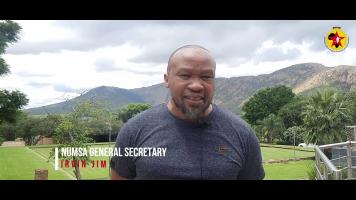 U.S. political prisoner Mumia Abu Jamal has supporters around the world. Irvin Jim, General Secretary of the National Union of Metalworkers of South Africa, discusses his support of Mumia’s fight for…


