A New
Book on Clarence ‘The Lawn Jockey' Thomas
 by George E. Curry
"Only one Supreme Court justice during the century was
worse than Justice Clarence Thomas: James McReynolds, a white supremacist who
referred to blacks as 'niggers.'"
This article originally appeared in the author's newsletter, The
Curry Report.
Anyone who has followed my career knows how I feel about Clarence Thomas. In
fact, Jack E. White, writing in Time magazine, said, "No matter
what George Curry accomplishes during the remainder of his journalistic career,
he will be remembered for one thing: he was the editor who slapped a portrait
of Clarence Thomas wearing an Aunt Jemima-style handkerchief on a 1993 cover of
Emerge magazine."
White
continued, "That shocking image outraged Thomas supporters, of course, but
it crystallized the disgust that many African-Americans had begun to feel about
the ultra-conservative legal philosophy of the U.S. Supreme Court's only black
member."
Given
my view of Thomas, I never thought I'd want to read a book on the supreme prick
from Pinpoint, Georgia. However, I resisted the urge and this week read Supreme
Discomfort: The Divided Soul of Clarence Thomas. The only reason I read the
book was because it was written by Kevin Merida and Michael A. Fletcher, two
friends who work at the Washington Post. They have done a superb job
describing the many contradictions of Clarence Thomas.
"I never thought
I'd want to read a book on the supreme prick from Pinpoint, Georgia."
After
reading the book, I have one regret about that famous Emerge cover. If I had an
opportunity to do it over, I would tie the Aunt Jemima knot tighter. While
criticizing African-Americans for embracing "victimhood," the book
portrays Thomas as the ultimate professional victim, at every turn claiming
that people didn't like him because of his dark skin, his broad lips, or his
conservative ideology.
Recounting
a 1998 speech before the National Bar Association, the authors note, "In
remarks that veered from self-pity to combative, he maintained that the
'principal problem' he faces could be summed up in one succinct sentence: 'I
have no right to think the way I do because I am black.'"
As
the late Appeals Court Justice A. Leon Higginbotham pointed out at the time,
"He's got a right to think whatever he wants to, but he does not have a
right to be free of critique."
And
a critique of Thomas shows that while professing to oppose special treatment
because of his race, every job he has held, including his appointment to the
Supreme Court, was obtained, in part, because of his race.
"Every
Thomas employer, from Danforth, who gave him his first job, to President George
H.W. Bush, who nominated him to the Supreme Court, chose Thomas at least partly
because he is black. Race is a central fact of his meteoric rise, and Thomas
has alternately denied it and resented it - all the way to the top," the
book states.
To
get to the top, to the Supreme Court, Thomas allowed his Right-wing handlers to
misrepresent his past.
"'The
Pin Point strategy,' some advisers dubbed it: file down the sharp ideological
edges and keep emphasizing Thomas' personal story of triumph over
adversity," the authors wrote. "... What the White House advisers
didn't know - or, perhaps, just ignored - was that Thomas' connection to his
birthplace was tenuous at best. His family's house had burned down when he was
six, and for most of his young life he was raised comfortably in Savannah by
his grandfather, Myers Anderson, one of the black community's leading
businessmen."
"The books
details Thomas' long and deep attraction to pornography."
Although
Thomas' affection for pornography was disclosed during his confirmation
hearings, the books details Thomas' long and deep attraction to pornography. He
told Dan Johnson, a Yale classmate, "My favorite movie of all time is Deep
Throat. I've seen that [MF] six times."
In
the public arena, Thomas appears only before friendly audiences; he rarely
speaks to Black organizations. He saw nothing wrong with officiating the
wedding of conservative talk show host Rush Limbaugh while sitting on the
Supreme Court. The most incredulous assertion made by Thomas was that his
actions benefit African-Americans. He told a visitor to the Supreme Court,
"It's unfair how black America criticizes me. I'm trying to help black
America."
Help
us to do what? Return to slavery?
African-Americans
are not fooled. According to a study by the Joint Center for Political and
Economic Studies, cited in the book, a 1998 poll showed that Thomas had a
favorable rating of just 32 percent, the worst numbers of any prominent
African-American.
Judge Higginbotham said, "I have often pondered how is
it that Justice Thomas, an African-American, could be so insensitive to the
plight of the powerless. Why is he no different, or probably worse, than many
of the most conservative Supreme Court justices of the century? I can only
think of one Supreme Court justice during the century who was worse than
Justice Clarence Thomas: James McReynolds, a white supremacist who referred to
blacks as 'niggers.'"
George E. Curry, former editor-in-chief of Emerge
magazine and the NNPA News Service, is a keynote speaker, moderator, and media
coach. He can be reached at george@georgecurry.com or through his Web site,
www.georgecurry.com.

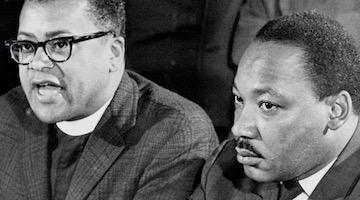 Rev James Lawson, a confidant and comrade of Dr Martin Luther King and longtime student of non-violent social activism, will speak at the 150th anniversary of Muhatm
 More than half of Canada’s Black population was born elsewhere, but disproportionate stops by police “can not only end in jail, but deportation and removal,” said Robyn Maynard
 African Americans practiced an internationalist politics in their epic struggle against US white supremacism, said Paul Ortiz, professor of history at the University of Florid
 This week you discussed nuclear contamination, the electability of Joe Biden, and theories of racism. We share your letters for “
 In the corporate-organized Race to the Bottom, withdrawal of health care is a weapon to discipline workers and their families, as is the whole “austerity” regime.



