A Black Agenda Radio commentary by executive editor Glen Ford The U.S. prison system is the true measure of how America regards its Blacks citizens. In a country that is till two-thirds white and only one-sixth Black, African Americans make up majorities of the prison population in 12 states. To bring U.S. incarceration rates down to 1972 levels, fully 80 percent of the 2.3 million current prison inmates – a total of 1,850,000 men and women – would have to be let go.
4 out of 5 Prisoners Would Have to be Released to Reduce U.S. Incarceration to 1972 Levels A Black Agenda Radio commentary by executive editor Glen Ford “ Mass Black incarceration knows no bounds in the United States of America.”
A new report shows that New Jersey has the nation’s highest racial disparity in incarceration rates, with Blacks in the state 12 times more likely to go to prison than whites. The report is titled, The Color of Justice: Racial and Ethnic Disparity in State Prisons
Some states are worse than others, but all of them are much worse for Black people than for whites. Blacks don’t make up a majority of any state in the country, but they are the majority of the prison population in 12 states: Alabama, Delaware, Georgia, Illinois, Louisiana, Maryland, Michigan, Mississippi, New Jersey, North Carolina, South Carolina and Virginia.
In terms of the proportion of the Black male population that is incarcerated at any given time, the prize goes to Oklahoma, where 1 out of every 15 Black men, age 18 or older, is currently living behind bars. In 11 other states, 1 out of every 20 Black males has been snatched from his communities.
“Don’t expect any late term prisoner release surprises from Barack Obama.”
New Jersey stands out for high rates of racial disparity in incarceration and for having a Black majority in the prison system, but in recent years its one of three states that have substantially reduced their prison populations. New York and California have also scaled down their gulags. According to The Sentencing Project, the key to shrinking the prison population lies in the intake valves of a criminal justice system that arrests far too many people, especially Black people, and then locks them up for way too long. Project executive director Marc Mauer told Black Agenda Report that President Obama and his successors should consider clemency for whole categories of prisoners, similar to President Gerald Ford’s amnesty for draft resisters back in 1974. But, don’t expect any late term prisoner release surprises from Barack Obama, who went to court to keep about 5,000 federal crack cocaine prisoners behind bars, even after the racist legislation under which they were convicted was repealed and replaced.
Without fundamental changes at every stage of the criminal justice process, Black Americans will continue to make up something approaching 1 out of every 8 prison inmates in the world. Indeed, accounting for growth in U.S. population, by my calculations the nation’s jailers and prison wardens would have to set 4 out of every 5 of their prisoners free just to get incarceration rates down to the levels of 1972 , when the effects of the national mass Black incarceration regime were just starting to be felt. Of the 2.3 million current prison inmates, fully 80 percent, totaling 1,850,000 men and women would have to be let go – and even then, the United States would still be a high incarceration nation. 1972 was one year after the Attica Rebellion – not a great time for Black people in the criminal justice system. If only we had known that, 44 years later, things would be far, far worse.
For Black Agenda Radio, I’m Glen Ford. On the web, go to BlackAgendaReport.com.

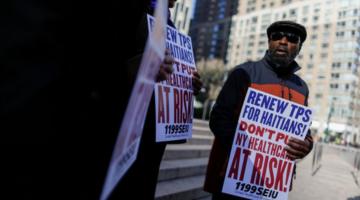 Trump's attacks on immigrants have focused on Haitians. Temporary Protected Status (TPS) may end for 350,000 people, and even those scheduled to be sworn in as citizens are now being denied. Abraham…
 The Democratic Party is useful only to the oligarch class, who give them their marching orders. Doing anything that serves the people is never on their agenda. They will not address the ICE…
 “We forget easily in America. We have forgotten the story of the Palmer Raids.”
 The US invaded Venezuela and kidnapped Nicólas Maduro to defend the dominance of the US dollar. Venezuela had been selling oil to China in China’s currency, the yuan.
 "For an ICU VA Nurse" is the latest from BAR's Poet-in-Residence.


