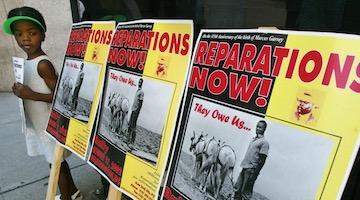
No sensible person should doubt the fundamental justice of arguments for reparations for the historic crimes of slavery, Jim Crow, and today's prison state. Accomplishing reparations would require a massive political realignment. But is reparations today a political movement, or is it an empty brand available for African American public figures in need of a little blackwashing?
Why is Ta Nehisi Coates suddenly a public reparista , and what does this say about the reparations movement?
Back in the day when black politicians used to fall out of favor, their friends ratting each other out before grand juries and prosecutors combing their personal records for evidence of wrongdoing, the standard thing for the political figure to do was to get very publicly right with Jesus. The church, after all, seems to never turn anybody down.
Nowadays a disgraced black politician is as likely to blacken herself up with a public embrace of reparations in addition to the old confession of religious faith. Like the church, all one has to do to join the reparations movement is to make that confession of faith, a kind of secular Shahada.
Nobody here at Black Agenda Report disagrees with the fundamental justice of the case for reparations. But it's a just cause with a huge problem. Reparations for the descendants of slaves, the victims of historic Jim Crow and the current prison state is an immense political project. But apart from a single piece of legislation and a few lawsuits over the last 30 years, reparistas seem to take no responsibility for proposing, discussing or advancing even the sketchiest of political roadmaps to bring us to reparations.
I'm a lifelong socialist, somebody who believes political mountains can and must be moved. But when proponents of reparations don't even try to discuss what the needed political coalitions might look like, what sectors of society we need to win over to make reparations happen, or how many years or decades all this might take, are they acting like a political movement, or like something else? What kind of political movement advances no measures, discusses no plans, takes no responsibility for advancing its own just cause? The answer is that movements don't behave like that at all. But brands do.
Brands neither say what they mean, nor mean what they say. Brands are stories, brands are narratives contrived to get specific emotional reactions, to pull real or imagined memories, sights, smells or feelings from a target audience. To do this brands operate outside of and independent from fact and/or logic. Reparations is not a movement, it's a brand.
A centerpiece of the reparations brand is the study bill that Rep. John Conyers has introduced in every one of the last dozen Congresses except the 110th and 111th . In those two Congresses, Rep. Conyers, with four decades of seniority finally chaired the powerful House Judiciary Committee with the ability to make demands or cut deals to move the study bill, or at least the discussion of reparations. If reparations was a political project instead of a brand, he would have done just that. But Conyers put the reparations study bill in his desk drawer until Republicans re-took the House and he no longer had that power. Safely back in the minority again in early 2011, he re-introduced the reparations study bill once more.
After five and a half years of the Obama presidency, during which the problems of black America were ignored and in some cases made worse, some of his black enablers and apologists feel the need to get their ghetto passes re-stamped. Wrapping themselves in the reparations brand is their way of asserting fictive allegiance to African Americans along with some imaginary distance from the president. If Wal-Mart and BP pretending to be environmentally responsible is greenwashing, this is blackwashing.
Polls indicate that a majority of African Americans do favor reparations. But in the absence of a reparations movement with discussions of plans and strategies against which to measure progress and performance, reparations is only a brand, available for scoundrels to hide behind whenever their faces need blackwashing, and their ghetto passes need re-stamping. Today it's Mr. Coates. Tomorrow? Well...
For Black Agenda Radio I'm Bruce Dixon. Find us on the web at www.blackagendareport.com , and subscribe to our free weekly email updates at www.blackagendareport.com/subscribe . That's www.blackagendareport.com/subscribe .
Bruce A. Dixon is managing editor at Black Agenda Report, and a state committee member of the Georgia Green Party. He can be reached via this site's contact page, or emailed directly at bruce.dixon(at)blackagendareport.com.
Your browser does not support the audio element.