Black Agenda Report
Black Agenda Report
News, commentary and analysis from the black left.

  • Home
  • Africa
  • African America
  • Education
  • Environment
  • International
  • Media and Culture
  • Political Economy
  • Radio
  • US Politics
  • War and Empire

Ford and IBM May Have to Answer for Their Role in Apartheid
23 Apr 2014
🖨️ Print Article

A Black Agenda Radio commentary by executive editor Glen Ford

It’s taken 12 years, but victims of South African apartheid finally convinced a U.S. federal judge to hear their case against IBM and Ford Motor. The plaintiffs say the two multinationals sold the white regime the products it needed to torture and oppress the Black majority – and that the companies intended their vehicles and computers be used for that purpose.

Ford and IBM May Have to Answer for Their Role in Apartheid

A Black Agenda Radio commentary by executive editor Glen Ford

“The judge rejected Ford and IBM’s contention that multinational corporations are legally shielded from these kinds of lawsuits.”

The United States court system, whose value to anyone but the rich is rapidly disappearing, may yet play a role in the unfinished business of South African liberation. A federal district judge in Manhattan ruled that a group of South Africans can proceed with a suit against Ford Motor Company and IBM for doing business with the white regime during the time of apartheid. The plaintiffs include victims of torture and relatives of people killed by the racist government. They will have to prove, not only that the American corporations knew that their products would be used to oppress and torture South Africans, but that Ford and IBM’s purpose in doing business in the country was to “aid and abet” the white authorities.

That’s a very high burden of proof. However, it’s a better shot than the U.S. Supreme Court gave to a group of Nigerian refugees who tried to sue Shell Oil for helping the Nigerian military to systematically torture and kill environmentalists in the 1990s. The High Court’s interpretation of the relevant U.S. law was that the crimes committed in Nigeria didn’t have a close enough connection to the United States. However, the justices left the door open to other cases that might have a stronger connection to the U.S.

This week, federal judge Shira Scheindlin – the same judge who issued the sweeping ruling against New York City’s stop-and-frisk policies, last year – gave the South African plaintiffs permission to make their case. She also rejected Ford and IBM’s contention that multinational corporations are legally shielded from these kinds of lawsuits. Judge Scheindlin found no basis in law to argue that international laws against such things as genocide, slavery, war crimes and piracy “apply only to natural persons and not to corporations.”

“The South African government failed to prosecute perpetrators from the old regime and paid out only paltry reparations to the victims.”

The South African plaintiffs are part of the Khulumani Group, which was created as a response to the weaknesses of the Truth and Reconciliation Commission set up by the new Black government of South Africa. The Khulumani activists say the government failed to prosecute perpetrators from the old regime and paid out only paltry reparations to the victims. Most importantly, the Black government that came to power in 1994 and its reconciliation program provided no redress for the systematic social and economic crimes of apartheid. The Khulumani Group agreed with Frank Meintjies, a South African activist and intellectual who wrote that the Truth and Reconciliation Commission “failed to address the more collective loss of dignity, opportunities and systemic violence experienced by the oppressed.” He continued: “No hearings were held on land issues, on the education system, on the migrant labor system and on the role of companies that collaborated with, and made money from, the apartheid security system” – companies like Ford and IBM.

Thanks to the Khulumani Group’s lawsuit in Manhattan, two U.S.-based multinational corporations may finally have to explain why they gave aid and comfort to South African apartheid.

For Black Agenda Radio, I’m Glen Ford. On the web, go to BlackAgendaReport.com.

BAR executive editor Glen Ford can be contacted at Glen.Ford@BlackAgendaReport.com.


Your browser does not support the audio element.

listen
http://traffic.libsyn.com/blackagendareport/20140423_gf_FordIBMSAfrica.mp3

More Stories


  • BAR Radio
    Black Agenda Radio with Margaret Kimberley
    Black Agenda Radio November 6, 2026
    06 Nov 2026
    In this week’s segment, we hear about the Southern Human Rights Organizers' Conference (SHROC), which will be held in Jackson, Mississippi, in December. But we begin with an analysis of the Michigan…
  • Abdul al Sayed
    Black Agenda Radio with Margaret Kimberley
    Abdul El-Sayed's Senate Victory in Michigan
    06 Nov 2026
    Abayomi Azikiwe is editor of the Pan-African Newswire and a Detroit-based activist. Abdul El-Sayed won his election and will represent Michigan as a United States senator. He defied the Democratic…
  • SHROC logo
    Black Agenda Radio with Margaret Kimberley
    Southern Human Rights Organizers' Conference
    06 Nov 2026
    Jaribu Hill is the executive director of the Mississippi Workers Center for Human Rights in Greenville, Mississippi. She joins us from Greenville to discuss the upcoming Southern Human Rights…
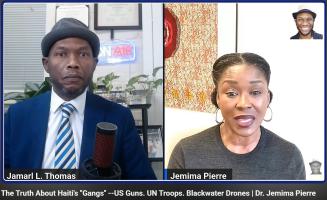
  • Jamarl Thomas and Jemima Pierre
    Jemima Pierre, BAR Editor and Contributor , Jamarl Thomas
    The Truth About Haiti's "Gangs" --US Guns. UN Troops. Blackwater Drones | Dr. Jemima Pierre
    04 Nov 2026
    Jemima Pierre joined Jamarl Thomas to discuss the ongoing occupation of Haiti, deaths at the hands of Eric Prince's mercenaries, El Salvador's intervention at the behest of the U.S., and the…
  • Margaret Kimberley, BAR Executive Editor and Senior Columnist
    U.S. Plans for An Attack on Iran
    04 Nov 2026
    Public opposition to war with Iran has forced Trump to wait until after the midterm elections to commit more war crimes. But all signs point to an imminent attack.
  • Load More
Subscribe
connect with us
about us
contact us