A Black Agenda Radio commentary by executive editor Glen Ford
The United States, in its infinite kindness, is making Haiti a gift of two penal institutions. It's actually the most back-handed kind of charity. In order to keep Haiti a failed state, the occupiers deny the Haitian government funds for even the most basic functions of government: law and order.”
U.S. Gives Haiti the Gift of Prisons
A Black Agenda Radio commentary by executive editor Glen Ford
“The United States somehow thinks it has something to teach Black people in Haiti about prisons.”
U.S. imperialism never runs out of tricks to play on Haiti. The latest project of the U.S. overseers who overthrew Haiti’s democratically elected government in 2004, is prison-building. The new penitentiaries will be constructed under the auspices of none other than the Narcotics Affairs Section of the U.S. Embassy to Haiti. U.S. narcs care so deeply for the Haitian people, they are building them two prisons
The top U.S. narcotics agent at the embassy says America’s concern is humanitarian. The men’s prison will replace the penitentiary that was destroyed in the coup sponsored by the United States in 2004 – so it would be fair to say that Washington owes Haiti that prison. The lack of prison space and other public safety infrastructure means Haiti’s incarcerated population – which is somewhere between two and three thousand – is held in some of the worst conditions in the world, and for a very long time. The U.S. embassy says it wants to reduce overcrowding, disease and violence in Haiti’s prisons, to bring them up to international standards.
The United States, itself, has never paid much attention to international standards when it comes to prisons. It locks far more people up for far longer periods of time than any other developed country. On any given day, 50,000 to 80,000 U.S. prison inmates are held in solitary confinement, some of them for decades at a stretch – a form of torture according to most international standards. Violence in U.S. prisons is endemic, especially rape. Through its sheer size, alone – encompassing one out of every four prison inmates on the planet – the U.S. prison Gulag contains the greatest concentrations of prison evils in the world. The U.S. serves as an example of how not to treat prisoners, and how not to treat Black people, who are far more likely to wind up in U.S. prisoners at some point in their lives. But, the United States somehow thinks it has something to teach Black people in Haiti about prisons.
“The occupiers withhold from the government that they installed the means to claim even the most elemental legitimacy.”
The U.S. claims it wants to move Haitian inmates more quickly through the system. It has not done very well, here at home. On any given day, more than 735,000 inmates crowd local U.S. jails, 60 percent of whom cannot make bail. Most remain economic prisoners for at least 50 days.
Rather than provide the Haitian government with money to construct the two prisons, the U.S. is making all the arrangements, itself, and will spend between $5 million and $10 million. That’s consistent with American and European behavior since the occupation of Haiti: they deny the Haitian government funds for even the most basic functions of the state: law and order. Having overthrown the legitimate government of President Jean-Bertrand Aristide and virtually outlawed his political party, the occupiers withhold from the government that they installed the means to claim even the most elemental legitimacy. The Americans and their allies’ mission is to maintain Haiti as a failed state, one that can neither protect nor punish those accused of crime, nor pay the judges, police and jailers that are fundamental to any notion of government. Anything resembling the rule of law in Haiti must be seen as a gift of the U.S. embassy – a gift of prisons, from the greatest international lawbreaker of all, the United States.
For Black Agenda Radio, I’m Glen Ford. On the web, go to BlackAgendaReport.com.
BAR executive editor Glen Ford can be contacted at Glen.Ford@BlackAgendaReport.com

 In this week’s segment, we examine why there are violent racist and Islamophobic riots in Britain. But first, we talk about the upcoming trial of the Uhuru Three, which is yet another state attack on…
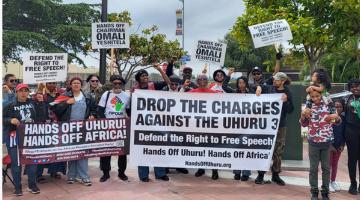 Omali Yeshitela joins us to discuss the looming federal trial of the Uhuru Three on charges of being foreign agents. We also talk about this year’s presidential election and the defeat of…
 Roger McKenzie speaks with us about the wave of Islamophobic and racist attacks in the UK. We also discussed his Morning Star Online article, “Only Class Solidarity Will Defeat Racism.”
 The United Kingdom’s ugly history of subjugating people in the global south has created a deeply racist country. The criminal ruling class exploits, but white racism blames the desperate newcomer.
 It cannot be said that the U.S. has free and fair elections. Yet, the country regularly uses the false virtue of democracy to enact regime change when its interests are threatened by a…


