A Black Agenda Radio commentary by executive editor Glen Ford
The imperial offensive in North Africa and Syria “was designed to put a Euro-American spin on the momentum of change” with the advent of the Arab Spring. But it has actually empowered Islamist forces and their royal Persian Gulf patrons. This house of cards must ultimately collapse.
The Coming Imperial Implosion in the Arab World
A Black Agenda Radio commentary by executive editor Glen Ford
“Although the NATO powers account for about 70 percent of total worldwide arms spending, they are by no means fully in charge of their own offensive in North Africa and the Middle East.”
The French intervention in Mali and the deadly Salafist assault on an Algerian natural gas facility on the border with Libya reveal the deepening crisis of U.S. and European imperialism in northern Africa. What is playing out in the western Sahel is the direct, and broadly predictable, result of the aggressive Euro-American response to the outbreak of the so-called Arab Spring.
Two years ago, Washington, Paris and London were swept by panic at the prospect of a realignment of forces in the Arab world. With Egypt’s Mubarak on the way out, the West’s henchman in Tunisia overthrown, and America’s warlord in Yemen facing opposition from all quarters, the NATO powers decided to alter the regional chessboard to what they thought would be their own advantage with a mass application of force against Libya. The assault on Muammar Gaddafi’s government, with absolutely no provocation and no basis in international law, was designed to put a Euro-American spin on the momentum of change. Almost simultaneously, Syria was targeted for massive subversion, and it was universally assumed that Algeria was next on the hit list.
This scheme for wholesale game-changer in the region necessitated an even deeper alliance with the royal regimes of the Persian Gulf. In practice, it was the West that became dependent on the Saudis and Qataris to provide Arab cover for NATO’s military and, much more importantly, to provide the Islamist fighters who would actually seize power on the ground in Libya and then Syria and beyond. Moreover, the Saudis and Qataris are rich, and can afford to pursue their own political objectives.
“The Islamists hate them with far more intensity than the secular leftists and Arab nationalists that the U.S. and Europe are so keen to destroy.”
This fundamental reordering of the relationship between the West and its royalist Arab allies is reflected on the ground in Libya, where it is Saudi Arabia and Qatar’s Islamist friends who wield the guns. The real crisis in Benghazi was that the Islamist fighters for whom NATO had provided an air force were not totally dependent on the U.S., Britain and France. They have rich friends in the Persian Gulf, on whom the West is now also dependent. Although the NATO powers account for about 70 percent of total worldwide arms spending, they are by no means fully in charge of their own offensive in North Africa and the Middle East. The Islamist fighters and their Persian Gulf patrons have their own agendas.
Ultimately, the Pentagon and the CIA and their counterparts in Europe cannot win this game. They are racist imperialists who will always make themselves hated. Certainly, the Islamists hate them with far more intensity than the secular leftists and Arab nationalists that the U.S. and Europe are so keen to destroy. That’s why the Americans can’t operate safely in Benghazi.
The great contradiction is that the Islamic fundamentalism with which the West is now allied and critically dependent behaves, in practice, like a nationalism without borders. And, like nationalism, it is ultimately incompatible with imperialism, which today is corporate rule without borders.
The fighters that attacked the gas facility in secular-ruled Algeria surely entered through Libya, partially controlled by fellow Islamists who are friends with the guys who killed the U.S. ambassador, and who are also friends with the Saudis and Qataris who are supposed to be America’s allies. The Arab Spring is far from played out, and nowhere near under U.S. control. For the West, it will end in a huge implosion, because this house of cards cannot stand.
For Black Agenda Radio, I’m Glen Ford. On the web, go to BlackAgendaReport.com.
BAR executive editor Glen Ford can be contacted at Glen.Ford@BlackAgendaReport.com .

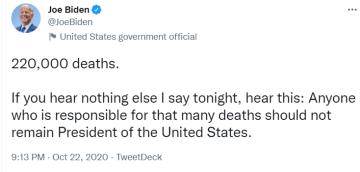 Presidential candidate Joe Biden promised action on issues that had broad public support. But once in office he refused to do what the people wanted.
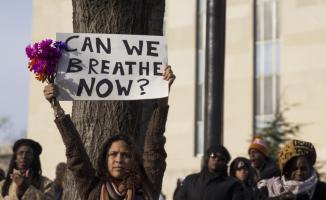 Like all of his predecessors, Joe Biden is in the pocket of fossil fuel corporations and other polluters. Environmental racism is a byproduct of this corruption.
 The use of the word democracy in this country is farcical. It is meant to hide that an oligarchy is in power.
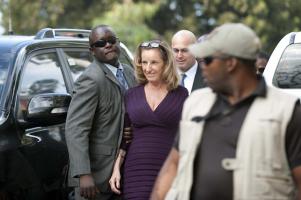 A remark by the former U.S. ambassador to Haiti fuels suspicion of American involvement in the assassination of president Jovenel Moise.
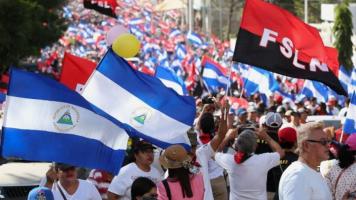 The U.S. regime change effort in Nicaragua has failed. The people are determined to assert their rights of self-determination and the U.S. is not the only player on the world stage.


