A Black Agenda Radio commentary by Glen Ford
When the Hurricane hit, Occupy movement activists wanted to do good in the hood. However, their mission has inevitably become political as well as humanitarian. “Occupy Sandy illuminates how economic and political power shapes the geography of pain.”
Occupy Movement Finds Mission Combating Disaster – and Disaster Capitalism
A Black Agenda Radio commentary by Glen Ford
“After the natural disaster, comes disaster capitalism.”
The Occupy Wall Street movement has rediscovered a reason for existence: service to the people. Hurricane Sandy provided the remnants of Occupy with a social service mission, and they responded with remarkable speed and efficiency, bringing aid and a semblance of relief infrastructure to battered neighborhoods in New York and New Jersey. The purpose was humanitarian but, simply by virtue of focusing on those neighborhoods of greatest need, Occupy Sandy illuminates how economic and political power shapes the geography of pain, even in natural disasters.
The Occupy activists have been most vital to the minority residents of New York public housing and places like ocean-swept Far Rockaway, Queens. New York’s subway system may have made a miraculous recovery from the worst damage inflicted in its history, but public housing tenants were largely left to fend for themselves. In Coney Island, until recent days there was no sign of FEMA or the Red Cross or much of a local government presence at all in the waterless, powerless, lightless high rise public housing projects. Residents have been forced to defecate in buckets
“The Occupy movement's rescue efforts have served to point up the political and economic nature of the disaster.”
Occupy Sandy’s hubs for distribution of supplies and services have been a “godsend” to afflicted neighborhoods – in sharp contrast to the calculated callousness of New York’s billionaire mayor, Michael Bloomberg. The city only launched its so-called “restoration centers” this Tuesday, two weeks after
Even New York’s corporate media, which are notorious for their fawning treatment of the mayor, have noted the glaring absence of aid to the poor – a logical extension of Bloomberg’s relentless gentrification of the city. The Occupy movement's rescue efforts, which have been competent and efficient beyond even the activists’ own expectations, have served to point up the political and economic nature of the disaster.
On the New Jersey shore, the Federal Emergency Management Agency, FEMA, quickly showed itself to be more concerned with people control
Some Occupy movement activists believe their role in areas worst hit by Sandy has only just begun. After the natural disaster, comes disaster capitalism, as corporations and their servants in government transform afflicted neighborhoods into profit centers for new development – minus the poor people that used to live there. After Katrina, you don’t need a weatherman to read the warning signs, and know that a storm of human displacement is coming. For Black Agenda Radio, I’m Glen Ford. On the web, go to BlackAgendaReport.com.
BAR executive editor Glen Ford can be contacted at Glen.Ford@BlackAgendaReport.com .

 The following is a manifesto in the full sense of the word; a Black anarchist’s proposal for a sweeping approach to a nation and world without capitalism.
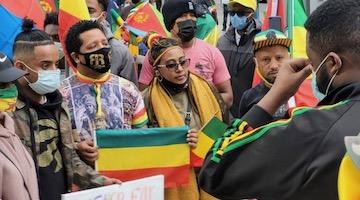 The US bid for sanctions against Eritrea was rebuked by the UN Security Council, so the imperial bloc had to settle for European sanctions against the fiercely independent African government.
 $13 billion aircraft carriers, $10 pencils and $500 hammers, renamed “portable hand-held transcribing devices” and “impact fasteners;” so war-profiteer pimps—war
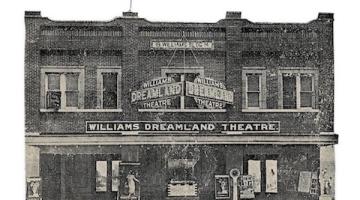 In 1921 thousands of whites attacked the Black population of Tulsa, Oklahoma with machine guns, airplanes, fire and pure hatred, killing at least 300.
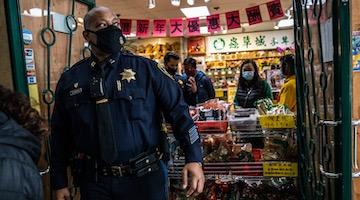 More policing rarely results in justice for anyone, and only puts Black, Indigenous, and other communities of color (BIPOC), including Asian people, at risk for more violence.


