A Black Agenda Radio commentary by Glen Ford
The name “Rwanda” evokes instant sympathy among Americans, who view the African nation as a quintessential victim of genocide. But Rwanda is also the main player, along with Uganda, in a much larger genocide: the death of six million Congolese. A leaked UN report shows Rwanda’s Tutsi rulers are up to their old, deadly tricks in Congo – under U.S. protection, of course.
The Endless Genocide: Rwanda Still Spreading Chaos and Death in Congo
A Black Agenda Radio commentary by Glen Ford
“A leaked United Nations report charges that Rwanda continues to prey upon its Congolese neighbor.”
Rwanda, the tiny African country run by a small but armed-to-the-teeth Tutsi tribal minority, is known to most Americans as the site of the 1994 genocide that killed hundreds of thousands. But Rwanda, along with fellow U.S. client state Uganda, is largely responsible for the worst genocide since World War Two: the death of six million Congolese. A leaked United Nations report
It’s not surprising that the UN report on Rwanda’s serial crimes against Congo had to be leaked. U.S. collusion with the world’s most genocidal regimes does not jibe well with Washington’s constant preaching about humanitarian intervention. In 2010, another leaked UN report
“The United States is deeply involved in the deadly games that both Rwanda and Uganda play in Congo.”
The focus of the current UN report is a Congolese Tutsi warlord whose allegiance is clearly with his fellow Tutsis in Rwanda – and to his own bank account. General Bosco Ntaganda took part in the overthrow of the Hutu-led government of Rwanda in 1994 and has acted as a proxy warlord for Rwanda in Congo ever since. Ntaganda is also known as “the Terminator.” The International Criminal Court charged him with war crimes in 2006, including the use of child soldiers. But he was never arrested, undoubtedly because the United States, from which the Court takes its orders, is deeply involved in the deadly games that both Rwanda and Uganda play in Congo – games whose ultimate winners are multinational corporations.
But before Congolese minerals find their way to the big corporate guys, they are first stolen by warlords like Ntaganda, the Terminator. A UN Group of Experts reported late last year that the general controls a network of mines in Congo. He also uses his militia to levy “taxes” on other mining operations. Ultimately, it appears Ntaganda is an important cog in a vast criminal enterprise centered in the Rwandan government, itself – all profiting off the bones of six million dead Congolese.
In a peace deal between the Congolese government and Rwanda in 2009, the Tutsi Congolese militia was technically merged into the Congolese Army. But it was just a façade. Under Ntaganda, the Tutsi Congolese staged a mutiny. According to the leaked UN report, young Rwandans who thought they were being recruited for their own country’s army found themselves shipped to the Congo to fight alongside Ntaganda against the Congolese Army. In reality, there was no mutiny
Which means they also serve United States interests in Africa – a ticket to impunity, no matter how many Africans you kill.
For Black Agenda Radio, I’m Glen Ford. On the web, go to BlackAgendaReport.com.
BAR executive editor Glen Ford can be contacted at Glen.Ford@BlackAgendaReport.com .

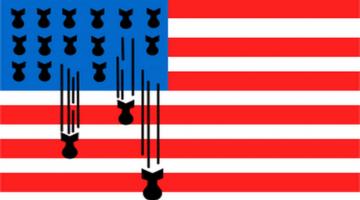 The liberal news media treat U.S. violence and oppression as aberrations from the country's founding ideals rather than expressions of its fundamental character as a settler colony, empire,…
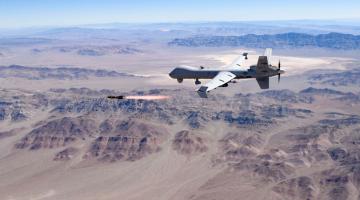 The U.S. relocation of MQ-9 Reaper drones from Africa to Latin America is not a drawdown of imperial aggression but a strategic reallocation, with the drones likely to be used against Cuba, Venezuela…
 Race is a sociopolitical construct, not a biological truth. The real determinants of health are structural factors such as zip code, environmental pollution, and access to resources.
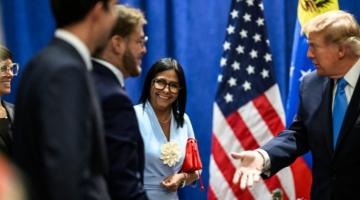 A photograph of Delcy Rodríguez smiling with Donald Trump after the U.S. kidnapped Nicolás Maduro is evidence of subordination to the United States. These images cannot be reconciled with the dignity…
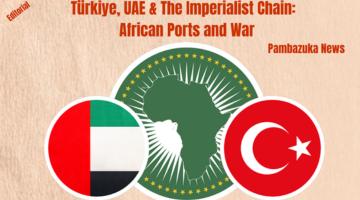 Imperialist competition and wars that facilitate extractivism have long shaped the use of seaports for access to resources, markets, and devalued labor. In the last decade, countries in the chain of…


