A Black Agenda Radio commentary by BAR editor and columnist Jared Ball
Mumia Abu Jamal’s life and work is testament to the need to put political prisoners at the top of the agendas of movements for change. “Political prisoners have much experience with the legal system, the police, the entire apparatus of surveillance and incarceration, all of which is essential knowledge for those now entering political activism for the first time.” Besides, “We wouldn’t do half bad by replacing some of the Dysons, Simmons and Sharptons with folks like Ashanti Alston, Mutulu Shakur and Russell ‘Maroon’ Shoats.”
Political Prisoners: Lessons for Occupationists and Us All
A Black Agenda Radio commentary by BAR editor and columnist Jared Ball
“We need to encourage a renewed focus on the politically incarcerated because we are likely to see those ranks increase.”
After this week's rally for Mumia Abu-Jamal in Philadelphia, at which much of the focus was his being removed from death row, at least one thing has again been made clear; going forward all movement building must deeply involve the plight of political prisoners. This point was made several ways by several different speakers, including Cornel West who described the more than 30 years of this particular fight, and Desmond Tutu who cautioned that the move of Mumia from death row was cool but not a real victory – and who better than a veteran of the freedom struggle in Azania to tell us about incomplete “victories.” And there was the tireless Ramona Africa who echoed Tutu’s sentiments by acknowledging that not being in solitary confinement was itself no guarantee of safety, and how Mumia’s enemies considered this move a close second to actual execution since he would now be in general population with “his own kind” and likely, hopefully, to be killed by one of them. So what was a rally and tribute to Mumia was also a lesson to be learned about the kinds of struggle required, a lesson we all can use at this time of outspoken frustration with the current world.
There are at least three reasons for aggressively including the politically incarcerated: 1) Their experience, 2) their analysis and 3) the standard they establish for the rest of us. Their experience as conscious actors for liberation, as activists, journalists and soldiers needs to be studied and incorporated by the emerging campaigners in and out of these occupations. Their analyses having gone through decades of political struggle can only help shape the evolving activities here and around the world. And as long as they remain locked up political prisoners serve as permanent reminders of an absence of real change. Especially now as the current president worsens the previously set precedent of denying civil liberties and constitutional rights and as more and more new initiates to social movement occupy political activity we need to encourage a renewed focus on the politically incarcerated because we are likely to see those ranks increase.
To the first point, political prisoners have tremendous reservoirs of knowledge regarding struggle with the state. They have decades worth of time to reflect on their successes and failures, on what did and did not work and why. Political prisoners have as much experience with the legal system, the police, the entire apparatus of surveillance and incarceration, all of which is essential knowledge for those now entering political activism for the first time. Mumia has himself penned a number of books, including a recent one dealing particularly with jailhouse lawyering, but simply studying the legal case of any political prisoner becomes a painful and detailed lesson in the function of “law.”
“As long as they remain locked up political prisoners serve as permanent reminders of an absence of real change.”
Secondly, the analyses that come out of all this experience are essential. Who better to guide us through the web of radical thought and organization than political prisoners? Who better than they to offer guidance in grappling – on an organizational level – with issues of race, class, gender, sexuality and radical implementation of radical theories? And especially for this still largely White occupation effort, there is simply no reason for people like Michael Moore and Naomi Klein to speak on their behalf while Claude Marks, David Gilbert and Laura Whitehorn are still here. And while these folks should and do speak to the rest of us we wouldn’t do half bad by replacing some of the Dysons, Simmons and Sharptons with folks like Ashanti Alston, Mutulu Shakur and Russell “Maroon” Shoats.
And again, lastly, their standard of commitment, action, study and continued incarceration allows political prisoners to serve even further as liberation guideposts. Let theirs be the standard upon which we determine success and upon which we judge ours or their actions. And let their lack of freedom be genuine reminders of our own.
So even in death former political prisoner Safiya Bukhari continues to teach through her work and her legacy. As she said, “The issue of political prisoners is part of [the] movement that we are building, and in building that movement we must understand that this is not a separate issue. It is an integral part of that movement. It can’t be put in front of the movement and it can’t be an afterthought. It must be woven into the very fiber.”
For Black Agenda Radio, I’m Jared Ball. On the web find us at BlackAgendaReport.com.
Dr. Jared A. Ball is the author of I Mix What I Like! A Mixtape Manifesto and is an associate professor of communication studies at Morgan State University in Baltimore, MD. He can be reached via IMIXWHATILIKE.ORG.

 This week’s column discusses the Bernie Sanders campaign, Medicare for All, and white supremacy in Venezuela.
 The book is a meditation on a way of life that is joyous and abundant without ever asserting that we must all convert to Pentecostalism.
 Gay liberation didn’t originate as a single-issue movement, and must confront neoliberalism and gentrification as well as anti-queer violence.
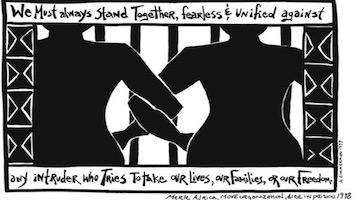 Society needs prison abolition in order to heal, but people living in prison need basic humane conditions in order to survive.”
 Chicago media care more about the safety of a killer cop and the Jesse Smollett saga than victims of the city’s rabidly racist police.



