A Black Agenda Radio commentary by Glen Ford
Racism is a powerful potion. It invents fungible constructs that can be deployed against new targets that are not comprised wholly of people of color. “Public workers have now become fair game for abuse, because they are associated with Blackness – the ultimate American curse.”
The Blackenization of Public Sector Employment
A Black Agenda Radio commentary by Glen Ford
“Public employees have been associated with Blacks ever since they began unionizing.”
America’s racist chickens are coming home to roost – in Wisconsin, Ohio, New York and California, under Republican governors like Scott Walker and John Kasich, and Democratic governors named Andrew Cuomo and Jerry Brown, as well. Racism has always been the Achilles Heel of the U.S. labor movement, the insurmountable obstacle centered in white American hearts and minds that has prevent the United States from forging any kind of real, lasting compact between its peoples. If there is an American exceptionalism, it is race, which has kept the U.S. from even coming close to forming a true working people’s party.
It is racism that allows poverty to be perceived as something that Black people have afflicted on the nation, rather than the other way around. It is the multitudinous crimes of racism that have made criminality synonymous with Black in the American mind. And, through the remarkable powers of racial transference, public workers have now become fair game for abuse, because they are associated with Blackness – the ultimate American curse.
The fact that Blacks are disproportionately represented in government employment makes the entire public sector vulnerable to attack – not just because billionaires like the Koch brothers back Tea Party politicians, but because huge sections of the white public are prepared to withhold solidarity for racial reasons. When the Post Office became perceived as too Black, public support for the Postal Service began to evaporate. Black people’s relative success in the public workforce, where civil service regulations limited the reach of raw racism, has allowed rightwing politicians to slander public workers as the equivalent of “welfare queens.” Many of the same white workers that feel so assaulted by the language of the Right, deployed the same vocabulary against Black people they considered shiftless and lazy freeloaders and malingers. That’s the chicken coming home to roost.
“Racism has always been the Achilles Heel of the U.S. labor movement.”
Monica Wilson, a Black Madison, Wisconsin organizer, puts it this way: “They came for us already, and now they’re coming for all of them.”
Public employees have been associated with Blacks ever since they began unionizing. Nelson Lichtenstein, of the University of California's Center for the Study of Work, Labor and Democracy, says “the origins of public sector unionism coincide with the rise of the civil rights movement.
The most famous strike in American history, today, is the Memphis sanitation strike,” in support of which Dr. Martin Luther King was assassinated. Dr. Lichtenstein says the Memphis strike has “eclipsed” the 1936 Flint, Michigan auto workers strike, “and probably eclipsed Homestead,” the 1892 steel workers strike - two seminal moments in U.S. labor history.
And now Wisconsin and Ohio are moving to break their public sector unions. What does the future look like? It threatens to look like the same place most Black folks came from, and where more than half still live: the South. The future, if it is allowed to happen, looks like the present in Black activist Kevin Alexander Gray's home state. Gray will tell you that “South Carolina is first when it comes to everything bad, and last when it comes to everything good.” The nation's fate is anything but unknown. The chickens know where they came from.
For Black Agenda Radio, I'm Glen Ford. On the web, go to www.BlackAgendaReport.com.
BAR executive editor Glen can be contacted at Glen.Ford@BlackAgendaReport.com.

 Dahoud Andre is a member of KOMOKODA, the Community to Mobilize Against Dictatorship in Haiti, and host of Eritye Papa Desalin, the Heirs of Jean Jacques Dessalines, a daily Haitian community radio…
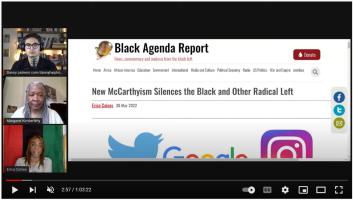 Erica Caines, Editor of Hood Communist and Coordinating Committee Member for the Black Alliance for Peace, joins the stream to discuss the New McCarthyism and its implications.
 It is disheartening to hear movement leaders say they are inspired by Martin Luther King while also supporting the U.S. proxy war against Russia. Like all wars it endangers the lives of…
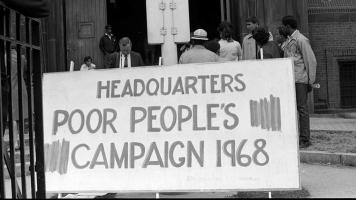 The demands for justice at home and abroad must not be sacrificed on the altar of what is called pragmatism. The false choices presented by liberalism can undermine the movement altogether.
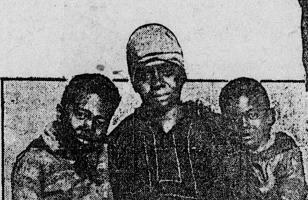 A May Day 1928 essay by Black communist Williana “Liana” Jones Burroughs – aka Mary Adams – recounts the history of African revolt in the Americas.


