A Black Agenda Radio commentary by Glen Ford
The discovery of oil has been a curse for many peoples of the world, as corrupt elites forged criminal conspiracies with multi-national corporations at the expense of their own populations. Not so in Venezuela, where petroleum riches fund social transformation and empower President Hugo Chavez to build a South American movement to free the continent from U.S. tentacles. Chavez recently finalized the nationalization of Venezuela's oil resources, five years to the month after the U.S. backed an unsuccessful coup to topple his democratically elected government.
Oil Means Thievery in Nigeria, Royal Dictatorship in Saudi Arabia - but Dignity in Venezuela
A Black Agenda Radio commentary by Glen Ford
“Hugo Chavez’s democratically elected government has used the nation’s oil riches to fund vastly expanded social services and to launch a continent-wide project for the independence of South America – from the United States.”
Here's a tale of three countries, all rich in oil. In Venezuela at the beginning of this month, President Hugo Chavez took possession on behalf of the Venezuelan people of oil fields in the Orinoco region, petroleum deposits that may prove to be the largest on the entire planet - bigger than Saudi Arabia. State control over national oil resources is actually the norm in most of the world - about 75 percent of the Earth's oil deposits are controlled by state oil companies - on paper, at least.
 Of course, the real question is: who profits? Multi-national oil companies don't really care much if a country's government holds legal title to the oil fields, as long as the corporations can squeeze out maximum profits. It's actually a good deal for the oil companies if the state technically owns the fields, because the government is then obliged to protect the corporation's drilling and transit operations. This works fine for the multinationals, who enter into corrupt relationships with the ruling elites of the oil-rich countries, cutting them in as partners in the theft of the nations' resources. Nigeria may be the worst example; there, oil-based corruption is bottomless, infinitely polluting the political and moral culture of Africa's most populous nation. But it's a cozy arrangement for the oil companies, who are even better at world-class theft than Nigerian politicians - and that is saying a lot.
Operating as a joint criminal enterprise, the multi-nationals and the Nigerian elite have plunged the country into a hell of poverty, environmental destruction, moral degeneracy and a cynicism so deep it may take generations for the national personality and culture to recover.
"It's what Venezuela does with the money that bothers Uncle Sam."
Back to Venezuela. Hugo Chavez's democratically elected government has used the nation's oil riches to fund vastly expanded social services and to launch a continent-wide project for the independence of South America - from the United States. Rather than the masses of people becoming immiserated by the presence of oil under their land - as in Nigeria - ordinary Venezuelans are enriched and liberated, and the nation regains its dignity. That's why the United States pretends that Venezuela's nationalization of oil is something close to an act of war, but has no problem with Nigeria's national oil company, or with the Saudi Arabian Royal Family's treatment of that country's oil as it's own private property.
Five years ago this month, the Bush administration backed an attempted coup against Hugo Chavez. Condoleezza Rice, then George Bush's national security advisor, became visibly distressed when the coup failed. Washington has been making war noises ever since. However, U.S. hostility is not based on the nationalization of Venezuela's oil resources - it's what Venezuela does with the money that bothers Uncle Sam. Exporting the politics of using national resources for the general uplift of the people, of an end to rule by the rich, and of national dignity and independence - these are considered capital crimes in Washington's eyes, and cause for war against Venezuela - if the U.S. were not already tied down in Iraq.
For Black Agenda Radio, I'm Glen Ford.
BAR executive editor Glen Ford can be contacted at Glen.Ford (at) BlackAgendaReport.com.

 “I don't mean just in the struggles in these prisons. America is one whole concentration camp in and of itself.”
 "During the last week of July, I traveled to the front lines of Somalia’s unresolved border conflict with Somaliland, the Somali secessionist state now recognized by Israel but not by
 There is near unanimity of opinion against data centers in the U.S. But elitist and compromised environmental groups and the climate industry should not lead this fight.
 "What’s with a Pomade Man’s testosterone obsession?" is the latest from BAR's Poet-in-Residence
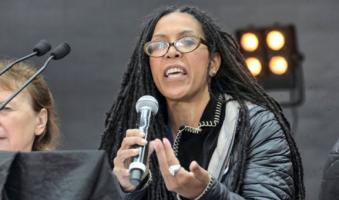 Johanna Fernandez left a powerful and revolutionary legacy through her scholarship and activism.


