US Military's Haiti "Relief" Ops A Rehearsal For Troop Deployments in Latin America
A Black Agenda Radio commentary by Glen Ford
“U.S. naval units sailed into Haitian waters without bothering to load up with food, water and medicine at the nearby U.S. base in Guantanamo Bay, Cuba.”
The American commandeering of the airport at Port au Prince and de facto seizure of sovereignty over Haiti looked exactly like an invasion and occupation – except that Haiti had already been invaded in 2004 by the U.S., which then turned over occupational duties to its servants in the United Nations. To speak of a U.S. “invasion” of Haiti is getting a little bit redundant. The Americans never left, and they and their flunkies walk all over Haiti like an old rug.
Clearly, however, the U.S. was not on an earthquake rescue mission. U.S. naval units sailed into Haitian waters without bothering to load up with food, water and medicine at the nearby U.S. base in Guantanamo Bay, Cuba. What kind of “relief” mission was this, in which the rescuer comes empty-handed? Thousands of paratroopers were flown in from Fort Bragg, North Carolina – and then sat at the Port au Prince airport for several days, claiming not to have transportation into town. They could have walked! The city is just beyond the airport fence and downtown and the port are only a couple of miles away. A BBC reporter noted that, several days after the paratroopers landed, they sent small relief missions to outlying areas. Meanwhile, literally right down the street was the vast shantytown of Cite Soliel. But the Americans didn’t go there.
The United States military, except for its special operations units, is the “heaviest” fighting force in the world. That means, the Americans require more logistical support – more pounds of equipment, more fresh food, more support personnel for every grunt with a gun – than any military on the planet. When the U.S. decided to airlift thousands of troops into Port au Prince, commanders knew the logistical needs of that force, alone, would overwhelm the airport’s capacity, leaving little room for actual relief supplies. The Americans knew they would be creating a bottleneck that would become an impediment to relief efforts by the rest of the world. But they hogged the air and runways, anyway. What was the purpose?
“The Americans knew that they would be creating a bottleneck that would become an impediment to relief efforts by the rest of the world.”
The explanation is quite simple. For the Americans, the operation was not primarily a rescue mission. Often, they carried only supplies for themselves. I don't buy into speculation that the Americans were attempting to worsen the Haitian situation through deliberate delays, in order to justify taking over the country. It was clear from the first day that the earthquake was a visitation from hell that would create more than enough drama than the U.S. would ever need – and besides, the Americans and their minions were already in charge of Haiti. But the Americans' actions make perfect sense when understood as an air and naval exercise to test the capabilities of the U.S. Southern Command to move its own men and machines from one place to another, quickly. The Southern Command's 4th Fleet was just taken out of mothballs last year, and has been staging exercises in the Caribbean to threaten Venezuela. The U.S. has just opened 7 new bases in Colombia, and would be anxious to test its ability to support them with quick infusions of large units of troops and equipment. The Haiti earthquake was a good excuse. But the mission was not about them.
BAR executive editor Glen Ford can be contacted at Glen.Ford@BlackAgendaReport.com.

 A pamphlet written 70 years ago by an exiled Black American communist reveals an African continent seething to break free from European colonization.
 The real story of the Rwandan genocide begins in 1990, when exiled Tutsis from Uganda invaded northern Rwanda, unleashing a deadly campaign that uprooted a million Hutu peasants and set ethnic tens
 Northeast, midwest, southwest, south, down south, up south, out south—south of the Canadian border—Slouched down in his cruiser, slow-rollin’ the ‘hood; Or a-
 The new Democratic administration seems determined to sabotage an agreement to end the “longest war.”
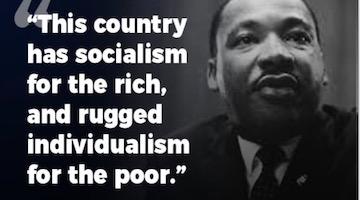 King explicitly linked the value of human dignity to the material conditions necessary to enable people to live a decent life.


