A Black Agenda Radio commentary by Glen Ford
For more than 50 years, the Royal Dutch Shell corporation and its Nigerian government partners have inflicted the world's worst oil pollution on the people of the Niger River Delta. Now, the United Nations squanders its dwindling prestige to help whitewash the vast environmental and human rights crime. According to a UN report, the Nigerian people are to blame for soaking the Delta in 9 to 13 million barrels of oil.
UN Report Whitewashes Mass Murder, Ecocide by Shell Oil and Nigerian Government
A Black Agenda Radio commentary by Glen Ford
"The United Nations has attempted to facilitate a corporate-government cover-up of monumental dimensions."
In July of last year, Amnesty International released a report, documenting the vast environmental and human rights degradations imposed on the people of the Niger River Delta by 50 years of oil exploration and production. Amnesty International sent a letter to Peter Voser, the newly appointed CEO of Royal Dutch Shell, the dominant company in the Delta oil fields, asking him to "come clean" on the "failures and poor practice" of both Shell and the Nigerian government. A little over a year later, Royal Dutch Shell and the Nigerian government have presented their answer, in the form of a monstrous whitewash produced in collusion with an agency of the United Nations.
The United Nations Environmental Program study, which was paid for by Shell oil, rewrites history to blame 90 percent of the region's pollution on spills caused by local people, tapping into oil pipelines and from sabotage by guerilla groups. The United Nations agency admits that it only studied 300 petroleum spill sites on a list given to it by Shell oil, and vouched for by Shell's partners in the Nigerian government. The true scope of Niger River Delta pollution is catastrophic, with the equivalent of 9 to 13 million barrels of oil fouling the waterways, farmlands and mangrove forests of Africa's largest wetland. That's at least twice as much oil as escaped in the recent Gulf of Mexico disaster, thus ranking Nigeria and Shell as the number one oil polluters in the world. Now the two super-polluters try to blame the people for their own half-century of crimes.
The UN agency is now backtracking, claiming its study is not yet done and there will be no report until early next year. The figures used in the study, the UN says, are the responsibility of the Nigerian government and Shell oil. If that is the case, then the study has no credibility whatsoever.
"The two super-polluters try to blame the people for their own half-century of crimes."
Twenty-seven years ago, the Nigerian National Petroleum Corporation, itself, noted the "slow poisoning of the waters...and the destruction of vegetation and agricultural land by oil spills which occur during petroleum operations." The 1983 report declared that, "since the inception of the oil industry in Nigeria, more than twenty-five years ago, there has been no concerned and effective effort on the part of the government, let alone the oil operators, to control environmental problems associated with the industry." Thus, 27 years ago, the oil companies and the government had already been committing environmental crimes against the people of the Niger River Delta for a quarter of a century. It is commonly accepted that oil tapping by local people and guerilla sabotage are relatively recent phenomena.
Shell Oil and the Nigerian government have no shame. Delta residents fear the UN report will be used as an excuse for stepped up Nigerian government military operations in the region. There is also good reason to worry that the United States might seize on the UN report to add an environmental justification for its expanding military activities in West Africa. The United Nations, once the hope of the planet, has in this instance attempted to facilitate a corporate-government cover-up of monumental dimensions. But the evidence cannot be hidden. It oozes from every nook and cranny of the Niger River Delta. And the people know how it got there.
For Black Agenda Radio, I'm Glen Ford. On the web, go to www.BlackAgendaReport.com.
BAR executive editor Glen Ford can be contacted at Glen.Ford@BlackAgendaReport.com.

 The US is funding a genocide. Of course we all know that, but how many of us know about Sudan?
 "Kid growing up under growing fascism" is the latest from BAR's Poet-in-Residence.
 Israel has been singled out for immunity rather than accountability, exposing the "rules-based order" as a farce.
 Caribbean governments are betraying Cuba through silence and compliance with U.S. empire. The only way to challenge this failure of leadership is for the people to build an anti-imperialist movement.
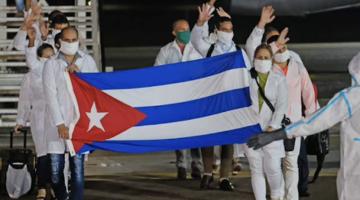 Cuba has provided Guyana with doctors, scholarships, and healthcare for nearly five decades. In return, Guyana's government has turned its back at the moment of Cuba's greatest need.


