A Black Agenda Radio commentary by BAR columnist Jared A. Ball
In the Seventies, Black radio news was a powerhouse reaching virtually every Black household with hourly newscasts that fueled political movements and incubated youthful Black leadership. Famed journalist and educator Phyl Garland chronicled and helped shape the era. “This time the struggle is not only for jobs and meaningful representation, but for the control of black minds through the grist they are fed by the communications media,” she wrote. The present generation’s mission is to seize control of Black-oriented media in service of the people.
More than Remembering Phyl Garland! Black Power and Community Controlled Broadcasting
A Black Agenda Radio commentary by BAR columnist Jared A. Ball
“Radio today has been stripped of its capability to produce relevant news to its audiences and has its musical content determined by no more than three European and Asian conglomerates.”
In October of 2011, from DC to Baltimore and probably a city near you, the most popular radio stations targeting Black and Brown people have their FCC licenses coming up for renewal. They offer no news, orchestrated play lists filled with songs selected by the companies that own them which are played with deadening repetition in between the sale of their audiences to the highest corporate bidder who can then advertise any number of useless and harmful products. These stations do not address our needs. Instead they redefine those needs into their interests. Our refusal to address this means we routinely turn ourselves and our loved ones over to the whims of others and suffer the consequences. So lets lay claim to the airwaves which belong to us already and forcibly redefine our relationship with our media environment. Its been done and it needs doing again.
Though she died four years ago this month Phyllis or “Phyl” Garland wrote forty years ago this month of similar efforts happening around the country. Garland herself taught and was the first woman granted tenure at the Columbia School of Journalism, she loved and wrote about music and had been a journalist with the Pittsburgh Courier and Ebony magazine. And in the November 1970 issue of Ebony magazine, she explained the one-to-one correlation between radio programming and radical political movements. She described efforts around the country among Black people who were threatening the very licenses which give our public airwaves to corporations who, in exchange for the extremely lucrative public property, are theoretically supposed to provide us with relevant information, cultural expression and freedom to make public the concerns of our communities. Garland was as right to cover those efforts as were the people who then claimed that those stations did them a disservice. And we would be right in our similar claims today.
“The airwaves which daily convey news of wars, moon landings, consumer products and so-called entertainment to millions of Americans are the property of the people.”
Defining the importance of public challenges to radio and television broadcast licenses Garland wrote, “Black Power, that dynamic political economic concept born of both hope and pride, is finding new directions in these uncertain days of ‘good news, bad news and Agnews.’ The objective has been selected, the strategy plotted and the offensive is underway. This time the struggle is not only for jobs and meaningful representation, but for the control of black minds through the grist they are fed by the communications media... The distantly perceivable results could revolutionize a people.”
She continued, “The premise supporting this battle is the underpublicized fact that the airwaves which daily convey news of wars, moon landings, consumer products and so-called entertainment to millions of Americans are the property of the people. They are only leased to those who use them through licenses granted by the Federal Communications Commission (FCC) a regulatory government agency which is supposed to determine whether the licensee is upholding his obligation to ‘fulfill the tastes, needs, and desires of his community.” Broadcasters have not often lived up to this responsibility, so far as blacks are concerned, and gradually this neglected segment of the public is coming to understand that it has a right to challenge the media barons who have so blatantly ignored black tastes.”
She writes of an Atlanta-based “ad hoc Community Coalition on Broadcasting composed of civil rights groups” who pressured and got signed agreements from 23 of 26 local stations to employ more Black workers both “on-air and behind the scenes” and to return some of their millions of dollars of revenue back into the community via scholarships, job-training programs and to “more accurately reflect black life of the past and present.”
As we’ve highlighted for years radio today is as important in Black America as ever, but has been stripped of its capability to produce relevant news to its audiences and has its musical content determined by no more than three European and Asian conglomerates. Let’s flood the public files of these radio stations with emails and letters that express our concern over their programming. Specifically, we must begin to further document the absence of news, local reporting and locally-based artists from the airwaves. We must challenge the complete dominance over our programming, music and news, by an ever-decreasing number of white-owned corporations and advertisers who reduce even nominal Black ownership to meaninglessness.
Stay tuned for more calls to build new Community Coalitions on Broadcasting, or what we have more recently called a News For the People Coalition. Lets begin by making the fundamental point that the airwaves are ours to begin with and what happens with them is up to us.
For Black Agenda Radio, I’m Jared Ball. Check us out at BlackAgendaReport.com.
Jared A. Ball can be reached via email at: freemixradio@gmail.com.

 The United Nations occupation of Haiti under MINUSTAH and BINUH brought instability, violence and even cholera to that nation. Signatories of an open letter to Mexico's president Lopez Obrador remind…
 Djibo Sobukwe participated in a Canadian Foreign Policy Institute panel, "NATO and Global Empire" on June 30, 2022. These are his remarks on NATO and Africa.
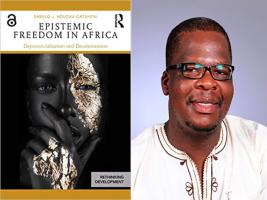 This week’s featured author is Sabelo J. Ndlovu-Gatsheni. Dr. Ndlovu-Gatsheni is Chair of Epistemologies of the Global South, Faculty of Humanities and Social Sciences and Vice-Dean: Research, Africa…
 This week, we interview Courtney Cox. Dr. Courtney M. Cox is an assistant professor in the Department of Indigenous, Race, and Ethnic Studies at the University of Oregon. Her research examines issues…
 The prison system links corporate interests, the military industrial complex, and policing into a web of oppression impacting more than 2 million people in this country. The Mapping Project reports…


