A Black Agenda Radio commentary by BAR editor and columnist Jared A. Ball
Hip-hop flourishes overseas while becoming grotesque and underdeveloped at home. In foreign lands, hip-hop is seen as part of the American brand, along with Barack Obama. But domestically, as the product of a “subnation” within the U.S., real hip hop is suppressed, just as are the political institutions of its creators. Black America must develop and reclaim its own brands on the cultural and political levels.
Hip-Hop v. The U.S.? Brand Wars!
A Black Agenda Radio commentary by BAR editor and columnist Jared A. Ball
“This nation must brand its most oppressed as both deserving of that suffering but also able to overcome it.”
A recently published article reviewing academic research of nation branding got me thinking about last week’s statement from Chuck D of the legendary rap group Public Enemy. On the one hand this article, by Nadia Kaneva, describes at least some work whose focus is the ways in which nations are branded and for what purposes. She describes competing views of nation branding, various definitions and claims of particular impact, but it is clear that at least some in the world of high finance and geo-political strategy consider nation branding as necessary to the process of “social engineering,” managing populations and exerting a political and ideological dominance over the world.
On the other hand Chuck D’s concerns over hip-hop’s condition or place in the world speak to Kaneva’s own worries over the future direction of nation branding research. For Chuck represents what she describes as the “blind spot” in such research that avoids questions of how nation branding specifically impacts “subnational and transnational identities.” The hip-hop nation, and certainly the more real Black and Brown nation(s) that produce it, are indeed sub and transnational, and are impacted in specific – horrific – ways.
Of course brands aren’t meant to convey anything real. Brands are mirages meant to convey that which its producers think will yield them the most benefit, economically or politically. And nobody brands like the United States. And especially since 2008’s “Brand of the Year” became president the U.S. has for two years been named the world leader in “global image.” In fact, as a leading public affairs brand researcher says, 2009 was a year in which we “saw the United States make… a significant leap in its standing to the top nation spurred by the election of President Obama.” Its “reputation” in the world had been renewed, restored to its proper branded position as “a beacon of democracy” and free-trade business opportunity.
“Chuck D explains that, while we have been kept from developing our national talents the cultural legacy has been taken up overseas.”
Chuck D’s concerns over the condition of hip-hop worldwide is also an issue of competing brands. And as he says, “never before have so many been pimped by so few.” He points out that the hip-hop community in the United States has lost is prominence globally. Among his many concerns is that corporate dominance over the cultural expression and ownership of mass media have forced hip-hop nation founders to now be last among those in the world who perform its core elements. Because of this nation’s ability and need to brand itself as quintessential freedom it must brand its most oppressed as both deserving of that suffering but also able to overcome it.
So simultaneously, for instance, Black America can be said to have reached its highest level of long-term unemployment since 1948 and still be able to produce a president and the famous rappers all of whom can be exported to the world as proof of this nation’s brand. Regarding the hip-hop nation, Chuck D explains, while we have been kept from developing our national talents the cultural legacy has been taken up overseas. There rappers are, he says, rhyming in “three languages,” which has “created super rappers to move the crowd with intensity and passion.” But the “arrogant” American, Chuck D continues, “comes in blackface.”
Reasons for this he summarizes as a “lack of support from local radio, television and community in the United States,” which prevents “’local’ acts [from thriving] in their own radius [and] has killed the ability to connect and grow into a proper development as a performer, entertainer and artist.” This is, of course, the inevitable outcome within the confines of a subnation held in hostility. As Kaneva’s article points out, “every nation is a brand, and most nations have their brand made for them.” This imposed condition requires an equally imposed brand. In this case it is a brand that of necessity protects against the most likely group historically to have its cultural expression reflect its genuine condition.
Popular rap music is the perfect low-cultural brand equivalent to the higher cultural product that is brand Obama. Both demonstrate their restorative capacity for the country’s global image. And, therefore, the responses must be similar. Just as hip-hop must from within develop its own brand that will topple that which has been created for it by a hostile and dominant nation so too must we develop from within that which will re-brand what is real political struggle, movement and leadership.
For Black Agenda Radio I’m Jared Ball. Online go to www.BlackAgendaReport.com.
Jared A. Ball can be reached via email at freemixradio@gmail.com.

 Dimitri Lascaris speaks with Ajamu Baraka about Colombia's Presidential Election and Gustavo Petro's allegation that Israel tampered with the voting tabulation to bring about a razor-thin victory for…
 The bipartisan consensus for regime change against Iran hit the wall of Iranian resistance. But Trump is forced into talks while democrats attack him from the right and expose themselves as partners…
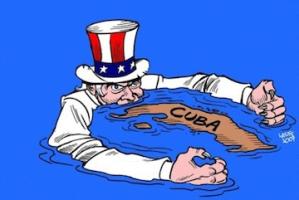 “The U.S.A. decided to annex Cuba economically and Cuba made history by becoming the first country in the world to be a victim of neocolonialism.”
 NBA superstar Victor Wembanyama grapples with the times we’re living in, even as his career takes off.
 "War House hosted cage-fighting for 250th what’s next?" is the latest form BAR's Poet-in-Residence.


