“I don't mean just in the struggles in these prisons. America is one whole concentration camp in and of itself.”
To commemorate Black August, The Black Agenda Review has, since 2021, reprinted historical statements, manifestos, and commentaries by and on Black political prisoners in the United States.
We began this tradition by publishing “Honor Fallen Black Freedom Fighters,” two statements on Black August written by San Quentin prisoners that first appeared in 1979 in the radical prisoner-support journal, Arm the Spirit. Since then we have published: The Attica Liberation Faction Manifesto of Demands and Anti-Depression Platform, 1971; an essay and petition on the massacre at Attica published in the The Black Panther Intercommunal News Service; William L. Patterson’s essay “Racial Genocide: The Case of the Martinsville Seven”; Assata Shakur’s commentary “Women in Prison: How We Are;” a 1976 statement from the Marion Political Collective; and “For George,” a letter by the Seventh of August Movement commemorating George Jackson.
We have reprinted Safiya Bukhari’s 1995 essay “On the Question of Political Prisoners,” which originally appeared in the magazine Crossroad: A New Afrikan Captured Combatant Newsletter, published by Chicago’s Spear and Shield Publications. Most recently we published “Attica then and Now!,” an essay on the Attica uprising by Trinidadian Black Studies professor Acklyn R. Lynch, first published in a special issue of DRUM, the UMass Black student literary journal, in 1971, and reprinted in Lynch’s Nightmare Overhanging Darkly: Essays on African American Culture and Resistance (Third World Press, 1993).
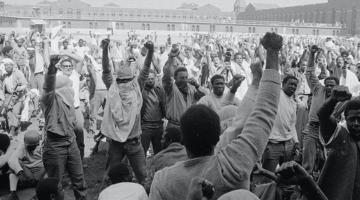
This year, we reprint an interview with Herbert X. Blyden (1936-1997). Born in St. Thomas in the colony called the US Virgin Islands, Blyden was a prisoner’s rights activist perhaps best known as one of the spokespeople of 1,200 men incarcerated in New York State’s Attica Correctional Facility during the September 1971 Attica Uprising. Blyden was the Minister of Information for the Attica Liberation Faction and was largely responsible for drafting their Manifesto of Demands. He was also one of the Tombs Seven, the group of inmates behind the October 1970 uprising in the Manhattan House of Detention for Men (aka “The Tombs”).
A two-part interview with Blyden was published in the International Socialist’s weekly journal, Worker’s Power in 1973. In the interview, Blyden speaks on prisoner conditions after the uprising and reflects on the role of the US prison complex within capitalism, the politics of internationalism, and the growth of political consciousness among the incarcerated.
The Worker’s Power interview with Herbert X. Blyden is reprinted below.
“I, for one, know I’m a prisoner of war”
Interview with Herbert X. Blyden, A Leader of the Attica Liberation Faction
[Worker’s Power is pleased to present…the following exclusive interview conducted in the Bronx House of Correction, where Herbert X Blyden is awaiting trial on charges stemming from the Tombs Prison Revolt of fall, 1970.
Blyden was one of the eleven prisoners chosen by the inmates to lead the negotiations with Lindsay over the deplorable conditions there.
From the Tombs Blyden was sent again to Attica, where in September of 1971 prisoners seized the prison demanding decent food, an end to censorship, amnesty, adequate medical care.
Blyden as a negotiator of the Attica Liberation Faction was a leading spokesman for the inmates. As Blyden states in an earlier interview “I came out of Attica with two things; my manhood and my life. I don't even belong in prison and they ask me why I riot.”
Herbert Blyden was originally convicted in 1965 for a robbery it is clear he did not commit. Evidence linking Blyden to the alleged robbery is outrageously circumstantial.
Unable to get a reasonable bail, or any bail for that matter, Blyden remains in the Bronx.
Shortly after the interview in October, he was placed in keep lock by the prison authorities with little or no reason. He is permitted to receive neither mail nor visitors.
We wish to express our thanks to Herbert X Blyden and the Attica Vanguard for helping us to arrange for the interview.
In this interview, Blyden discusses capitalist exploitation of workers and prisoners. Since the revolts, he tells us, prisoners have become increasingly aware of the need for a socialist alternative to the brutality of life under capitalism in the plants, the ghettos, and prisons.]
Workers' Power: How would you describe the living and working conditions here at the Bronx?
Herbert X Blyden: First of all we have to look at what one considers living and who indeed are working. The inmates and the detainees here are not working here and are most certainly not living here.
They are existing under archaic conditions which none of themselves create.
The guards here are not made aware of the fact that they are members of the working class, and that they are tools of the oppressor. You see them keeping us in these inhumane conditions.
I might add that the conditions are so deplorable now that the commissioner himself says that two years since the riots the overcrowding is almost as bad as before.
We just had a glimpse of the escape in Tombs and it showed the back section was still barred closed. It was shut – and had been that way for two years – and so I think the conditions are worse than they were two years ago.
WP: How do most prisoners feel since the revolts about the lack of improvements?
HB: I can't speak for most of the prisoners because they've got me now in an administrative segregation. I am in effect away from the prisoners for one reason or another.
It's an “administrative” reason. They wouldn't want me to convey the message to the people that the conditions are worse actually than they were since the riots.
I might add that it cost 43 lives up there in Attica and hundreds of injured before they would move the screens in the visiting room.
Here in the city prisons they have yet to even remove the bullet proof glass. So you know you still visit with your parents and family under the most sterile conditions.
But on the whole I would say that the inmates are much more conscious of their surroundings because of the type of literature that we read and some of the people we come in contact with.
Only yesterday, I might add again, Malcolm Enzeferedi, who's the head of the correction officers’ association, tried to blame the people coming into the institutions, and in some cases Third World people, for bringing in “contraband” and creating the atmosphere whereby you would have more liberal-type attitudes in the institutions.
WP: Is it difficult for prisoners to carry on political discussion given that political leaders are, for example, segregated from the rest of the prisoners? Is there a possibility of forming discussion groups?
HP: I'm glad you asked that question. We've had, in recent months in the city prisons, the Isabelle Arbach collective. I don't think you're familiar with that.
They set them up and get literature from the International Socialists and other organizations. The men have been receiving socialist and workers’ periodicals and publications.
They would sit down and discuss Marx and Lenin, Engels and try to show the relationship of a Marxist ideology to the present day struggle of Third World people.
But so soon as they (the guards) find a gathering they would in effect break it up or confiscate the books as contraband. Now word of mouth carries the message.
I think it's in the interest, in effect, of the inmates! As a result of this, now more clearly conscious brothers can see where they are ripped-off and they try to find out why.
And if there is one who wasn't ripped-off he would say: remember last week when we were trying to explain this part, this facet of capitalism or socialism to you? This is why the administration ripped them off.
And this makes them much more aware of their need to know. So they would seek knowledge not necessarily through Marxist study, but from someone who has some ideas of the oppressive nature of capitalism vis-a-vis the betterment of human lives under a socialist order of things.
WP: How would you account for the amount of interest in the philosophic, economic, and political writings of both Marx and Lenin. What works would you say do the men like to read or discuss the most?
HB: Well they do go through some of the most cumbersome works like Capital for example. I think that's four volumes or 2,200 pages. But then they also look at, I think there is one work in particular on the economic changes. They are looking at the overall structural make-up of capitalism.
They see how everything is entwined in a way that whatever happens in this prison, for example, affects the economics of the guards.
They may have to go out and get on the welfare lines. In other words the whole capitalist structure is such that, economically speaking, everything entwines; they’re interrelated. It affects the working class, much more so than if you had a social order of things.
So I wouldn’t specifically select any (particular books), not even the selected writings of Marx. I wouldn’t suggest that any single work is what probably makes the prisoners aware of any specific thing or their conditions, more than any other work.
They read Lenin, they read Mao, they read Che Guevara. Most of us read Fanon. As you notice, we’re getting into Frederick Douglass.
Because it’s the whole social awareness. It’s like a re-awakening and we’re becoming much more culturally oriented. You have the Puerto Ricans, for example, who today are going now into the whole history of “la historia Puertorriqueno.”
They're trying to find out the whys and wherefores of the Indians, the subculture of the island. They're going back to 1898 and before the Spanish Inquisition even, and how Spain eventually took Puerto Rico and how the United States became the colonial master of Puerto Rico.
They're talking about Independence today. So too the Blacks and Third World people are not only, as I say, reading Marx and relating to Marx, but they're reading Engels. A lot are reading Hegel -- they're going further back.
Again I might add some people are reading Trotsky, a great many people are; because whatever his differences were with Lenin, we find that you’re going to have to have a dialectics.
You’re going to have to approach any given subject and you’re going to have a pro and a con, and you cannot have anything unless you have a discussion of the issues. You’re going to have friction. You have this in any camp.
If that wasn't the case you wouldn't have the Communist Party on one side; you wouldn't have the people from Workers' Power and Workers' World; you wouldn't have, what's the other groups?
You have got about 20 hundred different socialist organizations! You know you wouldn't have all these papers if the socialist camp was in order, so to speak.
You wouldn't have, what do you call it, peaceful co-existence for example with China and the United States on one hand, China and Russia on the other hand, the United States and Russia on the next. You wouldn't have all this trouble.
You've got, as I said, these inconsistencies. You've got to discuss them before you can even try to work out what has to be done in the socialist camp.
But you've got to sift through the sayings of a Gus Hall – let's say, what he just said on the West Coast. Because what he says in effect supports McGovern's position, you see.
And then he further complicates the issue by saying that the workers shouldn't worry about what Russia is going to do, and then we see Russia even buys seven hundred and fifty million dollars worth of American wheat and all that.
And then you look at the Chinese $150 million deal for the Boeing planes. We have to question exactly who, first of all, is leading the Third World people, whether or not indeed they are in our camp.
WP: Has there been interest or discussion for example of Trotsky's theory of permanent revolution?
HB: Yes. You see, that's one of the most interesting parts. This is why I mentioned Trotsky before.
Especially today, we are specifically trying to work out a formula whereby we can wage the struggle on whatever level it has to be waged.
WP: What strategy then for liberation do you see for the Black Movement?
HB: Well, I'm not a spokesman for the Black Movement. I'm speaking as a Black and a member of the Third World community. That particular question I think I'll leave to some of the spokesmen for the Blacks themselves, for there are a great many of them out there.
I have some ideas, however, as to what I feel should happen. For example, in the Black camp in this country we've got the people talking about forming a third party. Now this is not new talk. A lot of us have been calling for a Workers' Party for sometime.
So people are talking now of a Third World party, that's going to bring in a lot of workers. Some type of a third party, a workers' party would have to be formed.
You know you're going to have to make the working class aware of the inconsistencies in the capitalistic order or things. You're going to have to show them their relationship to the industrialist. You have to follow the transformation of the various systems up to the industrial age and what we have today.
If we actually look at what’s happened, with half a dozen countries around the world controlling all the wealth, you would readily see that the underprivileged classes are going to have to wage some type of struggle.
I am for armed struggle myself. And we have to question what type of a political apparatus we have to set up, as distinct from the military apparatus. There’s no question that we're going to arm ourselves and wage a struggle. I think we see that this has got to happen if we are going to ever regain control of industries – of our destiny I dare say – in this country.
But I'm not a spokesman for the guerrilla movement by any means. I am a spokesman, in effect, for a political faction: a political arm of the Afro-American liberation army – which is the Attica Liberation faction.
And as such I cannot speak on anything other than what we see from maximum security which is where I am, as it relates to our comrades in “minimum security.”
You see, when the two start functioning as a group, you know it's the old adage about the fingers that can individually be chopped off, but when you close them and you make a fist you can strike a deadly blow.
So what we've got to do is bring the maximum and minimum security together. I'd like to think that Attica is going to do it.
I think that the repercussions we're going to have if we are indicted should unite the people. If it doesn't we're going to be for one hell of a time.
WP: What type of support movement outside of the prisons would you like to see created?
HB: What do you mean?
WP: In support of the Attica prisoners and other prisoners, what type of support movement do you think would be the most effective? For example, the International Socialists at this point have been corresponding and distributing literature which prisoners have requested. Broad united front defense committees are another example of the type of support which we have seen growing up around revolts and around the prisons. What would you like to see in the future in the way of support?
HB: The socialist community, for example, are not actually getting themselves behind the cases other than Feliciano, Juan Farinas, Angela Davis. We've got to get ourselves involved in grass roots cases.
This is what these weekly bulletins are going to have to put out. They are going to have to do some community work around the everyday Joe Blow in the factories, you see, because he is forced to take a plea for something he didn’t do.
A poor man that is making $150 a week and has six kids to support gets arrested and held hostage in here for some infraction. Maybe he was out on the town drinking one night and he commits a "crime against humanity."
He's housed here for five or ten thousand dollars bail. He cannot make that bail. Some of them are housed on higher bail, right? So he lays up in these prisons here.
I've been waiting now almost two years for a trial, mind you, that stemmed from the fact that we were focusing attention on these deplorable conditions in here.
For almost two years I still have yet to be brought to trial on this condition. Now when this Joe Blow that we’ve been talking about comes in here, he's never been in prison.
He cannot cope with these situations in here. He cannot cope with some of these sadistic guards. He cannot cope with the overall administration because of the bureaucracy, the way it's set up, and all this red tape about getting an aspirin if he has a headache.
So he would just as soon take a plea of "guilty" to get out to his family and the community.
Then he goes out and as a result of that infraction he probably cannot get his job back because now he's an ex-convict. So what they're going to have to do, I think, is deal with the little cases of the average citizen, the average worker, and then put the Felicianos and Juan Farinas in the position of acting in effect as spokesmen for those workers.
Instead of the media acting as a spokesman for the Juan Farinas, you see? That's one of the first things that has to be done.
Secondly we're going to have to look at some of these other organizations like the women's movement.
I happen to have spoken to a women’s liberationist recently and I asked her about the role which the women's liberation movement will play, the role that a Black woman could play in the women's liberation movement.
She couldn't tell me. Because, you see, she hadn't actually thought that a Black woman was supposed to have been involved in the first place in that type of liberation that she was talking about!
I told her that I personally could not see the position she was taking because it would be in effect throwing off one shackle for another. It would be throwing off one oppressor, one slave master, for another.
So, you see, what the women's liberation movement is going to have to do as far as their involvement in the struggle.
I don't mean just in the struggles in these prisons. America is one whole concentration camp in and of itself.
The men out there, and the women out there, on welfare rolls, working for those petty wages – they are in prison. They are imprisoned by the whole capitalistic structure.
That's two of several other things that I could mention. But I think those two for a start should be something that could be done.
I hope it answered your question. It's not as thorough as I could make it.
WP: Do you think prisoners should form unions?
HB: Do I think they should form unions? I happen to know they have already formed unions.
I'm not for prison unions myself. But the Attica Liberation Faction’s position is that they will support any prisoners’ union that is formed.
They don't again receive the support from workers' periodicals that they should.
Now Mr. Oswald (the New York State Correction Commissioner) in his book Attica Story made an interesting point about the $1.85 minimum wage. [Note: Blyden is referring to the fact that prison unions are raising the demand for minimum wage payments for prison labor.] He questioned whether or not the inmates should pay their own way - taxes and so forth!
So this is going to be a tricky thing. This is why I'm not for it until such time as we can determine what happens to our tax dollars.
I'm not for paying taxes to drop bombs on North Vietnam. I'll pay the taxes gladly if it's going to go toward better homes, schools, something that is going to be beneficial for our community and our people in general.
Other than that I don't think we should pay any taxes. I therefore, in effect, don't think we should form a prison union unless we are going to be benefitting from the taxes.
Workers' Power: How do you see the relationship between capitalism and prisons?
HB: Look at prison industries: for example, Auburn with the license plates.
I would think that if a man works in a steel plant five days a week, that he should first of all be allowed to take a shower every day after he comes out of that plant.
I hear they are up to two showers a week now in the prisons upstate. Only one was permitted before the riot.
In addition the prisoners are making on the average thirty-five cents a day. Now before the first infractions that they had up there, the uprisings, they were making ten to twenty-nine cents a day.
This was doing steel work. I think that in Detroit steel workers are making $4, 5, 6 an hour that's not too much. Now I would think that out of that money, with that salary, some of the men could take their families off the welfare rolls.
I think it would be more of an incentive for the people not only to work but in effect rehabilitate themselves.
“Rehabilitate," that's a hell of a word. That’s to make you what you were! You know we don’t want to be made into what we were before!
We want to be retrained, taught to do things which are constructive generally speaking and conducive to an overall betterment to our people and the community.
The prison administrators are not for that. They are for housing you here just for care, custody, and control.
So I see capitalism as in effect the same type of oppression as we have in the ghettos, where the landlords and the factory owners make us go to work for so much a week.
They build a prison industry in the prison. We don't get any of the money. We don't get any of the benefits from the prison.
That little upstate community and the surrounding communities, these rural communities benefit by it.
However they are not housing people from that rural community in that prison. They are taking people from the urban areas, the inner cities and transporting them several hundred miles away.
In effect these are warehouses, prison colonies for black and third world peoples. That, I think, is what capitalism is doing to us by transporting us.
WP: How have the revolts affected the consciousness of white and black prisoners in terms of unity in struggle, and in terms of class consciousness?
HB: [Russell] Oswald himself [New York State Correction Commissioner] said that he was amazed at the working order among so many different groups that he saw when he came in to meet with the Attica prisoners during the uprising.
He broke them down into the Young Lords, the Black Muslims, and the Weathermen. Sam Melville was a white radical prisoner who died in the troopers' attack. He called Sam Melville’s group "the Weathermen."
I think that the fact that Attica, with some of the most hardened of New York State criminals, could come together and stay as a unit, as one close knit family for so many hours, and had to be vamped on as a unit, I think it shows the consciousness level of today's prisoners.
A lot of people thought Melville was black. I'm a black power advocate myself, so don't misconstrue what I'm saying. I relate to all whites like Sam Melville, John Brown, Robin Palmer. I relate to that type of white first and foremost.
The fact is that you're not having white inmates being beaten up by blacks any more. You have a lot of Blacks and Puerto Ricans in here, and only a handful of whites, so naturally Black and Puerto Rican inmates used to say, "Oh, here is a white guy. A white guy has got me in here, let’s beat this guy up." But now you say to him, “what are you doing in here?”
He says, I’m third world. I'm poor, I’m oppressed. So there is some form of bond there, because the white guy is catching hell too--Appalachia-type whites, working class whites for example.
Out there in minimum security when a Black man would come into a factory he’s the last one hired and the first one fired. This couldn't happen if the whites on the assembly line would tell that management: “Wait a minute, this is our factory!
We are going to hire this man. Black or white, if he is qualified."
WP: What effect has the repression and imprisonment of its leadership had on the black and Puerto Rican movement?
HB: Let's go back to when Malcolm X came out of prison. He joined with the Nation of Islam under Elijah Muhammed. But his death had the effect of putting everything in limbo.
Then you had the rising up of the Panthers. Actually the reorientation of Huey Newton's thought began with his incarceration. So again you have everything in limbo.
Then you look at the James Farmer types who went into the government and come back worse than they were when they went in. You look at Roy Innis and Core and some of the money that they're getting and you question whether or not they are working for you or against you.
You look at the Gary conference, the National Black Convention. You see where they actually come out supporting the Democrats and the Republicans. They haven't really done anything. I think they're starting another meeting this week now, the second convention. What are they trying to prove?
You've got people like Ronald Dellums on the Coast who was supported by the Panthers and then kicks Shirley Chisolm over the wayside and ends up supporting McGovern.
When the people see this they question the sincerity of some of these more rhetorical leaders. Because all they're doing is talking. They're not actually putting their money where their mouth is. They're not putting it into action.
They just talk that talk; they can't walk that walk.
So when you see an Eldridge Cleaver or Rap Brown or George Jackson ready to put into practice what he preaches, then you can relate to him on a different level.
I don't think that Eldridge is sleeping well today and I don't think Rap is sleeping well either. Because they know that all true revolutionaries are the ones that are dead. So they are striving towards that higher plane, death. But they are going to die in a revolutionary act. They are true revolutionaries.
That's why we relate to them. That's why our people are beginning to relate to the Rap Browns and the George Jacksons and the Jonathan Jacksons and the Eldridge Cleavers, you see. A lot of us are disgusted to be alive.
I know for a fact I shouldn't be sitting here at this table. But Sam Melville is probably resting in peace. Because he knew that his death came in a revolutionary act. It came about as the result of a revolutionary act. He knows that we will not let his name be dragged in the mud.
Some people refer to the so-called political prisoners in American prisons today as prisoners of war. I for one know I'm a prisoner of war. I'm at war with the system. We are all for overturning the system, by armed force if necessary.
An interesting point was raised in the demands of the prisoners at Attica. It's been referred to in the media as Point Two.
It’s the second point of five and it calls for the comrades to be transferred to a non-imperialist country. A lot of these comrades' plights are such that they would rather just get the hell out of America. It's been a year since Attica, but the conditions are still the same.
We are at war with the system. We're not going to compromise our principles. We're going to fight the system.
We want to get the hell out of these prisons.
If we can get out of these prisons, we will certainly be granted asylum somewhere. As a matter of fact, before the situation in Algiers changed so dramatically--where now they want to make their billion dollars for the oil that was one of the countries that said that they would accept us. Tanzania said the same. Guinea Bissau said the same. And I think China. But I don’t think I'd like to go to China.
WP: Why not?
HB: Because of the peaceful co-existence treaty with the U S. If you're going to exist with your enemy peacefully; all the while your comrade is being kicked in the head, then something is wrong with the comradeship. Then you have to question who the real enemy is. This is why I question China's leadership over the Third World community.
WP: What do you expect to result from the recent indictments against Attica prisoners?
HB: They are trying to work a deal which would in effect sweep the whole indictment, the seventy-seven counts, under the rug. I'm against this deal.
I think the people want to see [Frank] Hogan [Manhattan District Attorney] squirm because he has been using their name. "In the name of the people we indict so and so. We indict Feliciano. We indict the Tombs Brothers Seven, the Panther 21, the Harlem Six," And the people keep saying, "No, you're not doing this in our name Mr. Hogan,"
With the acquittal of three of my co-defendants, the people told him to take those charges and throw them out the window.
This interview with Herbert X Blyden was initially published in two parts in Worker’s Power as “‘Conditions are worse than before the riots’: Part one of an interview with Herbert X. Blyden, A leader of the Attica Liberation Faction,” No. 70 (January 19-February 1, 1973) and “‘I for one, know I’m a prisoner of War’: Part two of an interview with Herbert X. Blyden, A leader of the Attica Liberation Faction,” Number 71 (February 2-15, 1973).





 NSPM-7 and the State Department's international campaign against "far-left political terrorism" represent new and more dangerous forms of domestic repression in the 21st century, while reconstructing…
 In this series, we ask acclaimed authors to answer five questions about their book. This week’s featured author is Colin Kaepernick.
 The climate movement has been captured by a professional managerial class that prefers charity galas and virtue signaling to building power.
 "Find me another 11,780 votes?" is the latest from BAR's Poet-in-Residence.
 The Yemeni attack involved dozens of ballistic missiles and drones, targeting sites from which Saudi warplanes took off to strike Yemen.


