A Black Agenda Radio commentary by executive editor Glen Ford Obama’s legacy is having set back the cause of universal health care many years through his duplicitous switch to a corporate-based scheme, in 2009. Since then, half of the non-profit health insurance co-ops created as a consolation to the Left have gone out of business. However, “a new Kaiser Poll shows 58 percent of the public are in favor of Medicare for All, including 81 percent of Democrats” – more popular than Obamacare.
Single Payer Health Care Still More Popular Than Obamacare A Black Agenda Radio commentary by executive editor Glen Ford “With every year, more and more companies and jobs are tied directly to the cash flow of the privatized system Obama created.”
Boosters for the Obama administration claim that his Affordable Care Act is a legacy that qualifies Obama for permanent residence in the pantheon of progressive domestic policy presidents, like Franklin Roosevelt and Lyndon Johnson. Black Agenda Report takes the opposite position: that, in 2009, newly-elected President Obama set the cause of universal health care back many years with his surprise endorsement of a Republican health insurance plan, hatched in the bowels of the Heritage Foundation in the 1980s and championed by GOP presidential candidate Bob Dole in 1996 and Massachusetts Republican Governor Mitt Romney shortly thereafter. Obama’s bill was written by the health insurance and pharmaceutical corporations, and brutally imposed on the Left wing of the Democratic Party, whose members were threatened with loss of party campaign support if they resisted.
Cleveland Congressman Dennis Kucinich was the last holdout for the so-called Public Option, a scaled down alternative to Obama’s corporate-based scheme that finally disappeared altogether – as did Rep. Kucinich’s seat in Congress, which was redistricted out from under him .
The White House justified its abandonment of Single Payer health care, claiming compromise was necessary in order to get Republican votes. But the Democrats controlled both Houses of Congress, and Obamacare passed without a single Republican vote.
As a consolation for the loss of the Public Option, Obama offered to create non-profit health insurance co-ops in the various states. However, more than half of these co-ops have gone out of business in an environment dominated by cut-throat health care capitalists.
“Majorities of Americans still support Single Payer health care.”
Our biggest concern seven years ago was that Obama was setting in concrete the corporate role in health care, planting the insurance and drug companies right smack in the middle of a multi-trillion dollar river of federal money – and that it would take decades to pry their profiteering hands loose. We still feel that way. With every year, more and more companies and jobs are tied directly to the cash flow of the privatized system Obama created. As Bruce Dixon has warned, conservative judges are increasingly likely to rule that rolling back corporate pillaging of health care would constitute an illegal “taking ” and seizure of reasonably expected profits. Under Obama’s Trans Pacific Partnership trade rules treaty, the corporations would win.
Therefore, it is encouraging that majorities of Americans still support Single Payer health care, in the form of Medicare for All. A new Kaiser Poll shows 58 percent of the public are in favor of Medicare for All, including 81 percent of Democrats. That’s only slightly below the high mark of Single Payer support in the months before new President Barack Obama announced that he wasn’t really talking about Single Payer when he used the term “universal coverage” – he meant universal payment to private corporations, under penalty of law. His plan, Obamacare, remains less popular than Medicare for All . Obama’s legacy is that he has made it far more difficult to dislodge the corporations from their parasitic role in U.S. health care.
For Black Agenda Radio, I’m Glen Ford. On the web, go to BlackAgendaReport.com.

 Sanders has been made into a non-person, and his proposals routinely distorted, because the corporate media want Americans to meekly submit to the Race to the Bottom.
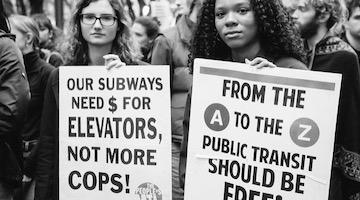 A thousand young people demonstrated in Brooklyn, jumping over turnstiles in solidarity with others arrested and brutalized by the cops.
 Whether Trump tried to make an impeachable arms deal with Ukraine or not, “the last thing Ukraine needs is more weapons of any kind.”
 Black political captivity in the Democratic Party has a lot to do with why there is no clear peace movement in the United States.
 Much of the internet chatter over low- hanging fruit issues fails to address our material realities within a settler colony.



