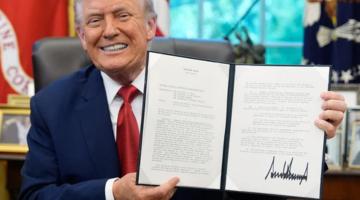
Delcy Rodríguez and Donald Trump at a meeting on the sidelines of the United Nations General Assembly in New York on Wednesday, September 2, 2026. Photo: Venezuelan Presidential Press.
A photograph of Delcy Rodríguez smiling with Donald Trump after the U.S. kidnapped Nicolás Maduro is evidence of subordination to the United States. These images cannot be reconciled with the dignity and defiant sovereignty that once defined Chavismo under Hugo Chávez.
Originally published in Orinoco Tribune.
Editorial note: There is confusion regarding the authorship of this piece. While Abel Prieto posted it on is X account, sources familiar with Barrio Adentro, the source, suggest that the initials “DM,” partially visible in the post, refer to its editor, Diego Molinas.
Photographs as evidence
There is a photograph that is evidence: Delcy Rodríguez and Donald Trump, together, smiling, in New York. Around that photograph, hundreds of narratives can be constructed; diplomatic, tactical, or strategic explanations can be elaborated; discussions about pragmatism, power relations, negotiation, or political necessity can be held. All of that can be discussed. But there is something that remains before any narrative: the photograph is evidence and shows a specific scene. And that scene is difficult to reconcile with much of the political tradition from which Delcy Rodríguez comes.
There is another image from the same day that completes the scene: Delcy Rodríguez approaching Pedro Sánchez while he is on the phone, waiting for him to finish so she can greet him. The image conveys something difficult to reconcile with the power of the historical leadership of the Bolivarian Revolution: a desire for closeness, almost like a student waiting for the other to finish the phone call to be able to greet him; an attitude that seems very far from the dignity and authority with which Chavismo once stood up to the powers of the world. And a few hours later, the photograph with Trump appears. Two images from the same day that speak for themselves, because one thing is diplomacy and another is the position from which it is exercised; one thing is to negotiate and another is to show subordination. It is what you see.
What chavismo once represented
And what you see is far from that “go to hell, damn Yankees” of Hugo Chávez. It is far from that defiant Chavismo that could stand up to the King of Spain, that could publicly confront the United States, and that built much of its political identity around an idea of sovereignty, dignity, and resistance against imperial power. There was a political power there, a capacity to stand up to authority, a way of exercising leadership that is hard to find in these images today.
When the narrative takes the place of reality
At the same time, we live in a dystopian world where artificial intelligence, technological advances, and algorithms often makes us unaware of reality or to inhabit it from a place different from what is actually observed. We can construct stories, narratives, and entire universes around a scene until the narrative ends up taking the place of reality. While the world’s wealthy talk about moving to Mars or colonizing other planets, perhaps the biggest debate that we have is much more fundamental: aligning stories, narratives, and algorithmic currents with reality.
Considering that reality is something different from what we see often leads us to navigate ideas, utopias, or even political positions from a place increasingly distant from what actually happens. And perhaps today a revolutionary leap would be to make reality coincide with what is recounted or narrated. Ideas, utopias, and political positions need to start from reality and not from a constructed reality that aligns with what we need to believe. When the narrative begins to take the place of the facts, we stop interpreting reality and start accommodating it to our needs.
The power is in what we see
This is why the power lies in what we see. And what we see is not just a photograph between Delcy Rodríguez and Donald Trump. That photograph appears after a US military intervention in Venezuela, after the kidnapping of Nicolás Maduro and Cilia Flores, and after Trump publicly claimed victory in the operation. What we see is Delcy Rodríguez in front of the man who glorifies that intervention and presents its result as a victory. This matters because the photograph is not floating in a vacuum: it has a context, it has deaths, it has a military intervention, it has a kidnapped Venezuelan president, it has strategic resources at stake, and it has a US president boasting the outcome of that operation.
In these hours, paradoxically, surprisingly, an entire epic of triumph, of peace diplomacy, a grandiloquence around a supposed victory appears. And the important thing is to say something very simple: defeat has no epic. A defeat can be just a defeat. What can be discussed is how to face it, what position to adopt in front of it, and what dignity is preserved when conditions are adverse. But a defeat does not turn into a victory simply because we build a grandiloquent narrative around it. Reality retains a dimension that discourse cannot erase.
The words of the victor
What we see is a Delcy Rodríguez who tolerates Trump saying the outrageous things he said. Trump spoke of the US operation in Venezuela in terms of victory and the victor, defended the use of force, and even spoke of the spoils that go to the victor. This is an offensive disgrace to the dead, who are not only Venezuelan dead, but also Cuban, but fundamentally people who died in a US intervention on Latin American territory. This context does not disappear because a diplomatic photograph is later constructed or because a strategic explanation is found for each gesture.
That happened. And it is incomprehensible that afterward Delcy Rodríguez appears in a victorious, smiling attitude in front of that demonstration of power and in front of the one who has kidnapped the president of Venezuela, Nicolás Maduro, and Cilia Flores. We can discuss the reasons for the negotiation, the power dynamics, the tactical needs, the circumstances, and the alternatives. All of this is part of politics and can be analyzed. But there is something that comes before all those explanations: it is what happened.
Tactic and coherence
Here arises a question that we should not avoid: what is the difference between Milei’s attitude and Delcy Rodríguez’s attitude? Surely, in these hours, explanations will emerge aimed at establishing profound differences between one and the other, and we will be told that one responds to one logic and the other to another, that one expresses subordination and the other a tactic, that one expresses a political project and the other a historical necessity. All of that can be discussed. But it is important to look at the concrete attitude, because if politics can always be explained as tactics, then coherence begins to lose any specific weight. And when coherence loses its specific weight, almost anything can become a strategy: a concession can be presented as a victory, a subordination as pragmatism, a defeat as peace diplomacy and a photograph as an epic. Reality, however, remains there.
A reference of dignity
If today we need to look at a reference, as we did on January 3, that reference would be Cuban dignity, which fought until the end against US troops and produced a very tough, very dignified response, despite being at a disadvantage in terms of resources and conditions of all kinds. Also yesterday, it was the Cuban delegation that stood up and left. There appears a reference of dignity, a reference from which to fight and from which to look at ourselves. There are moments when politics needs to regain the ability to set a limit against power.
This is especially important for those of us who think of ourselves from a tradition of the left, of sovereignty, of emancipation, and of transformation. Because we cannot lose the ability to recognize a reference when we see it. We cannot build an artificial epic around something that offers us no reference. And we cannot turn a scene of subordination into a scene of revolution simply because we need to preserve a certain narrative.
The surrender is also conceptual
Because if we fall into this pragmatic, tactical logic, where coherence seems to have little specific weight and reality can be distorted through grandiloquent discourse, we lose something much more important than a situational political discussion: we lose the ability to think. What we see is a very happy Delcy Rodríguez with Trump. What we see is a Venezuelan historical process that we have admired but no longer appears as a reference, because today it is part of devices that strengthen Donald Trump and a strategic delivery of resources, not only natural but also conceptual and ideological.
And this last point is perhaps even more important, because it is not just about oil, natural resources, or economic agreements. Symbols, references, words, and political traditions are also handed over. A tradition that for years was built around resistance to imperialism can end up being used to legitimize a new relationship of subordination. When that happens, the surrender is not only material: it is also conceptual. A part of what for years helped us construct a worldview, a way of interpreting sovereignty, and a manner of understanding emancipation is surrendered.
Not betraying our intellect
So there is no turning back. For the sake of dignity, as political activists, it is important not to betray our intellect and to realize what is truly visible.
Some will come out in these hours to say: “No, it is a tactic.” Well, but no revolutionary process ever reached that point. Can you imagine Fidel Castro celebrating with Kennedy after the Bay of Pigs? It would be more or less like that. The comparison may seem brutal, but it precisely allows us to understand the problem: one thing is to negotiate with the adversary and another is to build a scene of celebration with someone who has just boasted about a military intervention; one thing is to manage a defeat and another is to build an epic of defeat.
Back to reality
Perhaps the problem of our time is precisely this: we have learned to construct narratives capable of modifying our perception of reality. Artificial intelligence can do it, algorithms can do it, political narratives can do it, great powers can do it, and we ourselves can do it when we need reality to resemble what we want to believe. This is why perhaps today a revolutionary leap is something much more elemental and, at the same time, much more difficult: returning to reality, aligning what is with what is narrated and told, not abandoning utopias but preventing them from becoming an excuse to ignore the facts, not abandoning politics but preventing politics from forcing us to deny what is in front of us, not stopping strategic thinking but recovering coherence as a dimension of strategy.
Perhaps the first obligation of those of us who still believe that politics can transform reality is not to betray our intellect to save the narrative. Look at reality, think from it, and sustain ideas in the face of what actually happens. Because before any explanation, before any epic, and before any narrative construction, there is something that remains in front of us.
It is what you see.
Abel Prieto Jiménez (born 11 November 1950) is a Cuban politician. Abelito, as he was called as a child, is the son of Abel Prieto, a Cuban educator who, for several years pre- and post-Castro, ran a preparatory school in Pinar del Río. From 1997 to 2012 and from 2016 to 2018, he served as Minister of Culture. Since 2019 he has led the Casa de las Amercias.



 Pan-African Community Action (PACA) released a Transit Solidarity Plan for Washington, DC that challenges DC fare evasion crackdowns by collecting and redistributing fare cards to residents in the…
 “The Iraq invasion greatly accelerated the process of U.S. imperialism’s decline.”
 NSPM-7 and the State Department's international campaign against "far-left political terrorism" represent new and more dangerous forms of domestic repression in the 21st century, while reconstructing…
 In this series, we ask acclaimed authors to answer five questions about their book. This week’s featured author is Colin Kaepernick.


