Cuba's leadership has chosen resistance over subordination as the blockade tightens, but Venezuela appears to be allowing its economic sovereignty to be stripped away.
Originally published in 10Mehr.
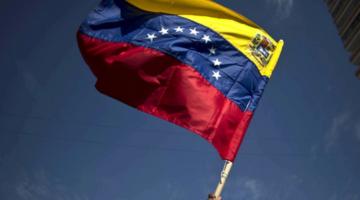
There are moments in history when the words “sovereignty,” “independence,” and “dignity” cease to be abstract concepts and become a concrete choice. What is happening today in the Caribbean and Latin America presents us with two profoundly different pictures: on the one hand, Cuba, subjected to unprecedented economic, political, and media pressure and yet determined not to give in; on the other, a Venezuela that, following the dramatic political shift of recent months, risks seeing its strategic resources and capacity for self-determination progressively eroded.
The gap between these two paths is now even more evident in light of Miguel Díaz-Canel’s statements and the oil agreement announced by Donald Trump with Caracas. The Cuban president has reiterated that the island is subjected to a multidimensional war and an energy blockade that has had devastating consequences on the daily lives of the population, with shortages of electricity, water, transportation, food, and medicine. But at the same time, he has stated unequivocally: “We have no alternative but to resist. We must resist.”
This is the fundamental difference. Cuba may be criticized, debated, and analyzed for its contradictions and difficulties, but it has not surrendered. Díaz-Canel has rejected the idea that the economic openings introduced to address the emergency represent a return to capitalism and has explicitly linked the defense of socialism to the defense of national independence and sovereignty. He also recalled that the country has already weathered moments when the very survival of the Revolution seemed impossible and that, once again, the choice is to resist without subordinating itself to U.S. interests.
Cuba resists while Venezuela appears to be surrendering. This is the dramatic contrast that emerges from Miguel Díaz-Canel’s words and the new oil agreement between Caracas and Washington. “We have no alternative but to resist. We must resist,” said the Cuban president, reaffirming that Havana has no intention of surrendering its sovereignty despite intense U.S. pressure. On the other hand, Venezuela runs the risk of seeing its vast oil resources increasingly subject to the control of U.S. interests.
It is a contradiction that Díaz-Canel also denounces in no uncertain terms; and for our part, we ask ourselves: Is it possible that in Venezuela’s highest echelons there is not even a shred of dignity—political or human—in the face of what appears to be the liquidation of sovereignty, self-determination, and the legacy of the Bolivarian Revolution? While Cuba, though exhausted, chooses to resist, Venezuela, on the other hand, seems to be taking the path of surrender.
The Venezuelan situation, however, appears dramatically different. The announcement of the new oil agreement between Washington and Caracas raises enormous questions about the future of the country’s economic sovereignty. According to ANSA, Donald Trump referred to it as the “largest agreement in history,” noting that the reserves involved in the agreement total 65 billion barrels. A private joint venture is set to receive 55% of actual production, and, according to a White House official cited by the same news agency, exploitation rights for the oil fields have reportedly been granted for a period of one hundred years.
If these details are confirmed in their final form, we would be facing something far more profound than a simple trade agreement. The issue would not merely be who extracts Venezuela’s oil, but who controls a strategic resource that is fundamental to the country’s future. ANSA notes that, for the first time, Venezuela could cede control of its oil fields to a private company under U.S. influence, while the role of the state-owned oil company PDVSA remains to be clarified.
This raises a political question that cannot be avoided: what remains of Bolivarian sovereignty if control over the country’s primary energy resources is gradually transferred to private actors linked to U.S. interests?
Venezuelan oil is not just any commodity. It is the material heart of the country’s economic sovereignty—a resource that Hugo Chávez had wrested from the logic of oligarchic rent-seeking and used as an instrument of social redistribution, Latin American integration, and the construction of an independent political project. For this reason, the eventual transfer of control over the oil fields cannot be presented simply as a necessary measure to revive production. We must ask ourselves what model of development, what kind of sovereignty, and what relationship with the United States will emerge from this transformation.
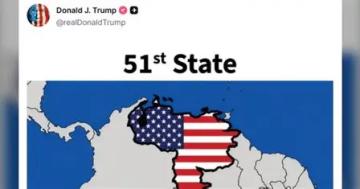
The issue is even more serious because it occurs within a context in which Washington has assumed a central role in the management and marketing of Venezuelan crude oil following the capture of Nicolás Maduro and the subsequent rise of Delcy Rodríguez. ANSA also notes that Caracas is reportedly even considering leaving OPEC, a decision that would represent a further sign of the country’s strategic realignment.
In light of all this, we cannot limit ourselves to recording these events as if they were mere financial transactions. We must speak openly about a possible erosion of economic sovereignty and of the political legacy built by the Bolivarian process. And we must ask ourselves how it was possible to reach a point where the country with the world’s largest oil reserves risks seeing control over a decisive portion of those resources shift to private interests under Washington’s influence.
Criticism must be directed with extreme severity against the decisions of the current Venezuelan ruling class and the PSUV leadership, but without turning political judgment into personal accusations lacking evidence. It is not necessary to assume private interests or personal deals to denounce what politically appears to be an enormous contradiction: a process born in the name of sovereignty and independence risks resulting in the subordination of key strategic resources to the interests of a foreign power.
And yet, Venezuela is not just its government. There is a deeper Venezuela: that of social movements, communes, working-class neighborhoods, workers, factories, intellectuals, and all those sectors that continue to identify with the political legacy of Hugo Chávez and with the idea of a Bolivarian revolution founded on popular sovereignty. From these sectors, a new political and social organization capable of reopening the prospect of emancipation may emerge.
This is not about idealizing the past or denying the mistakes, contradictions, and difficulties Venezuela has faced. It is about distinguishing between the Venezuelan people and the decisions of those who currently hold power. Sovereignty belongs to the people, not to a ruling elite. And precisely for that reason, the harshest criticism of the government’s decisions can and must be accompanied by solidarity with those social forces that seek to relaunch the Bolivarian project on new, democratic, and popular foundations.
Cuba, meanwhile, presents a different picture. The island is on the brink, subjected to a blockade that Díaz-Canel describes as an economic, energy, ideological, and media war. The Cuban president openly acknowledges the difficulties and admits the need for economic reforms, but rejects the idea that these reforms mean abandoning socialism. The 176 measures approved by Havana are presented as tools to address an exceptional situation, not as an ideological capitulation.
Díaz-Canel’s statement is simple and, precisely for that reason, political: “We have no alternative but to resist.” Even more significant is the refusal to accept a dialogue based on subordination. Cuba declares itself willing to engage in dialogue with Washington, but not to negotiate under pressure or to cede its sovereignty.
This position does not mean that Cuba should not change. On the contrary: the survival of the Revolution demands the capacity for transformation, economic innovation, greater efficiency, popular participation, and the ability to respond to the real suffering of the population. But reform is not necessarily a surrender. The problem is who decides, in whose interest, and within what international balance of power.
This is the crux of the matter that, by contrast, unites Cuba and Venezuela. It is one thing to open up economic spaces to survive a siege without renouncing sovereignty; it is quite another to hand over control of one’s own strategic resources to the power that exerts the greatest pressure on the country.
That is why Cuba deserves attention today not as a perfect and untouchable model, but as an example of national and political resistance. Venezuela, on the other hand, must be viewed with concern: not because its people have renounced their history, but because a segment of its ruling class appears to be accepting a process of progressive economic subordination that risks erasing the very meaning of the Bolivarian Revolution.
The issue, therefore, is not a choice between two governments. It is a matter of choosing between two visions of Latin America: a land capable of making autonomous decisions about its resources and its future, or a continent once again transformed into a platform for the extraction of wealth in the service of the great powers.
Cuba, today, says it will not surrender. Venezuela reminds us how quickly a revolution can be hollowed out from within when sovereignty becomes a negotiable variable.
That is why we must support any process of popular, social, and cultural reorganization in Venezuela that seeks to restore the original meaning of the Bolivarian project. And we must regard the Cuban resistance with respect, because in a Latin America once again beset by external pressures and geopolitical interests, the defense of independence is not a nostalgic longing for the past: it is a dramatically pressing issue of the present.
In the end, there is only one real question: Who should decide on the oil, the land, the resources, and the future of a people? The communities and institutions of that country, or the economic interests of foreign powers?
It is in this answer that the difference between sovereignty and subordination, between resistance and surrender, is measured today.


 Early last year, Governor Ron DeSantis began signing death warrants at a faster rate than ever before. What followed was the most intense period of executions the state has carried out in more than…
 Eight student activists in Michigan face decades in prison for advocating that their university divest from genocide. It is clear the goal of the indictment is to terrorize the Palestine solidarity…
 In this week’s segment, we discuss U.S. control over Venezuela and its resources, and the Venezuelan people's response to their loss of sovereignty. But we begin with a report on the police killing…
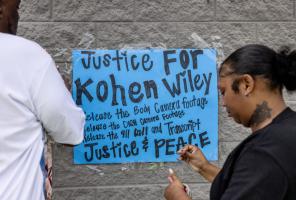 Our guest is attorney Jaribu Hill, executive director of the Mississippi Workers Center for Human Rights. She reports on the police killing of 1-year old Kohen Wiley in Senatobia, Mississippi and on…
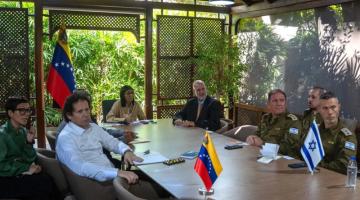 On January 3, 2026, the U.S. conducted a military attack against Venezuela and kidnapped president Nicolas Maduro and his wife, First Combatant Cilia Flores. Since that time interim president Delcy…


