“Professional soccer does everything to [destroy] that energy of happiness, but it survives in spite of all the spites.”
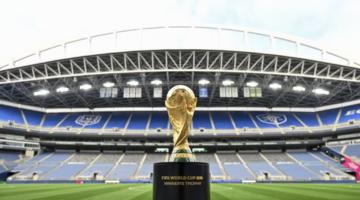
The signs do not look good for the 2026 World Cup. Jointly hosted by Mexico, Canada, and the United States, it is shaping up to be little more than a mean-spirited sportswashing exercise for the US fascist regime, and a hideous and bloated carnival of capitalism and FIFA-branded consumerism. In both instances, the “2026 FIFA World Cup™” (with its fantastically vapid slogan “WE ARE 2026”) is drawing on the grand traditions and the football heritage of prior iterations of the tournament.
The 1934 World Cup, staged in Italy and hosted by the dictator, Benito Mussolini, was described by Uruguayan writer Eduardo Galeano as “an elaborate propaganda operation.” Fans celebrated the host country’s victories with fascist salutes. Italy won the tournament. The 1978 World Cup was hosted by the Argentine military junta two years after the country’s president, Isabel Perón, was overthrown. While the tournament was an attempt by the regime to present a benign face to the world, it was said that one could hear the screams of the tortured in the concentration camps near the stadiums. Argentina, again, won the tournament.
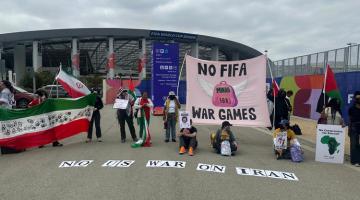
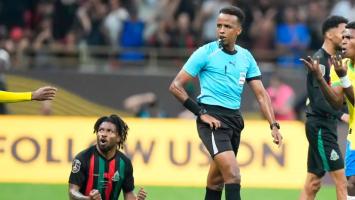
While co-partners Canada and Mexico have adopted a quisling-like silence on the United States’ actions around the World Cup, the US has shown no interest in acting like a “host,” in any meaningful sense of the word, assuming we mean someone who shows their guests hospitality and kindness. Players from Iran (a country that has been victimized by an immoral and illegal war launched by the US and the zionist entity), have been forced to train in Tijuana and will have to travel back and forth to and from Mexico on game days because the US will not allow them to stay in the country overnight. Dozens of Moroccan fans have been denied US visas. The Senegalese team was subjected to an intrusive and humiliating security check on the tarmac upon their arrival in the US. The globally-respected Somali referee Omar Artan was barred from entering the country after an 11 hour interrogation by the U.S. Customs and Border Protection — an extension of the routine, racist attacks on Somalia and Somalis by Trump and J.D. Vance. Meanwhile, both soccer fans and stadium workers fear they will be targeted by ICE, joining the 60,000 people currently in detention, the 400,000 people who have been detained, and the 2.5 million people who have been deported (according to DHS figures) since Trump took office.
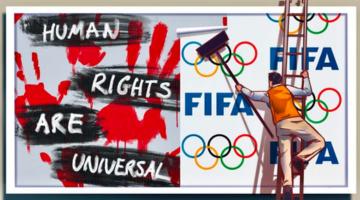
FIFA, the Fédération Internationale de Football Association, soccer’s global governing body, seems unperturbed by the US actions against players, fans, and workers. But why should they care? Not only is FIFA President Gianni Infantino happy to bask in Trump’s grimy aura and embrace his white supremacist fantasies, but the organization itself has a reputation for its Eurocentric structure and bias – a fact challenged by the African continent which boycotted the World Cup in 1966 because FIFA forced Africa, Asia, and Oceana to compete for one spot in the competition.
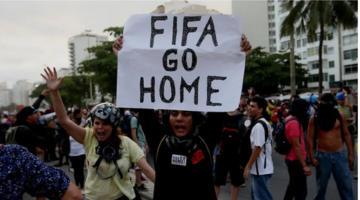
Most significantly, for FIFA, profit trumps any concerns over justice, equality, human rights, and labor abuse, let alone torture, detention, and deportation. FIFA’s profits during the previous four-year cycle are estimated to be $13bn, with $9bn coming from this summer’s World Cup. These profits are generated from sponsorships, and from the fact that individual cities shoulder the burden of hosting the World Cup. FIFA doesn’t pay for anything; taxpayers pay for FIFA. It is an extractive, parasitic organization that demands that cities and citizens bow to its every demand, from VIP police escorts, to trade mark exclusion zones designed to protect FIFA’s corporate sponsors from competition, to the banning of empty water bottles, vuvuzelas, and non-approved signs within stadiums, to the “market-driven” pricing scheme for tickets that have made it impossible for the true fans of the game to attend the tournament. The World Cup is a tournament for the pleasure of the rich, built on the backs of the poor and working classes.
FIFA has turned the people’s game into capitalism’s plaything. No wonder that Eduardo Galeano, writing of the 1998 World Cup stated, “In the final, France shocked Brazil, and Adidas beat Nike.” Galeano, among the greatest writers on the beautiful game, fully understood how the game he loved had been colonized by crass commercialism and corporate interests, including and especially by FIFA. Galeano’s essay, “All the World’s a Ball,” reminds us how athletes have become commodities and fans mere corporate pawns — a fact even truer today than in 1998. However, Galeano would probably not have predicted that 2026 would come to resemble Italy ‘34 and Argentina ‘78.
We reprint Eduardo Galeano’s “All the World’s a Ball” below.
All the World’s a Ball
Eduardo Galeano
Thanks to World Cup 1998, we learned, or confirmed a few things:
- Mastercard is a muscle toner, and a good athlete needs plenty of Coca-Cola and McDonald’s hamburgers.
- In the final, France shocked Brazil, and Adidas beat Nike. A lover of Brazilian soccer, Nike shelled out a reported $400 million to the team plus another fortune to its star Ronaldo. Well-placed sources say Nike insisted that Ronaldo play the final match even though he was seriously ill. Yanked out of the hospital, he played but he didn’t play.
- The winning side was a team of immigrants. Opinion polls say half of France would like to toss out such interlopers, but all of France celebrated as if these victorious blacks and Arabs were the sons of Joan of Arc.
- Soccer miraculously retains its capacity for surprise. Nobody gave 2 cents for Croatia, but their grit took them to third place.
- Miraculously, soccer retains its capacity for beauty. I saw every match and don’t regret it. Defensive and calculating, end-of-the-century soccer is chary with its splendor, but splendor there was.
* * *
St. Denis reminded us, once again, that today the stadium is a gigantic TV studio. The game is played for television so you can watch it at home. And television rules.
Twelve years ago, at the 1986 World Cup, Valdano, Maradona and other players protested because the big matches were played at noon under a sun that fried everything it touched. Noon in Mexico, nightfall in Europe, the best time for European television. The German goalkeeper, Harald Schumacher, told the story: “I sweat. My throat is dry. The grass is like dried shit: hard, strange, hostile. The sun shines straight down on the stadium and strikes us right on the head. We cast no shadows. They say it is good for television.”
Was the sale of the spectacle more important than the quality of the play? The players are there to kick, not to cry, and Jean Marie Faustin de Godefroid Havelange, head of FIFA, the International Federation of Football Associations, put an end to that maddening business: “They should play and shut their traps,” he decreed.
Who ran the ‘86 World Cup? The Mexican Soccer Federation? No, please no more intermediaries: It was run by Guillermo Cañedo, vice president of Televisa and president of the company’s international network. That World Cup belonged to Televisa, the monopoly that owns the free time of all Mexicans and also owns Mexican soccer. When a Mexican journalist had the insolence to ask about the costs and profits of the World Cup, Cañedo cut him off cold: “This is a private company and we don’t have to report to anybody.”
Throughout the world, by direct and indirect means, television decides where, when and how soccer will be played. The game has sold out to the small screen in body and soul – and clothing, too. Players are not TV stars. The program that had the largest audience in France and Italy in 1993 was the final of the European Champions Cup between Olympique de Marseille and Milan. Milan, as we all know, belongs to Silvio Berlusconi, the czar of Italian television. Bernard Tapie was not the owner of French TV, but his club, Olympique, received from the small screen that year 300 times more money than in 1980.
Now millions of people can watch matches, not only the thousands who fit into the stadiums. But unlike baseball and basketball, soccer is a game of continuous play that offers few interruptions for showing ads. A half-time isn’t sufficient. American television has proposed to correct this unpleasant defect by dividing matches into four twenty-minute periods – and Havelange agrees…
* * *
Who are the players? Monkeys in a circus? They may dress in silk, but aren’t they still monkeys? They are never consulted when it comes to deciding when, where and how they play. The international bureaucracy changes rules at its whim. The players can’t even find out how much money their legs produce, or where those fugitive fortunes end up.
The fact is, professional players offer their labor power to the factories of spectacle in exchange for a wage. What about the thousands upon thousands of players who are not stars? The ones who don’t enter the kingdom of fame, who get stuck going round and round in the revolving door? Of every ten professional soccer players in Argentina, only three manage to make a living from it.
Here is the itinerary of a player from the southern reaches of the globe who has good legs and good luck: From his home town he moves to a provincial city, then from the provincial city to a small club in the country’s capital. The small club has no choice but to sell him to a large one; the large club, suffocated by debt, sells him to an even larger club in a larger country. And the player crowns his career in Europe.
All along this chain, the clubs, contractors and intermediaries end up with the lion’s share of the money. Each link confirms and perpetuates the inequality among the parties, from the hopeless plight of neighborhood clubs in poor countries to the omnipotence of the corporations that run European leagues.
In Uruguay, for example, soccer is an export industry that scorns the domestic market. The continuous outflux of good players means mediocre professional leagues and even fewer, ever less fervent fans. People desert the stadiums to watch foreign matches on television. When the world championships come around, our players gather from the four corners of the earth, meet on the plane, play together for a short while, and bid each other goodbye without ever having time to become a real team – eleven heads, twenty-two legs, a single heart.
When Brazil won its fourth World Cup in 1994, only a few of the celebrating journalists managed to hide their nostalgia for the marvels of days past. The team of Romario and Bebeto played an efficient game, but it was stingy on poetry: a soccer much less Brazilian than the hypnotic play of Garrincha, Didí, Pelé and their teammates in ‘58, ‘62 and ‘70. More than one reporter noted the shortage of talent, and several commentators pointed to the style of play imposed by the coach, successful but lacking in magic. In 1998 it wasn’t even successful. Brazil sold its soul to modern soccer. But there was another point that went practically unmentioned: The great teams of the past were made up of Brazilians who played in Brazil. On the ‘94 team, eight of them played in Europe. Romario, at the time the highest-paid Latin American player in the world, was earning more in Spain than all eleven from Brazil’s ‘58 team put together, who were some of the greatest artists in the history of soccer.
* * *
The ball turns, the world turns. People suspect the sun is a burning ball that works all day and spends the night bouncing around the heavens while the moon does its shift, though science is somewhat doubtful. There is absolutely no question, however, that the world turns around a spinning ball: The final of the ‘98 World Cup was watched by the largest crowd ever of the many that have assembled in this planet’s history. It is the passion most widely shared: Many admirers of the ball play with her on fields and pastures, and many more have box seats in front of the TV and bite their nails as they watch the show performed by twenty-two men in shorts who chase a ball and kick her to prove their love.
At the end of the ‘94 World Cup every child born in Brazil was named Romario, and the turf stadium in Los Angeles was sold off like pizza, at $20 a slice. A bit of insanity worthy of a better cause? A primitive and vulgar business? A bag of tricks manipulated by owners? I’m one of those who believe that soccer might be all that, but it is also much more: a feast for the eyes that watch it and a joy for the body that plays it. A reporter once asked the German theologian Dorothee Sölee: “How would you explain to a child what happiness is?”
“I wouldn’t explain it,” she answered. “I’d toss him a ball and let him play.”
Professional soccer does everything to castrate that energy of happiness, but it survives in spite of all the spites. And maybe that’s why soccer never stops being astonishing. As my friend Angel Ruocco says, that’s the best thing about it – its stubborn capacity for surprise. The more the technocrats program it down to the smallest detail, the more the powerful manipulate it, soccer continues to be the art of the unforeseeable.
And afterward? Perhaps, just a source of melancholy, that melancholy we all feel after making love and at the end of the game.


 The liberal news media treat U.S. violence and oppression as aberrations from the country's founding ideals rather than expressions of its fundamental character as a settler colony, empire,…
 The U.S. relocation of MQ-9 Reaper drones from Africa to Latin America is not a drawdown of imperial aggression but a strategic reallocation, with the drones likely to be used against Cuba, Venezuela…
 Race is a sociopolitical construct, not a biological truth. The real determinants of health are structural factors such as zip code, environmental pollution, and access to resources.
 A photograph of Delcy Rodríguez smiling with Donald Trump after the U.S. kidnapped Nicolás Maduro is evidence of subordination to the United States. These images cannot be reconciled with the dignity…
 Imperialist competition and wars that facilitate extractivism have long shaped the use of seaports for access to resources, markets, and devalued labor. In the last decade, countries in the chain of…


