A critical analysis of ongoing social media warfare against Cuba and the global African response to a revolution under criminal siege.
Originally published in Pambazuka News.
A new front has opened in the long-running information war against Cuba. It is not being fought with overt political tracts or state-sponsored media, but with sleekly edited Instagram Reels and TikTok carousels.
The antagonists are not the traditional counterrevolutionaries of Miami, but a cohort of young, predominantly Black, self-styled influencers operating under the diffuse banner of the pseudo “Black left”—a space where anarchist critiques of the state and cultural nationalist laments over racial injustice converge. Their message is potent and seductive in its simplicity: “Cuba has done nothing for Black Cubans.” Accompanied by grainy, decontextualized footage from the 1960s, 1970s, and 1990s—images of poverty, aging infrastructure, and the Special Period’s hardships—these posts are not innocent historical documentation. They are a weaponized narrative designed to erase seven decades of revolutionary achievement.
This is not a mere social media debate; it is a coordinated attack on Cuba’s sovereignty and its most foundational principle: that the Socialist Revolution was, and remains, a project of racial and economic justice. To cede this digital battlefield is to risk unraveling the very legitimacy of the Cuban socialist state.
First, we must name the historical erasure at the heart of this campaign. To claim that Cuba “has done nothing” for its Afro-descendant population requires ignoring the pre-revolutionary reality. Before 1959, Cuba was a neo-colonial plantation society where Black Cubans were systematically excluded from hotels, beaches, managerial positions, and higher education. The Fulgencio Batista dictatorship, which the Revolution overthrew, presided over a Havana that welcomed mafia casinos and US tourists while Black Cubans lived in deliberately neglected urban slums and rural “bohíos”, denied access to basic healthcare and literacy.
The Revolution’s very first laws—the Agrarian Reform and the Urban Reform—disproportionately benefited the landless and the unhoused, the majority of whom were Black and mixed-race. The 1961 Literacy Campaign, which sent thousands of young people into the countryside and poor urban neighborhoods, erased the illiteracy that had been a tool of racial subjugation. By 1962, Cuba had universal, free education and healthcare—institutions that today produce Black doctors, economists, engineers, and scientists at rates that embarrass the United States. It is also worthy to note that the current president of the University of Havana (Universidad de La Habana) is Miriam Nicado García – a Black woman…the first woman to head one of the oldest universities in the Western Hemisphere.
Hence, these influencers’ cobbled-together footage of the 1960s-2000s deliberately misrepresents context. Images of food lines from the 1990s are not evidence of anti-Black neglect; they are evidence of the “Special Period in Times of Peace”, a humanitarian catastrophe triggered by the collapse of the Soviet Union and intensified by the US blockade. Those shortages affected all Cubans, but the state’s response—ration books, free medical rounds, the preservation of schools at any cost—was a collective survival strategy that prevented the kind of mass starvation and social breakdown seen in post-Soviet Russia. To weaponize that suffering against the Revolution is to blame the victim of a decades-long economic siege for the wounds inflicted by its aggressor.
The attack also ignores the Revolution’s profound, if imperfect, struggle against racism. Fidel Castro famously declared, “Racism is a form of discrimination that is incompatible with the socialist society we are building.” The Revolution outlawed racial discrimination in employment, housing, and public accommodations—laws that by the way did not exist in the US until 1964/65, and, as we witness, remain violently contested today.
More importantly, the state undertook systematic, structural interventions. The “Plan de Igualdad Racial” (Plan for Racial Equality) of the 1970s opened technical schools and university quotas to historically marginalized communities. The creation of the “Instituto Cubano de Amistad con los Pueblos” (ICAP) and Cuba’s internationalist missions—from Angola to Ethiopia to South Africa—were deeply intertwined with anti-apartheid and anti-colonial struggle. Thousands of Black Cubans volunteered as soldiers and doctors in Africa, returning with a political consciousness that linked the island’s destiny to the global fight against white supremacy. No other nation of Cuba’s size and resource scarcity has done more, materially and morally, to dismantle colonialism’s racial hierarchies.
In addition, Cuba has been the willing sanctuary for Black and Latinx revolutionaries escaping the US criminal injustice system. Since the early 1980s, it was the home of the late Black Revolutionary Assata Shakur who was constantly sought after by the FBI and New Jersey State Police. She had a more than $2 million bounty on her. She was always a bargaining chip within the US arsenal when they negotiated with Cuba. But at every US-Cuba negotiation, Cuba would insist that Assata Shakur was a Cuban citizen and any discussion of her is off the table. She lived and died as a free Black Woman in Cuba.
This is not to say that Cuba has solved racism. It has not. Residual prejudice, colorism in media representation, and the disproportionate impact of the post-Soviet economic crisis on Black neighborhoods (often due to their historical concentration in Old Havana and Santiago de Cuba) are real problems. In the 2010s, the Cuban state itself, under the leadership of Miguel Díaz-Canel, acknowledged these persistent racial disparities and launched a new program of affirmative action and public debate on race, including the 2019 Constitution’s explicit prohibition of racial discrimination and the creation of the “Comisión contra el Racismo y la Discriminación Racial” also known as The Aponte Committee.
The difference between Cuba and the nations from which these influencers broadcast (primarily the US and Europe) is that Cuba admits its unfinished work while being starved of resources by an external blockade. The critics in Miami or New York City speak from within a system that mass-incarcerates Black people, erases and distorts Black History, segregates schools, and refuses universal healthcare. Their platform, Instagram, is owned by a corporation (Meta) that profits from surveillance and disinformation. The moral equivalence they imply is a lie.
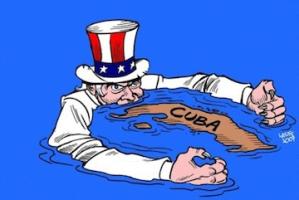
The deeper danger of this pseudo “Black Left” anarchist and cultural nationalist critique is that it plays directly into the hands of the US Blockade. The logic is circular: the blockade causes shortages; shortages cause visible suffering; the suffering is then filmed and presented as “proof” that the Revolution has failed Black Cubans.
The implied solution? Regime change.
But regime change in Cuba would not mean a progressive, Black-led utopia. It would mean a return to the pre-1959 gangster capitalist condition: a neo-colony where Cuban sovereignty is auctioned to the highest foreign bidder, where public healthcare is privatized, where education becomes a commodity, and where the descendants of the enslaved once again become cheap labor for foreign hotels, farming and mining companies. The pseudo “Black Left” influencers, whether wittingly or not, are amplifying the very narrative used by the Make America Great Again (MAGA) infused Republican Party and the hyper anticommunist Cuban-American rightwing cabal to justify the blockade’s intensification. They are the useful idiots of imperialism.
The Cuban Revolution is not a museum piece. It is a living, breathing, and besieged experiment in human dignity. The fact that young Black influencers in the imperial core can scroll through decades of Cuban history to find images of poverty is not an indictment of the Revolution; it is an indictment of the embargo that has strangled that Revolution. Cuba’s infant mortality rate for Black children is the same as for white children. Its Black population has life expectancy equal to its white population. No other nation in the Americas can make that claim. And the current medical supplies and fuel blockade by the US is a central factor in the deterioration of Cuba’s free world-class healthcare system for all.
The fight against racism in Cuba is not over, but the ground was cleared by the Revolution, and every tree planted since—every Black doctor, every Black university professor, every Black revolutionary intellectual—grows in that soil.
We must address this issue now, not with defensive nostalgia, but with militant truth-telling. When you see those decontextualized Reels, respond. Do not apologize for the hardships of the Special Period; explain the blockade. Do not deny residual racism; show how Cuba’s affirmative action and constitutional reforms go further than any “first world” nation. And never, ever allow the enemy to define the terms. Cuba has not done “nothing” for Black Cubans. It has done everything possible under the conditions of a criminal, genocidal blockade.
The true “Black Left” should be demanding an end to that blockade, not parroting its talking points. Solidarity is not performative critique from a comfortable distance. Solidarity is standing with a nation that, despite all odds, continues to make Black lives matter—in practice, not just on Instagram.
A Luta Continua!
Let’s help Cuba Live!
Sam E. Anderson is a Brooklyn, New York, native and a founding member of the Coalition for Public Education and the National Black Education Agenda. He has authored several books and essays on science, technology, and the history of slavery, among them The Third World Confronts Science and Technology and The Black Holocaust for Beginners. He was an editor at Black Dialog, NOBO Journal, and The Black Activist. He was the first chair of a Black Studies department in 1969–70 at Sarah Lawrence College and taught mathematics, science, and Black history at SUNY Old Westbury, City College of New York, New York University, Rutgers University, and Brooklyn College. He has been active in the civil rights and Black liberation movement since 1964 as a member of the Student Non-Violent Coordinating Committee, the Black Panther Party, and the Black reparations movement.

 The Patriot Front’s bold incursions into U.S. cities are a sign of their burgeoning strength and of the weakness of Black movement politics.
 “I was deported from the U.S.A, because as a Negro woman Communist of West Indian descent, I was a thorn in their side…”
 The records of the International Criminal Tribunal on Rwanda should not be surrendered to the Rwandan regime led by President Paul Kagame.
 Iran's 1979 revolution was a victory for national sovereignty which also forged solidarity with African people.
 The U.S. and Israel treat negotiations as a weapon to destabilize and disarm the region, but Iran and Hezbollah have shown that real sovereignty requires connecting every front in a unified anti-…


