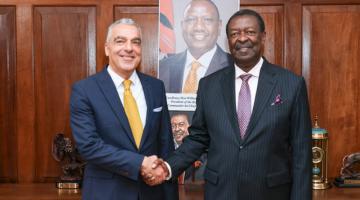
Cuban solidarity event in Kenya. Photo: Ajiambo Ashlyn/X
With the economic strangulation of Cuba by the United States, African progressive organizations and movements are calling for broader continental solidarity.
Originally published in People's Dispatch.
Across the African continent, progressive movements, grassroots organizations, and Pan-African networks are rallying in renewed solidarity with Cuba at a moment of deepening crisis. While global media narratives often reduce Cuba’s situation to internal failure (a narrative activists and many Cubans claim is imperialist propaganda), African movements are advancing solidarity rooted in history and shared struggle. International solidarity with the people of Cuba is rising, with caravans of medicines and food supplies being mobilized to support the island in the face of the ongoing siege.
Cuba today faces severe shortages of fuel, energy, and essential goods. These hardships are real and deeply felt. They are the direct outcome of a prolonged economic war, by the United States’ decades-long embargo, now intensified into new levels of inhumanity.
Since the victory of the Cuban Revolution, Cuba has stood as a defiant example of resistance to imperial domination. Its continued commitment to a socialist path, despite immense external pressure, has made it both a symbol of sovereignty and a target of sustained aggression.
Cuba and Africa: a history of shared struggle
Cuba, a nation of roughly 11 million people, has played an outsized role in supporting liberation struggles across the Global South. Its contributions have never been symbolic alone; they have been material, strategic, decisive, and often made at great sacrifice.
From the early years of African independence, Cuba provided weapons, training, and political support to liberation movements. Its role in Angola, Mozambique, and Guinea-Bissau was particularly significant. In Angola, over 300,000 Cubans fought alongside African liberation movements against apartheid South African aggression, contributing to decisive victories, such as the Battle of Cuito Cuanavale. This turning point weakened apartheid South Africa militarily and politically, accelerating the independence of Namibia and contributing to the eventual collapse of apartheid.
A continental call
In a statement endorsed by multiple organizations, Pan-Africanism Today has articulated a clear and uncompromising position of solidarity from Africa.
The statement situates Cuba’s crisis within the global context of intensifying imperialism:
“We write to you at this crucial moment in history, characterized by the increasing barbarism of United States imperialism and the equally growing anti-imperialist resistance of the peoples of the world. We write not only to offer words of comfort, but to reaffirm active solidarity and internationalism forged through decades of shared struggle against a common enemy.”
Linking Cuba’s situation to global struggles from Palestine to Iran, the statement puts it clearly the blockade is not an isolated policy but part of a wider system that has “abandoned all pretence of legality, morality, and human decency.”
And, “a persistent act of war against an entire people … one of the gravest ongoing crimes against humanity in the modern era.”
Recent escalations, including new measures under US policy, have intensified this reality, particularly through restrictions affecting fuel supplies, with devastating implications for hospitals, food systems, and daily life.
Internationalism vs. imperialism
African movements contrast Cuba’s global role with that of imperial powers. Where dominant states deploy sanctions and military force, Cuba has historically deployed doctors, teachers, and technical support.
From sending medical brigades across Africa to training thousands of African students in medicine, Cuba has embodied a form of internationalism rooted in solidarity rather than extraction.
As the statement affirms: “You have not lectured us; you have shown us.”
This distinction is central. Cuba’s internationalism is not charity; it has been a political commitment grounded in a shared struggle against domination.
Solidarity is our responsibility
For African progressives, supporting Cuba is not about gratitude, it is about political responsibility in the face of a common enemy.
The statement unequivocally declares:
- We condemn the criminal blockade of Cuba with contempt and pledge to intensify every effort to end it – politically, diplomatically, and in the court of international public opinion.
- We commit to strengthening our solidarity with the Cuban people and to ensuring that the truth about Cuba’s revolutionary achievements, and the crimes against it, reaches the widest possible audiences across our continent and the world.
- We salute the leadership of the Cuban Revolution for its steadfastness in the face of an ongoing US-led imperialist siege.
- We honor the memory of the revolution’s giants – such as Fidel Castro, Che Guevara, Haydée Santamaría and others – by dedicating ourselves to upholding their example in our own struggles.
- We stand with the Cuban people as you withstand the latest tightening of the imperialist stranglehold.
“You do not face this alone. An injury to Cuba is an injury to all of us.”
Cuba’s experience stands as living proof that another world is not only imaginable, but possible. As the statement concludes, “The task now, as African progressives insist, is to fight to make that world a reality. We commit ourselves to doing precisely that: building the organized power of workers, peasants, women, and youth; deepening the anti-imperialist consciousness of our peoples; and forging the continental and international unity in action. This can break the chains of capitalism and imperialism – our ability to work together and construct the socialist world that the people of Cuba have dared to demonstrate is necessary. A world for the many, built by the many!”


 Chris Smalls discusses his memoir, "When the Revolution Comes: A Fight for the Future of the Working Class," published by Penguin Random House. He is the first and only union leader to successfully…
 Our guest is Nairobi based political writer and strategist Clinton Nzala. He joins us to provide an update and an analysis of the South African anti-migrant March and March movement, which is…
 The Hague Group’s goal is to “. . . take coordinated legal and diplomatic measures against Israel’s violations of international law.” But international law was never a reality.
 “I believe that the Movement of Nonaligned Countries…can buttress the united will of the Arab nation and help it to prevail against intervention and aggression.”
 There is no evidence that Eritrea has surrendered its Red Sea Coast in exchange for relief from US sanctions.


