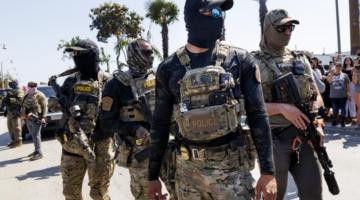
The response by law enforcement to protesters in Ferguson 2014 saw a brutal crackdown using military-style equipment labeld here. (Tom LeGro and Thomas Gibbons-Neff/The Washington Post)
The state is not drifting toward repression; it is building it with serious intent. ICE raids, militarized police, and mass surveillance are the tools of a system designed to manage and silence people in crisis.
What we are witnessing in the United States today is not a series of isolated policy excesses or unfortunate “overreaches,” but the maturation of a coherent architecture of repression — a national security state that fuses intelligence, policing, militarization, and ideological discipline into a single system of control. This system is not reactive; it is proactive. It is not defensive; it is anticipatory. And it is not primarily about safety — it is about managing populations, suppressing dissent, and maintaining imperial order in a moment of systemic crisis, fueling the consolidation of fascism.
In this issue of our Bulletin on Domestic Repression, we continue to cover those mechanisms of power and control – surveillance, militarization of police, community occupations, detention as commodity production, with a continued special focus on the new paramilitary role of the Immigration and Customs Enforcement agency (ICE).
In our last issue, we focused on the Department of Defense 1033 Program that transfers military equipment to local police departments but also the lesser-known 1122 Program. We exposed how these programs collapse the boundary between civilian law enforcement and military occupation. Armored vehicles, battlefield weapons, tactical gear, and military training reconfigure police from public servants into domestic security forces oriented toward control rather than care. Protest becomes insurgency. Poverty becomes a threat. Blackness, Brownness, migration, and political dissent become objects of suspicion.
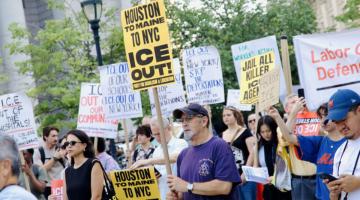
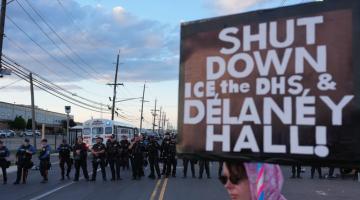
We provide further analysis in this issue on how, into this already volatile mix, comes the expansion of immigration enforcement as a central pillar of domestic repression. ICE raids in cities, mass arrests, workplace sweeps, and collaboration with local police transform immigration policy into a tool of terror — not simply to remove people, but to discipline communities. The goal is not only deportation, but deterrence, fear, fragmentation, and social paralysis. Migrant communities become laboratories of repression where techniques of control are tested before being generalized.
These mechanisms do not operate independently. Militarized police enforce intelligence through overwhelming force. ICE operationalizes it through raids and profit-based detentions. And all of it is ideologically legitimated through a permanent discourse of threat from the racialized “other” — terrorism, gangs, extremism, disorder, invasion — that re-codes political opposition and social crisis as internal security problems.
This is what a repressive, fascist state looks like in a late-imperial moment. Not jackboots in the street, but databases. Not mass roundups announced in advance, but targeted removals justified by intelligence assessments no one can see or contest.
The training relationships between U.S. police and Israeli security forces fit seamlessly into this logic. Israeli policing is shaped by occupation, counterinsurgency, and population control. It is designed not to serve a public, but to manage an enemy population. When U.S. police import those models, they import not only tactics, but an entire political logic: that certain populations are not citizens but problems, not constituents but threats, not humans but risks.
What ties all this together is the collapse of the distinction between foreign and domestic repression. The techniques used to occupy, sanction, destabilize, and discipline abroad are now fully integrated into domestic governance. The empire has come home, not because it wants to, but because it must. A system built on exploitation, inequality, and endless expansion cannot govern through consent in moments of crisis. It must govern through coercion, control and violence.
This is why we should not be surprised that ICE behaves like a paramilitary force, and that political dissent is increasingly framed as extremism. This is not drift. It is design. ICE Director Todd Lyons’ comment last April that the administration should treat deportations “like a business … Like [Amazon] Prime, but with human beings,” is the capitalist logic that is driving these moves toward a fully consolidated neofascism is clear.
The question is not whether this system will be used abusively. It already is. The question is whether it will be named for what it is: a repressive national security state emerging from the contradictions of empire, racial capitalism, and imperial decline that has now turned to the capitalist reform of fascism to uphold the dictatorship of capital.
And the task before us is not reform within that architecture, but confrontation with it. Not technocratic fixes, but political resistance. Not procedural objections, but principled opposition. Because once repression becomes normalized, legality becomes irrelevant — and freedom becomes a memory rather than a practice.
No Compromises, No Retreat
Ajamu Baraka
Director, North-South Project for People(s)-Centered Human Rights
Ajamu Baraka is an editor and contributing columnist for the Black Agenda Report. He is the Director of the North-South Project for People(s)-Centered Human Rights and serves on the Executive Committee of the U.S. Peace Council and leadership body of the U.S.-based United National Anti-War Coalition (UNAC).



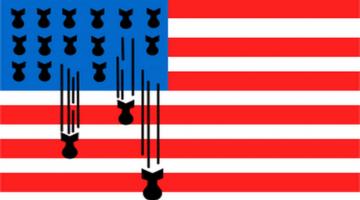 The liberal news media treat U.S. violence and oppression as aberrations from the country's founding ideals rather than expressions of its fundamental character as a settler colony, empire,…
 The U.S. relocation of MQ-9 Reaper drones from Africa to Latin America is not a drawdown of imperial aggression but a strategic reallocation, with the drones likely to be used against Cuba, Venezuela…
 Race is a sociopolitical construct, not a biological truth. The real determinants of health are structural factors such as zip code, environmental pollution, and access to resources.
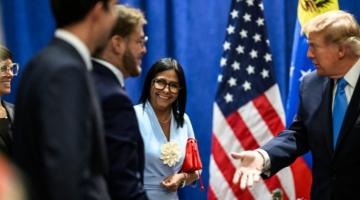 A photograph of Delcy Rodríguez smiling with Donald Trump after the U.S. kidnapped Nicolás Maduro is evidence of subordination to the United States. These images cannot be reconciled with the dignity…
 Imperialist competition and wars that facilitate extractivism have long shaped the use of seaports for access to resources, markets, and devalued labor. In the last decade, countries in the chain of…


