by BAR executive editor Glen Ford
Blacks in the South will probably not vote for Bernie Sanders, although they most resemble the “Scandinavian social democrats” of Sanders dreams. However, Black voters don’t express their politics through the ballot. Rather, “Blacks are drawn into the jaws of the Democratic Party, not by ideological affinity, but in search of protection from the Republicans.” It is the politics of fear.
Vector of Fear: Blacks and the Democratic Party
by BAR executive editor Glen Ford
“The Democratic Party oozes out of every orifice of Black civic society like a stinking pus, transforming every Black social structure and project into a Democratic Party asset.”
Bernie Sanders has succeeded in stalling the Clinton juggernaut in Iowa, and is expecting a resounding victory next week in New Hampshire. However, the euphoria will fade as his supporters confront the likelihood that their quest to transform the Democratic Party “from below” will be derailed in the South by Blacks, who are the decisive bloc, or outright majorities, in the region’s Democratic primaries, and who make up about a quarter of the Party’s support, nationwide. It is a great paradox that the Sanders campaign will almost certainly be rejected by the very voters whose fundamental political leanings are most closely aligned with the “Scandinavian social democratic” model on which Sanders has based his career.
Black voting behavior over the past two generations all but guarantees they will back the national Democratic candidate they perceive as most likely to defeat the Republicans – the “White Man’s Party.” White supremacy and the rule of capital in the U.S. are buttressed, electorally, by two pillars: 1) the bifurcation of the major party system into a White Man’s Party, whose organizing principle is white supremacy, and another party that is somewhat more inclusive of Blacks and other “minorities,” and 2) control of both parties by capital. For Blacks, the Democratic Party is a trap within a trap. If the overarching, perceived necessity is to block the Republican/White Man’s Party at every electoral juncture, then Blacks see no option but to huddle under the Democratic tent, despite the fact that it is, like the Republicans, a Rich Man’s Party.
“Fear turns Black politics on its head.”
It is a politics of fear, born of generations of raw terror at the hands of the White Man’s Party. The modern Democratic Party, like the post-Civil War Republican Party, is not a haven, but an enclosure, which Blacks fear to exit. At root, Black participation in the Democratic Party is not a matter of free allegiance, but the perception that there is no other effective means to hold back the barbarians of the White Man’s Party.
In practice, it is institutionalized group panic, a stampede every four years. Blacks are drawn into the jaws of the Democratic Party, not by ideological affinity, but in search of protection from the Republicans. This is an entirely different dynamic than an alignment based on thoughtful examination of political platforms. It’s not about picking a candidate or party that sees the world as most Black people do, from the left side of the spectrum, on matters of social justice and peace. Rather, the overarching objective is to choose a candidate from the Democratic wing of the Rich Man’s duopoly who is best equipped to defeat his or her Republican counterpart. Under these stilted circumstances, the Democratic candidate’s actual political positions become near-irrelevant to the Black primary voter, compared to the candidate’s perceived ability to win a national election. The question becomes, is the Democrat strong enough to beat back the latest offensive from the GOP? – which Black people perceive as an existential threat. In the grip of that mindset, the contestant that is richer, better connected to the party apparatus and more acceptable to masses of white voters is the better Black choice.
“The modern Democratic Party is not a haven, but an enclosure, which Blacks fear to exit.”
When the voter is seeking protection from what is seen as the greater, more racist evil, rather than searching for a candidate and party that takes positions more aligned with the Black political world view, independent politics goes out the window. Indeed, independent, leftist electoral campaigns can be viewed as a going AWOL from the fight, or worse, collaborating with the Republican enemy. Fear turns Black politics on its head. Since Black people are the most left-leaning constituency in the United States, the paradoxical nature of their behavior in national elections renders problematical the whole question of independent Left and Black electoral activity.
In 2008, Black voters did not support Dennis Kucinich, a more genuine social democrat and peace candidate than Bernie Sanders, or John Edwards, who kicked off his campaign in New Orleans and positioned himself significantly to the left of the ideological twins, Hillary Clinton and Barack Obama. About half of Black Democrats did not favor Barack Obama until he won white favor in Iowa, thus proving to Black voters that he could beat the Republicans. Blacks voted for Jesse Jackson in his 1984 and ’88 primary campaigns, but he opted out of an independent run for president, preferring to remain in the role of “power broker” within the Democratic enclosure. It’s not likely that Black voters would have supported Jackson in an independent race, anyway. When Ted Kennedy challenged Jimmy Carter from the Left, in 1980, his effort collapsed largely from lack of support from Black elected officials, who stuck with the Georgia peanut farmer even after he had shown himself to be a deeply conservative politician (a founding “neoliberal”) whose austerity policies opened the door to Ronald Reagan.
“About half of Black Democrats did not favor Barack Obama until he won white favor in Iowa.”
The Black Radical Tradition is real and enduring, but it is not expressed through participation in the Democratic Party. Rather, entrapment in the Democratic Party enclosure (within the larger Rich Man’s duopoly) grotesquely warps Black political behavior. This distortion profoundly diminishes the prospects for progressive electoral activity in the United States. More directly, the Black electoral imperative to seek protection from the Republican/White Man’s Party reduces African Americans to an appendage of the Democratic Party apparatus, and thus of the capitalists that fund and control the Party. It subverts the essentially progressive nature of the Black polity, objectively enfeebling Black America, even as rich white Democrats pander to Black voters as the “soul” of the party.
It is true that the Democrats would collapse were it not for the Black core of the party. It is also probable that that would be a good thing. What is certain is that the Democratic Party oozes out of every orifice of Black civic society like a stinking pus, sapping the self-determinist vitality of the people and transforming every Black social structure and project into a Democratic Party asset.
Black people – massed, organized, and fearless – shook this nation to its bones in the 1960s, before the Democratic Party achieved political hegemony in Black America; when there were less than two handfuls of Black congressional representatives and only some hundreds of Black Democratic officeholders to hold us back. Today, Democratic operatives attempt to smother the incipient Black grassroots movement in their lethal embrace – and some elements of that movement have eagerly hugged them back. The task of Black activists and their allies is to ensure that our first and last hope – movement politics – once again becomes central to the struggle, so that we can, as Dr. Cornel West puts it, “break the back of fear.” This will require the most intense internal struggle among Black Americans to break the chains that bind us to that vector of fear, the Democratic Party.

 "SNAP elections?" is the latest from BAR's Poet-in-Residence.
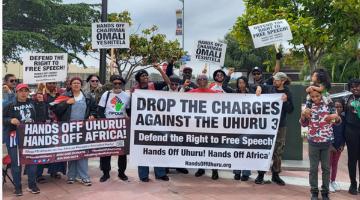 The federal trial of the Uhuru 3 has begun. The egregious charges of being foreign agents don't bode well for the future of free speech and the radical Black movement. However, the movement will…
 The new lithium mining project between Germany and Serbia appears to be part of an ongoing imperialist strategy to compete with China. The Serbian people are rising to reject this project and…
 The options for political representation are bleak - it may be better to say there isn't much of a choice at all. With Kamala Harris as the Democratic nominee, voters may have someone who presents a…
 Liberals are demanding that Black people in the U.S. put aside our long tradition of anti-imperialism to support Kamala Harris and sacrifice Palestine in the process.


