The U.S. is the Worst Kind of Neighbor
 A Black Agenda Radio commentary by Glen Ford
"The United States has repeatedly raped and ravaged Latin
America and the Caribbean."
In 1933, the new administration of Franklin D. Roosevelt
announced its Good Neighbor Policy for the Americas. It was supposed to be a
change from the more than century-old Monroe Doctrine, which treated Latin
America and the Caribbean like the United States' backyard, to do with as
Washington saw fit. President Roosevelt withdrew the Marines from Nicaragua and
Haiti, where they had waged savage wars against the peasants, and abrogated
parts of the 1903 treaty it had imposed on Cuba, by which the U.S. had reserved
the right to intervene whenever it wanted in Cuba's internal affairs.
Roosevelt declared, "The definite policy of the United
States from now on is one opposed to armed intervention." The U.S. Secretary of
State at the time, Cordell Hull, said quite bluntly that "No country has the
right to intervene in the internal or external affairs of others."
Needless to say, the Good Neighbor Policy, such as it was,
did not last long. In the three generations following FDR's death, the United
States has repeatedly raped and ravaged Latin America and the Caribbean,
causing the premature deaths of millions through direct and indirect
intervention. Not one neighbor to the South has been spared. The great success
story in Latin America has been Cuba, an island the U.S. once considered
annexing as a slave territory, but which flipped the historical script on the
racist bully to the North, to become a beacon of independence in the
hemisphere.
Cuba has stretched out her arms to Africa, where its
soldiers held back the armies of the white minority South African regime,
backed by the U.S., to preserve Angolan independence. Twenty-five thousand
Cuban doctors serve in 68
countries around the world, and Cuba's infant mortality rate is lower
than the United States.
"Cuba told Washington to
keep its pocket change."
It is Cuba that has shown what a Good Neighbor Policy really
is, extending its hand even to the people of the vastly wealthier United States,
training young American to become doctors in U.S. inner cities, and offering
millions of dollars in medical personnel and life-saving drugs to New Orleans
in the wake of Hurricane Katrina - an offer the Bush regime rejected.
In the last several weeks, two major hurricanes have slammed
into Cuba, the first, Hurricane Gustav, destroying 100,000 homes. What did the
superpower United States offer its wounded neighbor? A measly $100,000 - and
that only if the pittance would be handled by an aid group of Washington's own
choosing. Cuba, of course, told Washington to keep its pocket change.
Despite Hurricane Gustav hitting with the force of what
former Cuban President Fidel Castro called "an atomic bomb," no
fatalities were reported. Cuban society is organized for self-defense - not
just against the United States, but against the ravages of nature.
In the neighboring nation of Haiti, once again reduced to a
virtual colony of the United States and its minions in the United Nations, many
hundreds have died this hurricane season. Having deposed and kidnapped Haitian
President Jean Bertrand Aristide and systematically destroyed Haitian civil
society, the population is rendered helpless to the elements. That's the kind
of neighbor the United States is: super-petty, mean-spirited,
small-minded and stingy - a blight on the whole hemispheric neighborhood.
For Black Agenda Radio, I'm Glen Ford.
BAR executive editor Glen Ford can be contacted
at Glen.Ford@BlackAgendaReport.com.

 The United Nations occupation of Haiti under MINUSTAH and BINUH brought instability, violence and even cholera to that nation. Signatories of an open letter to Mexico's president Lopez Obrador remind…
 Djibo Sobukwe participated in a Canadian Foreign Policy Institute panel, "NATO and Global Empire" on June 30, 2022. These are his remarks on NATO and Africa.
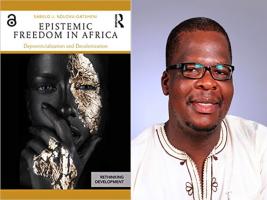 This week’s featured author is Sabelo J. Ndlovu-Gatsheni. Dr. Ndlovu-Gatsheni is Chair of Epistemologies of the Global South, Faculty of Humanities and Social Sciences and Vice-Dean: Research, Africa…
 This week, we interview Courtney Cox. Dr. Courtney M. Cox is an assistant professor in the Department of Indigenous, Race, and Ethnic Studies at the University of Oregon. Her research examines issues…
 The prison system links corporate interests, the military industrial complex, and policing into a web of oppression impacting more than 2 million people in this country. The Mapping Project reports…



