by BAR managing editor Bruce A. Dixon After 8 years of the first black president, it’s time to take stock of what we’ve won and lost, what’s changed and not. Today we look at the Obama administration’s abysmal record on corporate crime, in which Democrats went far beyond the atrocities of their Republican colleagues to protect and immunize corporate thieves from prosecution or lawsuits from their victims.
The Obama Legacy: It’s No Crime For Corporations To Steal From the Public, or the Poor by BAR managing editor Bruce A. Dixon Today we’re going to look for the Obama legacy in how the federal government treats those who steal from the public or from the poor.
The current bankster scam in the news right now is Wells Fargo, whose bosses deliberately incentivized thousands of $12 an hour employees to buckle down and sell connected financial services to customers who did not need or want them in order to keep their jobs or be eligible for promotion. For the record, Wells Fargo is not the only bank to do this, it’s been a standard kind of corrupt bankster move all over the world for decades. Wells Fargo made billions doing it this time alone.
So how do scamming banksters get handled in the age of Obama, and is it any different from what came before?
The answer is that a thousand or two bank workers will be disciplined or fired. For a small fine, a mere fraction of what its executives stole, Wells Fargo got the Obama Justice Department to co-sign on their professed innocence of any crime and to guarantee their immunity to lawsuits filed by the people they robbed.
Obama’s first attorney general famously declared the banksters too big to prosecute or even investigate, and his second attorney general wrote the fine print on the similar “get out of jail free” and the “can’t be sued by the people I robbed” cards Goldman Sachs, Bank of America, and of course Wells Fargo received in 2008-09. It wasn’t always this way. When savings and loan officials scammed the public out of billions during the first Bush administration, federal prosecutors put a couple thousand of them in prison. Obama could have done, and was expected by millions of his voters to do the same. He simply chose not to, which helped Democrats lose the Congress in 2010. In 8 years Democrat Barack Obama has gone further to protect criminal banksters and their investors than any Republican dared go before him.
Take a quick look at the Obama administration’s handling another kind of theft from the poor, wage theft.
Economist Richard Wolff estimates the yearly value of wages which employers refuse to pay, illegally withhold or otherwise steal from their workers in this country at several times the value of all the reported burglaries and armed robberies. Employers traditionally are not prosecuted, and in Los Angeles it’s reported that 83% of workers who WIN a case filed for stolen wages against an employer never recover a cent. Wage theft seems to be an area where little has changed. Previous administrations never bothered themselves about it, and neither did the Obama administration.
Finally not even the briefest of Barack Obama legacy on elite financial crime is incomplete without noting the president’s role in the massive expansion of the charter school racket. The Obama administration spent $4 billion in federal stimulus money outside any congressional or other oversight to incentivize the closing of thousands of so-called “underperforming public schools” mostly in black and poor communities. The near-complete absence of public accountability on the part of charter schools predictably ushered in a nationwide white collar crime wave, as charter school operators, their officers, contractors and their sugar daddy investors scrambled for shares of the cash that used to go to public education.
Thus the past 8 years reveal the definitive Obama legacy on elite financial crime. It’s not just too big to jail. It’s simply not punishable, or even investigatable as long as you steal from the poor or from the public.
For Black Agenda Radio, I’m Bruce Dixon. Find us on the web at www.blackagendareport.com .
Bruce A. Dixon is managing editor at Black Agenda Report, and the co-chair of the GA Green Party. He lives and works near Marietta Ga, and can be reached at bruce.dixon@blackagendareport.com.

 Statement on the Funeral of Ayatollah Seyyed Ali Khamenei by the General Secretary, Booker Omole, Communist Party Marxist Kenya.
 Gerald Horne joins editor Margaret Kimberley in analyzing his 2014 book, “The Counter-Revolution of 1776: Slave Resistance and the Origins of the United States of America.”
 In this week’s segment, we hear analysis of the situation in Cuba, which is struggling under a U.S. siege meant to undo the revolution. Yet Cuba is resolute in its determination to enact its own…
 Dr. Jemima Pierre is an editor and contributor to Black Agenda Report and a professor at the University of British Columbia in Vancouver. She joins BAR editor Margaret Kimberley to discuss the…
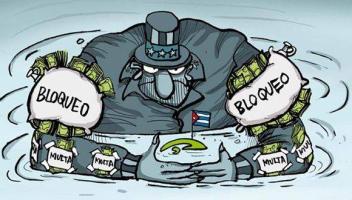 James Counts Early joins Black Agenda Report editor Margaret Kimberley to discuss the latest U.S. efforts to undo the Cuban Revolution and Cuba’s determination to retain its sovereignty while under…


