A Black Agenda Radio commentary by executive editor Glen Ford The Lords of Capital learned a great deal from the aftermath of Hurricane Katrina. They learned that the Black Misleadership Class was incapable of organizing resistance to even the most public crimes committed against the Black poor. Not only could African Americans be removed en mass from valuable urban property with no push-back from the Black political class, but many of them would join in celebrating the catastrophe as a “renaissance.”
Katrina and Other Catastrophes A Black Agenda Radio commentary by executive editor Glen Ford “ The New Orleans model has gone national.”
Eleven years ago this week, Hurricane Katrina flooded 80 percent of New Orleans, killing at least 1,200 people – although no one will ever know the actual death toll because most of the victims were Black and poor and, therefore, were never considered important enough to count .
What was important to the rulers of this country, in the aftermath of Katrina, was making sure that as many as possible of the displaced Black residents would not be allowed to return to the city. Before the waters had fully subsided, corporate planners were exulting in the opportunity to build a new New Orleans, a much whiter and richer metropolis. Katrina had ethnically cleansed the city -- permanently exiling 100,000 Blacks -- and the Lords of Capital could not contain their jubilation. What Blacks experienced as catastrophe was celebrated as a renaissance.
Katrina was a godsend for Disaster Capitalism, and provided a model for capitalists to create future disasters for Black people. President Obama’s secretary of education, Arne Duncan, said Katrina was “the best thing that happened to the education system in New Orleans" because it allowed school privatizers to fire all of the city’s teachers, 71 percent of them Black , and turn most of the schools into charters. Instead of firing Duncan for his outrageously callous and deeply racist remarks, President Obama joined in praising the so-called “recovery” of a city that had shed about a third of its Black population and was on the way to becoming the nation’s first all-charter school system. Over the next several years, Obama’s Race to the Top program would coerce states to create a “market” for charter schools or face the loss of federal education funds. Katrina paved the way to a catastrophe for public education, nationwide.
Black Caucus Muzzled, Easily
During the last weeks of the summer of 2005, when the magnitude of the disaster became apparent, it seemed that almost every Black community organization responded with some kind of Katrina support program. But, there was no political response from the Congressional Black Caucus, in Washington. The Democratic Party hoped to regain control of the House of Representatives in the 2006 elections, and Democratic Leader Nancy Pelosi didn’t want the Party to appear too pro-Black. She ordered her members to boycott the Republicans’ hearings on Katrina, and Democrats held no hearings of their own. In the face of what was then the greatest Black catastrophe of the 21st century, the Congressional Black Caucus allowed itself to be muzzled.
The Black political class’s abject failure to respond to Katrina guaranteed that there would be more catastrophes for Black folks. The Lords of Capital realized that, if they could get away with massive ethnic cleansing in New Orleans, while the whole world was watching, they could ratchet up the speed of gentrification and Black removal all across the country. Soon, half of the Black citizens of Michigan were disenfranchised by an emergency financial manager regime that took over all of the state’s heavily Black cities. The New Orleans model has gone national, because the rulers of this country know that they don’t need a storm to drive Black folks from the cities – and that there will be no resistance from a selfish, useless Black Misleadership Class .
For Black Agenda Radio, I’m Glen Ford. On the web, go to BlackAgendaReport.com.

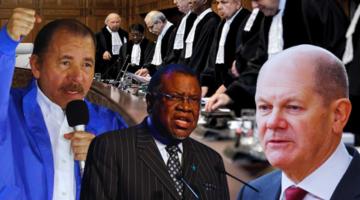 The Palestinian fight against colonialism is recognized by nations in the global south as one that mirrors their own. Solidarity and cooperation among the colonized must continue to grow on the…
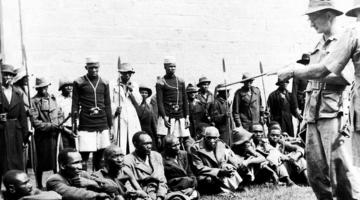 The British sought to cover up their atrocities in Africa and the Caribbean by manipulating information to obfuscate history.
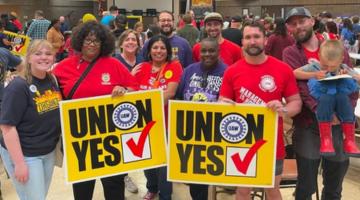 The vote by Volkswagon workers in Tenessee to unionize with the United Auto Workers union is a clear indication that it is possible to organize in the South.
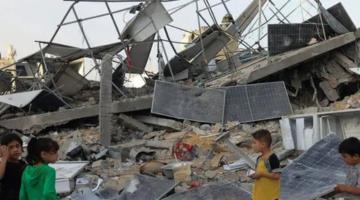 The destruction of the environment and acceleration of the climate crisis happen silently under the veil of “national security,” despite the fact that the environmental toll of war is the most…
 This week we discuss the proliferation of lies about non-citizen voting and U.S. policy toward Niger. First, we talk to Danny Haiphong about U.S. policy toward China and what we can learn from…


