A Black Agenda Radio Commentary by Bruce A. Dixon
Back when there used to be something like a black middle class, a lot of them were postal workers. Black postal workers were leaders in every struggle of the historic Freedom Movement, and the backbone of civic activism in African American communities everywhere, and played a crucial role in making the careers of black politicians possible. So why isn't the black political class disposed to defend the postal service?
Black Political Class Could Pick A Fight Over Postal Service Privatization --- But Won't. Why?
A Black Agenda Radio Commentary by Bruce A. Dixon
Twenty, forty and sixty years ago, a job at the Post Office was, for African Americans, the ticket to something like middle class stability. Since people with steady and well-paid work, who don't have have long commutes were more able to participate in community-building and sustaining activities black postal workers were well-represented in a wide range of civic, voluntary and political organizations from the 1940s clear to the end of the 20th century.
As an activist and organizer in Chicago of the 70s and 80s, I learned countless lessons from postal workers who took the lead in struggles against police brutality, for fair housing and opposition to Chicago's long running municipal dictators, the Daley regime. When I moved to Atlanta at the end of 2000, I learned about another postal worker, John Wesley Dobbs who used to be called the mayor of Auburn Avenue, and was so well known that you could mail a letter from overseas addressed to “John Wesley Dobbs, USA” and he would receive it.
It was predictable that when, in the 1980s, public policy took a turn against steady jobs at good wages, to force more and more Americans, particularly African Americans into less and less secure jobs at lower and lower wages, at the same time it vastly expanded the prison state and made welfare as scarce and punitive as possible, that the Postal Service, a monopoly enshrined in the Constitution itself, became a target for privatizers.
In the eighties, nineties and the new century, Democrats and Republicans in Congress and successive White Houses passed special legislation and rules that restricted the postal service while enabling UPS and Federal Express to take some of its most lucrative traffic. Massachusetts liberal Democrat Ted Kennedy took the lead in passing regulation specifically crafted to make unionization impossible at FedEx. The death blow to the postal service may have been struck during the Bush administration, when Congress saddled the postal service with the absurd requirement to fully fund all pensions seventy years in advance, for workers yet unborn. It's the end game now, with greedy privatizers like the husband of Senator Diane Feinstein and others snatching inner-city properties the postal service is forced to sell far below their value to fulfill its legal directive to self-destruct.
Barack Obama doesn't have a majority in Congress. His favorite President Ronald Reagan never had one either, but it rarely stopped the old bastard from picking the fights he wanted to win, and often winning them....
Still, I keep wondering when I'll hear members of our current black political class speak up for the postal service and those good jobs postal workers had that made them the bedrock of black communities and civic activism everywhere. I wonder why they haven't organized forums and conferences and petitions and mass meetings to preserve the last of what used to be the good jobs that made them a potent leading force in African American communities across the country, and even made some of their own careers possible.
Barack Obama doesn't have a majority in Congress. His favorite President Ronald Reagan never had one either, but it rarely stopped the old bastard from picking the fights he wanted to win, and often winning them. The American people as a whole DO reject privatization any time they're polled on it. That's why the Obama regime and its collaborators dare not call what they're doing to public education or the broadcast spectrum “privatization.”
The fight to halt the privatization of the postal service is certainly one the black political class, with or without the president could pick and possibly win, or at least slow down and delay for years. But fighting for good jobs for ordinary people just isn't our current black political leadership. No doubt John Wesley Dobbs and the postal workers I used to know in the 70s and 80s, are rolling over in their graves.
For Black Agenda Report, I'm Bruce Dixon. Find us on the web at www.blackagendareport.com .
Bruce A. Dixon is managing editor at Black Agenda Report, and a state committee member of the GA Green Party. He lives and works near Marietta GA, and can be reached via this site's contact page or at bruce.dixon(at)blackagendareport.com.

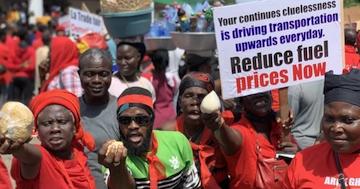 The 2001 Dakar Manifesto had a simple but unassailable claim: the total and unconditional cancellation of the odious African debt.
 Food production in Africa is complicated by climate change and the use of fertilizers which increase food production but which also create green house gases and create other environmental harm.
 …
… Onyesonwu Chatoyer of the All-African People's Revolutionary Party and BAR Book Forum Editor Roberto Sirvent discuss how "We Can Save Ourselves."
 This week’s featured scholar is Ayodeji Ogunnaike. Ogunnaike is an assistant professor at Bowdoin College where he teaches interdisciplinary courses on Africa and the African Diaspora highlighting…


