A Black Agenda Radio Commentary by BAR managing editor Bruce A. Dixon
Chicago, the city the president and his secretary of education hail from, has been the laboratory of corporate education reform and privatization. Among its “innovations” are the mass closings of public schools, and handing over entire schools to the army, the navy and the marines.
End Game For Corporate School Reform: Privatized Holding Tanks, Remote Ed, Military Charter Schools
A Black Agenda Radio Commentary by BAR managing editor Bruce A. Dixon
Doug Henwood, a radical economist and founder of Left Business Observer, says it as succinctly as anyone when he sums up the goal of bipartisan corporate education reform imposed on poorer neighborhoods as “...low cost privatized holding tanks leading to McDonalds jobs for the lucky, or to prison for the not so lucky...” along with classes delivered by computers rather than unionized teachers. But as useful as this summation is, it leaves out one element worth noting. You can't run a global empire without a military class, any more than you can run a prison without prison guards.
So in Chicago, widely touted as a laboratory of educational innovation, mostly because its current mayor, President Obama's former chief of staff holds dictatorial power over its public schools, one of the showpieces of education reform has been the handing over of entire high schools and even middle schools to the army, the navy and the marine corps.
Before the era of corporate reform there was at least one achievement of genuine small d democratic education reform pushed through by the administration of Chicago mayor Harold Washington in the 1980s. Since then parents in every public school have been allowed to elect parent councils, with reps from among rank and file teachers, which have veto power over title one funds and principal's contracts, which are limited to two years. The “innovative” answer of downtown bureaucrats, corporate elites and subsequent mayors to parents taking a hand in running the schools has been to simply close Chicago public schools and replace them with charters over which parents have no say.
This year, Chicago closed more public schools than any other school district in a single year in the nation's history. None were charter schools. This week Chicago Mayor Rahm Emanuel announced he was moving the middle school which had earlier been given to the marine corps into the facility of a fully functioning neighborhood school, Ames Middle School.
The fact that Ames parents and community members had testified, had met with officials and overwhelmingly rejected the closing of their school meant less than nothing, and may even have contributed the replacement of their school by a military academy. What mayor, and what alderman really wants organized parents running their own neighborhood institutions? It's bad for business if you're a privatizer, or a politician who takes cues and campaign contributions from privatizers. And ultimately habits of local democracy are bad for empire.
What Chicago, and corporate education reformers and privatizers and their contractors nationwide want, as Henwood observes, are low-cost holding tanks to funnel the well-behaved into low-wage precarious labor for the lucky and jail for the unlucky. They want distance education and computerized instruction because these are cheaper than human, potentially unionized teachers. And to Henwood's list we should add, they want a sprinkling of military charter schools. After all, you can't run an empire without soldiers, or a prison without guards.
For Black Agenda Radio, I'm Bruce Dixon. Find us on the web at www.blackagendareport.com .
Bruce A. Dixon is managing editor at Black Agenda Report and a state committee member of the Georgia Green Party. Contact him via this site's contact page, or at bruce.dixon(at)blackagendareport.com.

 BLM National Leadership Focused on Money and Careers
 “The mixed Black figure, the mulatta” is “a central focus of containing and managing Blackness and upholding whiteness” in both Brazil and the United States, said Jasmine Mitchell,
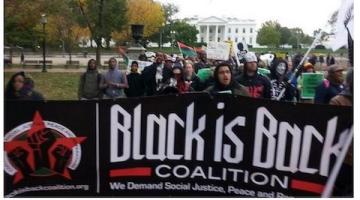 “The struggle has to be more than simply a declaration of our significance as human beings, as in the term ‘Black Lives Matter,’” said Omali Yeshitela, chairman of the Black Is Bac
 Breya Johnson, co-chair of Black Youth Project 100 (BYP100) in Washington, DC, said her organization enjoys a “working relationship” with the local Black Lives Matter chapter, but
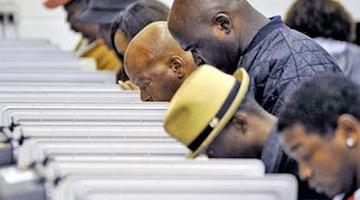 A significant portion of Black males are “contrarians” that take positions at odds with the general Black political consensus – while Black women tend to take the communal approach.



