A Black Agenda Radio commentary by Glen Ford
The arrangement whereby whites surrendered political control of South Africa, while continuing to dominate the economy, has become indefensible. “Workers seeking to organize outside the government-sanctioned unions are hunted down and prosecuted under spurious charges, physically tortured and vilified as enemies of the state.”
A “Triple” Betrayal in South Africa
A Black Agenda Radio commentary by Glen Ford
“South Africa cannot forever put off the revolution that was left unfinished 18 years ago.”
Since the transition to Black political rule, in 1994, South Africa has been governed by the African National Congress and its partners in the so-called Triple Alliance: the Congress of South African Trade Unions, or COSATU, and the South African Communist Party. It is a complicated and sometimes incestuous alliance, in which membership in the various legs of the triangle is often intertwined. And it is a relationship riddled with contradictions, the most fundamental of which now threaten to plunge South African society into a long night of bloody conflict.
In recent months, about 100,000 mineworkers have found themselves in deadly confrontation, not just with foreign-owned management, but with the South African state; with their own COSATU unions that are aligned with the South African state; and with a Communist Party that behaves as if it is part of the state. The mine workers, who thought the South African struggle had been waged for the benefit of people like themselves, have discovered there is no one to protect their interests, or even their very lives. Last August’s police massacre of 34 striking mine workers, at Marikana, showed that South Africa cannot forever put off the revolution that was left unfinished 18 years ago.
It is infinitely sad to hear Black South African union officials urge police to treat mine workers as “criminals” for demanding a living wage. It is bizarre in the extreme to hear high officials in a party that claims to be communist
“This damnable arrangement benefits a small class of new Black millionaires whose fortunes are tied to white multinational capital.”
Late last month, in Rustenburg, police fired rubber bullets and live ammunition to disperse
But the mineworkers know something about class warfare and class betrayal. They have seen that their unions, under COSATU, are aligned with a government whose main priority is to keep foreign investors happy, and that will sacrifice the mine workers living standards, their freedoms, and their blood, to keep the system just as it is. And they know that this damnable arrangement benefits a small class of new Black millionaires whose fortunes are tied to white multinational capital.
The great tragedy is that COSATU, the Communist Party and the African National Congress are so deeply embedded in the political culture of South Africa, that it will take a gargantuan struggle to pry loose that which has been hopelessly corrupted and to preserve those legacies worht salvaging. In the process, it seems inevitable that many thousands of Black South Africans will die.
For Black Agenda Radio, I’m Glen Ford. On the web, go to BlackAgendaReport.com.
BAR executive editor Glen Ford can be contacted at Glen.Ford@BlackAgendaReport.com .

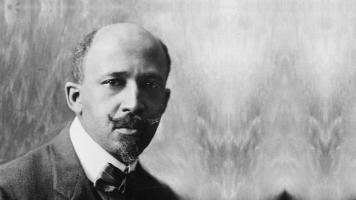 As the European-initiated World War I raged, W. E. B. DuBois reminded us about the destructive nature of the “culture of white folk.” It is a reminder sorely needed today.
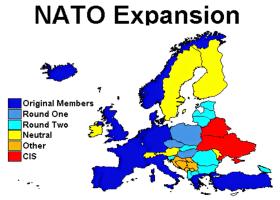 The end of the cold war was the beginning of the America unipolar moment.
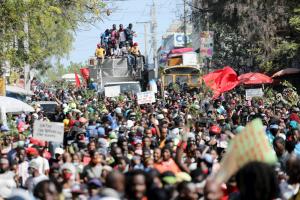 The garment workers' strike in Haiti can't be separated from that nation's history. Continued US interference on behalf of oligarchic rule keeps workers in poverty.
 The Black Alliance for Peace emphatically declares that the conflict in the Ukraine emerges from the ceaseless and single-minded drive of the U.S., NATO, and the European Union for global economic…
 In this series, we ask acclaimed authors to answer five questions about their book.


