A Black Agenda Radio commentary by Glen Ford
The U.S. is stalking Africa like an imperial predator. Eritrea is on the short list of who’s going to be attacked next. Eritrea, says the U.S., creates instability. However, “it is not little Eritrea that is destabilizing the Horn of Africa, but the United States, which has made the region a front line in its so-called War on Terror.”
Where Will the U.S. Strike Next in Africa?
A Black Agenda Radio commentary by Glen Ford
“Eritrea’s real sin is to be one of the very few nations in Africa that do not have military relations with AFRICOM, the U.S. war machine.”
Under the direction of the United States, the UN Security Council recently extended sanctions for another year against the northeast African nation of Eritrea. The country of 6 million people, nestled against the Red Sea, is on America’s hit list. In the imperial double-speak of Washington, Eritrea is described as a “destabilizing” force in the region – which simply means the government in Asmara has refused to buckle under to U.S. military domination of the Horn of Africa.
Back in 2009, Secretary of State Hillary Clinton threatened to “take action
The monitors, who are, in effect, tools of U.S. policy, reported that they found “no evidence
“In the imperial double-speak of Washington, Eritrea is described as a ‘destabilizing’ force in the region.”
It is, of course, not little Eritrea that is destabilizing the Horn of Africa, but the United States, which has made the region a front line in its so-called War on Terror. Washington's closest ally in the neighborhood is Ethiopia, from which Eritrea won its independence in 1993 invaded Somalia bankrolls, arms and trains
And there sits Eritrea, surrounded by warring American puppets, interfering in no one’s affairs, yet determined to defend her sovereignty – accused by the world biggest and most aggressive power of destabilizing the region.
Eritrea’s real sin is to be one of the very few nations in Africa that do not have military relations with AFRICOM, the U.S. war machine. That puts a bulls-eye on her back, along with Zimbabwe and Sudan, which U.S. Ambassador to the UN Susan Rice demanded be blockaded and bombed back in the George Bush administration. Barack Obama’s Africa policy is an extension and expansion of Bush’s aim to militarize the continent, and the much older U.S. policy to create chaos and horrific human suffering in those regions it cannot directly control. In practice, Obama’s doctrine is the same as Bush: “You are either with us or against us.”
Eritrea rejects that doctrine; that’s why it is a target. For Black Agenda Radio, I’m Glen Ford. On the web, go to BlackAgendaReport.com.
BAR executive editor Glen Ford can be contacted at Glen.Ford@BlackAgendaReport.com .

 The celebration of Black political representation in U.S. cities and states obscures that these officials often function as a comprador class that manages and legitimizes neoliberal governance and…
 In this week’s segment, we have an analysis from a Florida-based commentator on the victory of a Black republican gubernatorial candidate in that state, which, unlike others in this pivotal year,…
 Pascal Robert is a writer, political commentator, and co-host of the This Is Revolution podcast. He joins us from Miami, Florida, to talk about Byron Donalds victory in the governor’s race in that…
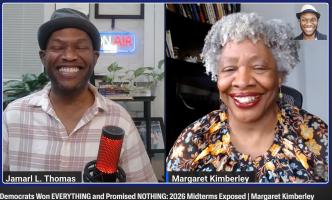 BAR Executive Editor and Senior Columnist, Margaret Kimberley, analyzes the 2026 midterm election with Jamarl Thomas.
 The Black Agenda Report celebrated its 20th anniversary on November 7, 2026, at Arnhold Hall at The New School in New York City, hosted by its School of Media Studies.



