A Black Agenda Radio commentary by Glen Ford
Americans want to believe their president when he poses as a humanitarian world leader. But Africa knows different. Literally millions have died and been displaced as a direct result of U.S. imperial strategies. “American policy in Africa is to create chaos, and then to present itself as the cure.”
Far from a Humanitarian Savior, the U.S. Causes Vast Misery In Africa
A Black Agenda Radio commentary by Glen Ford
“The United States is the main vector of mass carnage and misery, from Somalia to Libya to Congo and so many points in between.”
The United States has finally made a token effort towards reining in its central African client state, Rwanda, whose destabilization of neighboring Congo has contributed to the deaths of six million people over the past 16 years. A United Nations panel charged that Rwanda has been supporting a Tutsi tribal rebel group in Congo. Rwanda and another U.S. puppet regime, Uganda, have profited enormously from stealing the mineral resources 1.7 million Congolese remained homeless
Bowing ever so slightly to world opinion, Washington announced that it would cut military assistance to Rwanda. As it turns out, the only money the U.S. is withholding is for an academy for Rwandan non-commissioned officers – a measly $200,000 out of a total Rwandan aid package of $528 million. The gesture is an insult to the millions of Congolese who have been killed or displaced by the U.S. and its Rwandan and Ugandan mercenaries.
The United Nations Refugee Agency reports that the number of Somalis forced to leave their country has reached the one million mark Afghanistan Iraq Colombia
“The number of Somalis forced to leave their country has reached the one million mark.”
The U.S. dragged Somalia into hell in December of 2006, when it funded and armed an Ethiopia invasion of the country. Tens of thousands were killed outright, and Somalia was robbed of a chance to build peace under a moderately Islamist government. In the capital city, Mogadishu, alone, nearly two million people were forced from their homes, and soon the United Nations declared Somalia “the worst humanitarian crisis in Africa.”
In the ensuing five years, the United States methodically attempted to starve out the Somali Shabaab resistance forces, so that when the worst drought in 60 years struck the region, last year, mass deaths were inevitable. By now, the U.S. had ensnared most of Somalia’s neighbors in its war – Kenya, Ethiopia, and Djibouti, a whole region in flames – in order to facilitate an expansion of U.S. military influence in the region.
Far from playing a humanitarian role in Africa, the United States is the main vector of mass carnage and misery, from Somalia to Libya to Congo and so many points in between. American policy in Africa is to create chaos, and then to present itself as the cure. Economically, the U.S. offers nothing to Africa, except rigged deals and endless debt. Years ago, China eclipsed the U.S. as a trading partner, and now offers Africa more and better quality foreign aid than the Americans. Unable to compete on a level laying field, Washington exports death to Africa, in the form of weapons systems and Green Berets. There is nothing good that the United States can do for Africa, but leave.
For Black Agenda Radio, I’m Glen Ford. On the web, go to BlackAgendaReport.com.
BAR executive editor Glen Ford can be contacted at Glen.Ford@BlackAgendaReport.com .

 Keisha Lindsay: Questions about black all male schools; Chris Duran & Concerned 44 demand reform of African Studies at Seton Hal; Zayid Muhammad of Newark Concerned Communites on documenting po
 US presidents may seem different from one another, in terms of rhetoric, “but they all have in common being committed to empire,” said Anthony DiMaggio,a political scientist a
 Zayid Muhammad, of Newark Communities for Accountable Policing, was pleasantly surprised at the scope of a NJ Advanced Media report on police use of force in every city and town in
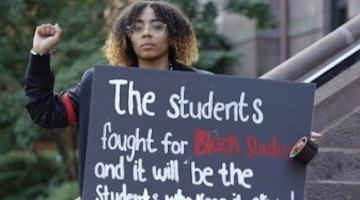 Students with the Concerned 44 movement, representing the 44 percent of students that are ethnic or gender minorities, plan to renew their protests after the holidays at Seton Hall University, said
 The movement for all-male Black schools is both “good and bad,” said Keisha Lindsay, author of In a Classroom of Their Own.



