A Black Agenda Radio commentary by Glen Ford
In refusing to even consider nationalizing the mining industry, South Africa’s ruling party, the African National Congress, has all but repudiated its most solemn (and fundamentally socialist) document: the Freedom Charter. Created and endorsed by a people’s movement in 1955, the Charter calls for national ownership of minerals, but the ANC government vows that will never happen. Under nominal Black rule, the “ANC has transformed itself into a handmaiden of multinational capital.”
South Africa Buries Its Freedom Charter
A Black Agenda Radio commentary by Glen Ford
“South African President Jacob Zuma closed the book on the Freedom Charter’s promise to nationalize the mining industry.”
In 1955, the African National Congress of South Africa sent 50,000 activists into communities around the country to ask the people what kind of freedom they wanted. The result was the ANC’s Freedom Charter
Two key provisions of the Freedom Charter were especially troubling to multinational corporations. The first declared that “The land shall be shared by those who work it,” meaning redistribution of farmland. The other proclaimed: “The mineral wealth beneath the soil, the banks and the monopoly industry shall be transferred to the people as a whole.” The Freedom Charter, which sprang directly from the aspirations of South Africans, and was endorsed by nearly 3,000 delegates at a Congress of the People, was a socialist document.
Through the long night of white rule, the words of the Freedom Charter shouted to the world that South Africa’s revolution would be a thoroughgoing break – not just with racial apartheid, but with systems of exploitation of man by man. The South African people and nation “as a whole” would reclaim their resources.
This month, South African President Jacob Zuma closed the book
“The African National Congress has assigned itself the task of chief protector of corporate rule over South Africa’s mineral wealth.”
Zuma left no doubt as to his position, in order not to upset world “markets” – meaning, the international networks of rich, mainly white men who have effectively ruled South Africa both before and since Nelson Mandela won the first multi-racial elections, in 1994. President Zuma’s underlings and advisors were even more adamant that the corporate mine owners’ property rights were sacrosanct. His Minister of Minerals Resource, Susan Shabangu, declared last year , the African National Congress has assigned itself the task of chief protector of corporate rule over South Africa’s mineral wealth – apparently, in perpetuity.
The same goes for the Freedom Charter’s promise of land to the Black farmworkers. When Nelson Mandela came to power, whites owned nearly 90 percent of the arable land. Since then, only seven percent of farmland has been redistributed, and much of that is not being worked because Black farmers lack money and equipment. The ANC government, which takes its land reform cues from the World Bank, thinks it may be able to redistribute 30 percent of the land by the year 2025 – but, at this rate, even that modest goal is doubtful
The ANC has transformed itself into a handmaiden of multinational capital. Its program of Black capitalism has served only to graft a corrupt Black political class onto the already existing structures of corporate rule. The Freedom Charter is a dead letter. Instead, Nelson Mandela's face, it was recently announced, will appear on every banknote
For Black Agenda Radio, I’m Glen Ford. On the web, go to BlackAgendaReport.com.
BAR executive editor Glen Ford can be contacted at Glen.Ford@BlackAgendaReport.com .

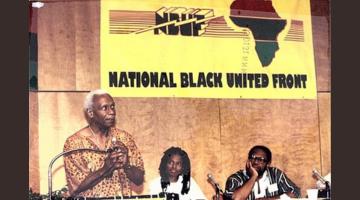 African people in the U.S. must consolidate their myriad organizations into a united front. A U.S. revolution is impossible without first building local alliances among Black radical organizations…
 Israel's election produced no real alternative for Palestinians, because every Zionist party from Eisenkot's Yashar to Golan's Democrats shares the same commitment to apartheid, occupation, and…
 Armed opposition groups have failed to make gains as the capital, Addis Ababa, remains firmly under government control.
 The collapse in support for the UN resolution against the U.S. blockade of Cuba reflects Washington's aggressive diplomatic pressure and blackmail on Latin American governments rather than any…
 Washington signed agreements for Congo's copper and cobalt while Ebola spread across 67 health zones and medical workers went unpaid for their hazardous labor.



