"Whatever [President] Barack Obama spends on people's needs will take a back seat to propping up the corporate sector, and feeding the all-devouring military industrial complex."
The Post-Election Struggle to Come
A Black Agenda Radio commentary by Glen Ford
We're sorry, but the audio for this commentary is no longer available.
"All of Obama's economic advisors, the ones that count, are steeped in the corporate culture: organized theft."
The election is now upon us. Barring massive theft - and only a fool thinks the Republicans will not steal as massively as they possibly can - it appears Barack Obama will be the next President of the United States. There is something that is much more certain than Obama's election, and that is, that the current economic crisis will deepen, punctuated with increasingly frequent upheavals as the capitalist system convulses in the throes of insurmountable contradictions. And there is another certainty: that Barack Obama will respond to these convulsions as his corporate friends and backers demand. He will try to do something about rebuilding U.S. infrastructure, but not necessarily in ways that benefit the inner cities, and certainly not in ways that clash with corporate plans for urban America - plans that reserve little space for populations that presently live there. And whatever Barack Obama spends on people's needs will take a back seat to propping up the corporate sector, and feeding the all-devouring military industrial complex.
We know this is true, because Obama has already shown it to be so. The bailout of Wall Street, which he embraced instantaneously, is but the first of many demands that will be made on the national treasury. All of Obama's economic advisors, the ones that count, are steeped in the corporate culture: organized theft. They serve government in order to serve their class. Obama picked them, so there is no reason to doubt he will follow their advice. Which means every economic measure they undertake will be geared to corporate health, not popular welfare. They will build barricades to preserve what is left of the corporate order, but it will never be enough to withstand the shocks that are in store. And the people will wind up with little to nothing.
"Whatever Barack Obama spends on people's needs will take a back seat to propping up the corporate sector."
What the bankers don't get, the military will. Obama has not only committed to maintaining the current structures of the U.S. Armed Forces, but to expanding the "boots on the ground" by 92,000 soldiers and Marines. These troops will have to be sent somewhere, requiring new overseas facilities, a whole new generation of equipment, and increases in salaries and benefits to keep the recruits coming. But most of all, the new administration will face tremendous pressures to deploy forces to project military power where U.S. economic power is no longer decisive - and that will mean a lot of foreign destinations in the coming months and years. Before the crisis of finance capital hit, the military was already strangling the nation's ability to meet human needs. Only a fundamental break with militarism can halt this spiral into bankruptcy and war. But nothing in Barack Obama's background offers any evidence he is capable of making that break.
No, the American people are not doomed, because they will fight back, as people always do. But that bleak struggle will take place under very different direction than today's so-called Black and progressive "leadership," most of whom are hopelessly wedded to Obama. They claim they will take up the people's cause, after the election. But nobody should believe them. Cynthia McKinney and Rosa Clemente, of the Green Party, will be there, part of the new leadership to replace those who capitulated to Obama. Elections come and go. Struggle is a constant.
For Black Agenda Radio, I'm Glen Ford.
BAR executive editor Glen Ford can be contacted at Glen.Ford@BlackAgendaReport.com.

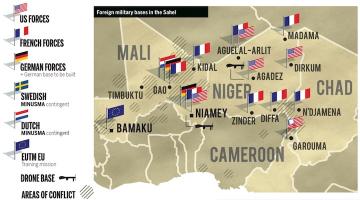 To justify US and European military occupation of much of Africa, migrants seeking jobs in the north of the continent or in Europe “are labeled as criminals and terrorists” when they are “just look
 At a webinar last week, Jericho Movement chairperson Jihad Abdulmumit said the Black Is Back Coalition’s National Black Political Agenda for Self-Determination “covers everything,
 Community control of police advocates in the Washington, DC region say their approach is the best -- and most democratic – way to achieve both defunding and total abolition of policing as it exists
 Biden rules like Trump regarding Venezuela, Iran, Iraq, Syria, Palestine and Haiti, because the two imperial parties serve the same masters.
 Scant attention has been placed on the context of anti-Asian racism and its roots in the history of U.S. imperialism.



