We're sorry, but the audio for this BA Radio commentary is no longer available.
Employee Choice Act is a Black Power Issue
A Black Agenda Radio commentary by Glen Ford
"African Americans comprised one out of five union members in the United States."
The battle over which sectors of society will be rescued from the unfolding crisis of capitalism, has so far been totally one-sided: the rich have already secured their open-ended bailout, which will result in the transfer of trillions in national wealth into the pockets of the very same people that caused the catastrophe. Far smaller sums of money will doubtless be targeted to so-called "Main Street" relief and rebuilding of national "infrastructure" - but, especially under the heading of infrastructure, much of the spending will still wind up in the hands of corporations, whose business plans will determine the quantity and quality of jobs created and profits extracted. The political complexion of Barack Obama's cast of economic advisors makes it all but certain that his administration will avoid any restructuring of power relationships as a response to the economic collapse. There is no evidence that Barack Obama will be another Franklin Roosevelt.
In the final analysis, it is changes in power relationships that determine who emerges from this crisis with a stronger hand. In strategic, real-power terms, possibly the most important measure on Barack Obama's menu for early action, is the Employee Free Choice Act, which organized labor believes would add five million new union members to the rolls over five years. At present, unions represent only 16 million workers, many of them public employees. In the private sector, only 7.5 percent of workers are unionized, the result of decades of unrelenting Republican assaults on the right to organize and backstabbing by corporate Democrats eager to declare an end to the class struggle.
The Employee Free Choice Act would require companies to recognize a union as soon as a majority of the workforce signed a union card, and to move immediately towards a contract. If negotiations were unsuccessful, a federal arbitrator would step in and impose a contract. As things stand now, even after workers win the right to a union, about one-third of the time the effort fails to lead to a contract.
"When workers have unions, each group strengthens the other, rather than undercutting each other's wages."
The Employee Free Choice Act passed the U.S. House in 2007, but was killed by a filibuster threat in the Senate. Democrats will almost certainly not have a filibuster-proof 60-vote majority in the Senate, in January - but let the Republican try to talk it to death. There is no reason to cave in without a fight, not on such a fundamental issue as the right to effectively organize - which is a human right.
Labor power is people's power, and that also means Black people's power. At least until the last recession, African Americans comprised one out of five union members in the United States. Since then, a disproportionate share of Blacks have lost their good-paying jobs in the manufacturing sector, stripping unions of their most militant members.
African Americans also have a vested interest in unionization of the growing Latino workforce, whose members are second only to Blacks in union militancy. When workers have unions, each group strengthens the other, rather than undercutting each other's wages. Union power outlasts presidential administrations, and is capable of making change on its own. It is, to paraphrase the TV commercial, "priceless."
For Black Agenda Radio, I'm Glen Ford.
BAR executive editor Glen Ford can be contacted at Glen.Ford@BlackAgendaReport.com.

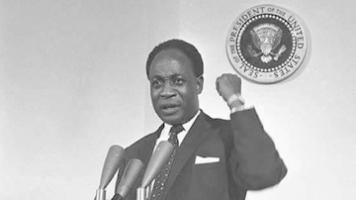 Sixty years ago, Nkrumah told us why it was important that Africa unite. Today, his message and roadmap for Pan-African unity is needed more than ever.
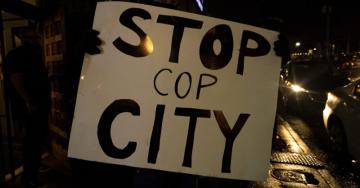 The war against Africans intensifies, the puppets and stooges do as they are ordered, while others are satisfied with empty gestures. But the revolutionary path is unchanged, as Ajamu Baraka…
 Last week I attended the Eritrean American Festival in the Seattle/Tacoma area, at the Tacoma Convention Center. This was the speech I would have given if the festival had not been disrupted by…
 …
… This week’s featured scholars are Alex A. Moulton and Inge Salo. Moulton is an Assistant Professor at Hunter College. Salo is a PhD student in Geography at Clark University. Their article is “Black…


