A Black Agenda Radio commentary by editor and columnist Jared A. Ball
Some of the leading lights of Black political thought have concluded that African Americans are an internally colonized people. This analysis allows us to place African America “within an international context, unites us with other colonized nations here and abroad and demands that no solution be excluded.”
Black History Month and The Unspoken Nature of Internal Colonialism
A Black Agenda Radio commentary by editor and columnist Jared A. Ball
“DuBois described us as ‘semi-colonial,’ or 'domestically colonized.'”
This past week the left-of-center host of GritTv, Laura Flanders, had a powerful segment focused on James Baldwin. It began with a clip of Baldwin explaining so poetically how race functions in this country. He spoke about what it means to grow up in a country “pledging allegiance to a flag… that doesn’t pledge allegiance to you” and how being Black imposes, by the age of 30, a condition whereby you lose any ability to trust your “countrymen.” But for her own reasons and his homosexuality, however, Flanders wanted to take Baldwin out of a context of Black History Month saying that he spoke to so many more. And I am sure he did. But she did that after one of her Black guests, professor Hortense Spillers, applying her own context, noted how Baldwin represented much of what goes today unspoken by too many within African America. She said, “there is so much we don’t talk about.” So I too will quite subjectively use Baldwin and this month’s nominal focus and raise one bit of the unspoken, at least for a moment.
Admittedly, my own favorite of the unspoken is the concept of African America as an internal colony, a nation within a nation or even more specifically a nation within a state apparatus which envelops and crushes other nations. Intellectually it can be challenging and it is certainly a most un-welcomed theoretical approach in the acceptable circles. But it is also one that has sustained radical movements within Black America for centuries. Martin Delaney said it in 1852, that we are a “nation within a nation,” colonized as any other. DuBois described us as “semi-colonial,” or “domestically colonized,” as did Claudia Jones. Of course Malcolm X did as well, he was assassinated largely because of that analysis forty-six years ago this week. James Boggs did, as did members of SNCC. And in his recently released collection of essays you can read how Jack O’Dell deployed the theory and see why he was forced out of his own organization and deemed a threat to this country’s national security. Of course, the Black Panther Party arrived at this analysis as did the Black Liberation Army. And today even a host of activists and academics hold to this theory. In fact, it is central to the work of the Uhuru Movement and the Malcolm X Grassroots Movement.
“The problems we face are scientifically inevitable, by design, intentional.”
Now, there is no unified field theory of internal colonialism. There are many debates and not all agree or apply it the same way. For me the highest value of the approach is three-fold. First, it demands that the adherent recognize that the problems we face are scientifically inevitable, by design, intentional. Secondly, the theory nicely synthesizes old beefs over race, culture and class. And lastly, and perhaps the greatest reason for its vigorous dismissal by the acceptable, it places African America within an international context, unites us with other colonized nations here and abroad and demands that no solution be excluded. By any means necessary takes on a level of clarity and immediacy that continues to frighten even those among us who find it most sound to apply the theory ourselves.
But this final point also means that the process of colonization, as Dr. James Turner said recently, also means a kind of permanent “subordination” that cannot be stopped by the dominant power primarily because it is necessary to the colonizer’s material well being as well as its own self-concept. I am a colonizer because you are colonized. Your underdevelopment is essential to my development. Without the subordinated you there can be no superordinate me. And this also means the colonized cannot wait for the impossible moral shift of the colonizer nor can the relationship be ended by a vote.
And what did Baldwin once presciently say about that? “And in any case,” he said in 1961, “what really exercises my mind is not this hypothetical day on which some other Negro “first” will become the first Negro President. What I am really curious about is just what kind of country he’ll be President of.”
For Black Agenda Radio, I’m Jared Ball. Here’s to hoping you’ve enjoyed this Black History Month and for more of our brand of anti-colonial work visit us online at: www.BlackAgendaReport.com.
Dr. Jared A. Ball can be reached via email at: freemixradio@gmail.com.

 The compilation of Glen Ford's work, "The Black Agenda" was published by OR Books posthumously. In the introduction he recounted his life story and career.
 This week’s featured author is Last Moyo. Moyo lectures in the Department of Communications and Multimedia Design at the American University, Nigeria. His book is The Decolonial Turn in Media Studies…
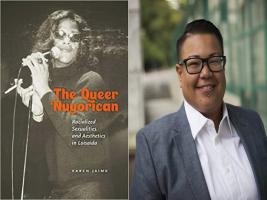 This week’s featured author is Karen Jaime. Jaime is Assistant Professor of Performing and Media Arts and Latina/o Studies at Cornell University. Jaime’s book is The Queer Nuyorican: Racialized…
 Ghana has initiated talks with the International Monetary Fund to seek a potential bailout amid a major economic crisis. This has been rejected by the Socialist Movement of Ghana and trade unions who…
 US police departments spend tens of millions of dollars every year to manipulate the news, flooding the discourse with “copaganda.” These aggressive tactics give the public a distorted view of what…


