A Black Agenda Radio commentary by Glen Ford
With its recent ruling that corporations have the constitutional right to suborn the government through unlimited campaign spending, the U.S. Supreme Court delivered "the final mockery and insult to the very concept of one person, one vote." There is not alternative but to change the Constitution.
Amend the Constitution or Submit to Corporate Dictatorship
A Black Agenda Radio commentary by Glen Ford
"The whole notion of government by the people will have been fully superseded by the reality of government by corporations."
A growing coalition of progressive organizations has begun a race against time, a desperate struggle to prevent corporate money from snuffing out what remains of electoral democracy in the United States. The U.S. Supreme Court's recent ruling, that corporations have the freedom of speech right to spend as much money as they see fit to influence elections, represents the final mockery and insult to the very concept of one person, one vote. If the High Court's decision is allowed to be the final word, then the whole notion of government by the people will have been fully superseded by the reality of government by corporations acting as a species of immortal super-citizens - paper people empowered by money.
The American political system has always favored the rich - which is no wonder, since the legal edifice of the Republic was invented by some of the wealthiest men in the slaveholding former British colonies. The U.S. Constitution's intricate system of "checks and balances" was primarily designed to keep everybody but rich white men in check, and to ensure that the balance of power would weigh decisively on the side of wealth. More than two centuries later, the U.S. Supreme Court decision has put a killer knot in the noose around the popular franchise, one that can only be loosened by amending the Constitution, itself.
It is a lengthy process, by design. After ten years, including a three-year extension, the Equal Rights Amendment for women, or ERA, failed to secure ratification by the required 38 states, and died in 1982. This, despite broad, bipartisan support. The Constitutional amendment submitted by Black Maryland Congresswoman Donna Edwards seeks to void the Supreme Court ruling, by allowing Congress and the states to regulate the way corporations spend campaign money. The amendment, if passed by two-thirds of the House and Senate, would then have seven years to gain ratification by three-quarters of the states, or bite the dust, like the ERA. Just getting the amendment through Congress will be a test of whether corporate money has already neutered the American legislative system, even without the Supreme Court's help.
"The U.S. Constitution's intricate system of 'checks and balances' was primarily designed to keep everybody but rich white men in check."
Donna Edward's amendment has 24 co-sponsors, eight of them fellow members of the Congressional Black Caucus. Other, more timid voices on Capitol Hill favor requiring corporate shareholders to approve of their managements' political and campaign contributions. But Republicans are certain to demand that unions be forced to seek rank-and-file permission for every contribution labor makes to political campaigns - a totally unacceptable and unequal trade-off.
Other congressional Democrats speak of strengthening the system of public financing of election campaigns. But to be effective, public financing would have to match corporate contributions on something approaching dollar for dollar, which could go into the billions, since the sky is the limit for corporate campaign spending under the Supreme Court's ruling. In addition, President Obama relinquished any moral authority on that score, when he abandoned public financing once he realized he could raise more money than John McCain - including corporate money.
Thus, there is no alternative but to go the route of Constitutional amendment, with no guarantee of success at the end of that long road. But, as Congresswoman Edwards says, history and the Supreme Court have left us no choice.
For Black Agenda Radio, I'm Glen Ford. On the web, go to www.BlackAgendaReport.com.
BAR executive editor Glen Ford can be contacted at Glen.Ford@BlackAgendaReport.com.

 In this series, we ask acclaimed authors to answer five questions about their book. This week’s featured author is Atiya Husain. Husain is Associate Professor of Africana Studies at Williams College…
 The Black Radical Tradition is the rich legacy passed down by revolutionaries. It is an important tool today as we struggle to turn the Americas into a Zone of Peace.
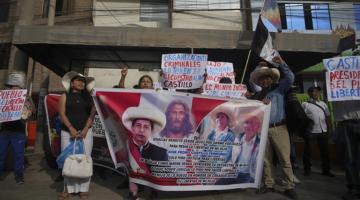 The trial of former Peruvian president Pedro Castillo, the victim of a 2022 lawfare-style coup, has begun. The legal process used against him is a sham covering up the human rights abuses…
 Trump administration interference in Panama has brought about a reckoning on migration and human rights throughout the region. These issues can no longer be ignored.
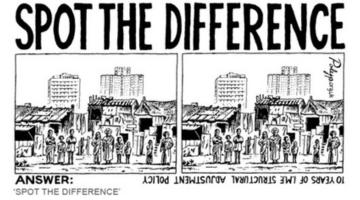 Presenting new research, Dylan Sullivan and Jason Hickel mount a devastating critique of the impact of structural adjustment in Africa in the 1980s and 1990s. Drawing on recent data on Africa’s…


