A Black Agenda Radio commentary by Glen Ford
One of the reasons U.S. imperialism is doomed – and there are many – is that the worldview of the imperialist renders him incapable of understanding why his system of control is collapsing, despite his overwhelming advantage in weaponry. Such blindness is a form of insanity. Yet, as a recent Wikileaks document reveals, the imperialist perceives those who resist his rule as irrational, defective, insane – as did the top U.S. diplomat in Tehran just before the embassy takeover of 1979
American Racism on Display in Wikileaks Iran Cable
A Black Agenda Radio commentary by Glen Ford
“Bruce Laingen maintained that the main problem was not U.S. policy in Iran, but an inherent psychological ‘defect’ in the Iranian people.”
Among the quarter million diplomatic dispatches released by Wikileaks this weekend is a posting from the U.S. embassy in Tehran, Iran’s capital, dated August 13, 1979, just three months before the embassy was seized by Iranian students. The cable, by Bruce Laingen, the highest ranking U.S. diplomat in Iran at the time, is less than 1,000 words long, but speaks volumes to the essential racism of the American imperial worldview, and to white America’s fundamental unfitness for the role of superpower.
The Iranian revolution had earlier in 1979 overthrown the dictatorial Shah, whom the Americans had forcibly installed in power in 1953. Needless to say, Iranians blamed the Americans for the unspeakable crimes committed by the Shah’s regime. But Bruce Laingen maintained, in his cable to the State Department in Washington, that the main problem was not U.S. policy in Iran, but an inherent psychological “defect” in the Iranian people – or “Persians,” as he called them. These “underlying cultural and psychological qualities,” wrote Laingen, “account for the nature of these difficulties” in dealing with Persians. He writes: ”Perhaps the single dominant aspect of the Persian psyche is an overriding egoism” whose “practical effect…is an almost total Persian preoccupation with self [that] leaves little room for understanding points of view other than one’s own.” In other words, the Iranians are too sick in the head to comprehend United States policy in their part of the world. It’s a “cultural and psychological” defect – unrelated, of course, to the fact that the U.S. stole their democracy from them and put their own puppet on the Peacock Throne.
“Not only were Iranians cursed by mental illness, but their inherent inferiority to westerners was made worse by their religion, Islam.”
Laingen observes that “the Persian” believes that he is surrounded by “hostile forces” – as if that were a clear symptom of mass mental illness rather than a logical conclusion based on a quarter century of rule by a U.S.-imposed Shah whose routine practice of torture was unsurpassed in modern history. Not only were Iranians cursed by mental illness, but their inherent inferiority to westerners was made worse by their religion, Islam, “with its emphasis on the omnipotence of God.” This, said Laingen, deprives Iranians of the ability to grasp “the inter-relationship of events” as they unfold. That is, the Muslim faith, itself, has rendered Iranians incapable of making sense of the world around them, according to the American diplomat. Finally, it is a “waste of effort” to try to cultivate “goodwill” with the Persians because, wrote Laingen, “given the Persian negotiator's cultural and psychological limitations, he is going to resist the very concept of a rational...negotiating process.”
In Bruce Laingen, we hear the unrepentant voice of the American slaveholder, who believed that Black resistance to slavery was a sign of mental illness. In the white supremacist's mind, Drapetomania was a mental disease that caused slaves to run away. Dysaethesia aethiopica was the defect that resulted in slave ill-discipline and “rascality.” In the eyes of the slaveholder and the imperialist, those who resist oppression are crazy. If that is so, then it is the crazies that will inherit the Earth.
For Black Agenda Radio, I'm Glen Ford. On the web, go to www.BlackAgendaReport.com.
BAR executive editor Glen Ford can be contact at Glen.Ford@BlackAgendaReport.com.

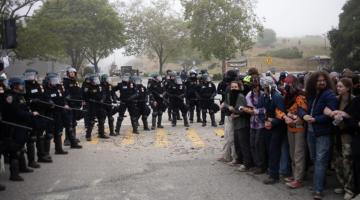 Schools across the U.S. have altered policies and even landscapes in an attempt to make a repeat of last spring’s Palestine protests impossible. The result is a far-reaching war on free expression…
 Israel once again is attempting to circumvent international law by appealing to the U.S.
 60 years ago, the Mississippi Freedom Democrats took a stand at the Democratic National Convention, bodily challenging the racist party and the violent voter repression of Black people. Years…
 We are joined by Jasiri Fahali Kiyamaa, an organizer of Curbfest, an event advocating for political prisoners. New York City's Curbfest will take place on Saturday, September 7, 2024 in Brooklyn.
 In 2020 our late comrade Glen Ford spoke at a Black is Back Coalition video conference on political prisoners. In these excerpts of his remarks, he discussed the need to understand the political…


