A Black Agenda Radio commentary by Glen Ford
Even the puppet parliament of the rump Somali state rebelled against association with mercenaries of the infamous Saracen International corporation, whose leadership cut their teeth in apartheid South Africa death squads. The parliament demanded severance of the contract with the soldiers of fortune. The U.S.-backed Somali mini-state is dependent on Ugandan troops for survival. “The Americans and their puppets have been militarily defeated by some of the most poverty-stricken guerillas on the planet.
Somali Regime Hires Mercenary Outfit Rooted in Apartheid
A Black Agenda Radio commentary by Glen Ford
“Saracen’s soldiers of fortune have been employed to overthrow or prop up governments all across the continent.”
Although it is difficult to believe possible, U.S. policy in Somalia is pushing that East African country even deeper into the abyss. The American-backed puppet regime, which controls only a few neighborhoods of the capital city, Mogadishu, and could not survive a day without the protection of Ugandan soldiers, has also contracted with as many as five foreign mercenary outfits to wage war against its own people. So deep is the stench, even the puppet parliament is recoiling. Last week the lawmakers demanded that the Somali rump state end its secret dealings with the mercenaries, who are said to be headquartered at Mogadishu airport.
The mercenary contractors include the infamous Saracen International corporation, whose roots go back to the murderous hit-squads organized by the white minority regime in South Africa. Saracen’s soldiers of fortune have been employed to overthrow or prop up governments all across the continent. Their services come at a high price – and not just in the lives of the Africans they slaughter. The Somali operation is thought to be financed partly by right-wing Arab emirates rulers and by the Sultan of Oman, who overthrew his own father with the help of white mercenaries. Rich Gulf Oil state involvement is confirmed by the Mogadishu regime’s own press release, which said that the contractors’ money has been “provided by some Muslim countries.”
When cash is not available, Saracen International is also said to accept payment in national resources such as oil or fishing rights. The private mercenaries already have contracts with the breakaway government in the Puntland region of Somalia.
“Saracen International is said to accept payment in national resources such as oil or fishing rights.”
The United States expressed mild diplomatic displeasure with the contracting out of security services by the puppet regime. That may be because Saracen is not on the U.S. State Department's list of most-favored mercenary corporations, of which there are plenty headquartered in the Washington, DC area. But it is certain that Uganda is upset at the mercenary contracts. The Ugandan military is paid many millions of dollars to keep the road from Mogadishu's airport to the tiny Somali government enclave in town, open. Uganda's military behaves precisely as mercenaries, themselves, and don't like the private competition.
Ethiopia, which invaded Somalia in late 2006 at the instigation of the United States, is also training young Somalis to act as pro-government militia, as has the U.S.-backed regime in Kenya. The Obama administration, like the Bush gang before it, is determined that no Islamic government come to power in Somalia. But so deep is Somali nationalism and hatred of foreign interference, the Americans and their puppets have been militarily defeated by some of the most poverty-stricken guerillas on the planet.
If there was one drop of human concern in President Obama's heart for the welfare of the people of Somalia, he would call off this cruel torture of a nation. But Obama is in accord with decades of American policy in Africa, with can be summed up in one phrase: What the U.S. cannot control, it plunges into chaos.
For Black Agenda Radio, I'm Glen Ford. On the web, go to www.BlackAgendaReport.com.
BAR executive editor Glen Ford can be contacted at Glen.Ford@BlackAgendaReport.com.

 Senior care puts care workers into racialized, gendered, and age hierarchies, making it difficult for them to achieve social and economic mobility.
 I am hoping my call will provoke/inspire us to practice forms of life and liveliness differently.
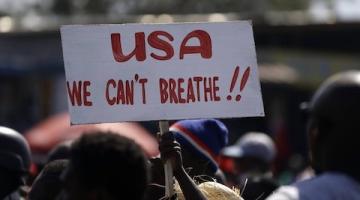 While Biden is telling Haitians “Don’t come over,” Haiti and its allies have been saying “U.S. Out of Haiti.”
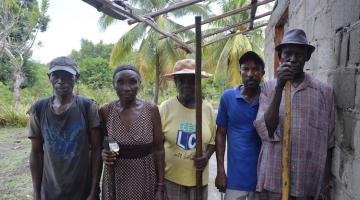 The author unpacks the tired trope of “poor rich Haiti,” highlighting the role of foreign capital and local elites in the destruction of life in the countryside.
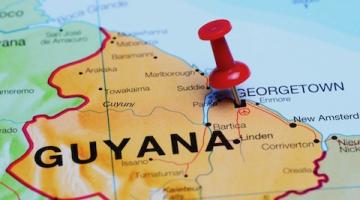 Guyana’s historically oppressed peoples direct their hostility at each other while neo-imperial powers hide in plain sight and reap the country’s wealth.


