A Black Agenda Radio commentary by BAR columnist Jared A. Ball, Ph.D.
Washington, DC, like other majority-Black metropolises, squeezes African Americans out of its borders through gentrification, while trapping growing proportions of those who remain in a rapacious criminal justice system. Activists charge that DC’s policy of hiring more white officers from surrounding states amounts to “coon hunting” in the nation’s capital.
South Africa On the Potomac: Washington, D.C. and Black Incarceration
A Black Agenda Radio commentary by BAR columnist Jared A. Ball, Ph.D.
“DC is losing 2500 or so Black residents a year as gentrification pushes them out of the city proper.”
During a speech aired on Memorial Day this year Noam Chomsky said, “The drug war is used as a pretext to drive the superfluous population, mostly black, back to the prisons, also providing a new supply of prison labor in state and private prisons, much of it in violation of international labor conventions. In fact, for many African Americans, since they were exported to the colonies, life has scarcely escaped the bonds of slavery, or sometimes worse.” This week I had a chance to sit down with Mr. Kwasi Seitu, a veteran activist with decades-long experience in organizing Black resistance to police brutality and what is often a malicious judicial system. Mr. Seitu has for many years now suffered first-hand and worked against the violently rapacious nature of the system described by Chomsky as “sometimes worse” than slavery. From Mississippi to where he now resides in Washington, D.C., Seitu has been on the front lines of this on-going tyrannical relationship between the Black community and the nation’s institutions.
In Washington, D.C., the nation’s capital, also referred to as the “last colony,” or a “a piece of South Africa on the Potomac,” Mr. Seitu describes the horrific procession of “hundreds of Black people” who “pass through the dungeons of D.C. Superior Court every single day.” Most of these women and men are there for non-violent drug offenses which Seitu argues is also part of a police “quota system” which rewards officers for higher numbers of arrests. The quality or just nature of those arrests is not the issue, just the numbers of Black bodies who will pass through the city’s jails. Part of the political economy of this streets-to-jail pipeline is, as Seitu says, the justification of the publicly-funded policing and incarceration budget which puts hundreds of millions of dollars at stake. But it is also, as Chomsky alluded to, an issue of “superfluous” labor, or an issue of what to do with those you cannot or will not employ. As recently as 2006 the employment rate for Black adults in Washington, D.C. was only 51% making their unemployment rate the highest in the world.
“It is an issue of what to do with those you cannot or will not employ.”
Washington, D.C. is now 52% Black and losing 2500 or so Black residents a year as gentrification pushes them out of the city proper. However, according to Seitu, this has not changed the complexion of those being targeted by the various police agencies in the city. DC police chief Cathy Lanier has had her attempts at instituting community check points ruled unconstitutional and her “All Hands on Deck” policy determined to be a violation of police union workloads. But despite the setbacks Lanier’s policies of hyper-policing remain largely intact which means more of the same. Seitu argues that these tactics, coupled with Lanier’s hiring of more white officers from surrounding states, amounts to the tradition of “coon hunting” and will likely result in more Black women and men being unnecessarily incarcerated or worse still killed by police.
Of course, many of these issues have their roots in the ignoble beginnings of this nation’s relationship with African people. Others point more recently to this as an issue of DC’s lack of statehood which means, in this case, that DC Superior Court, despite the name, is a federal court with judges and prosecutors appointed rather than elected by city residents. In either case the issues against which Seitu and others struggle is the tip of a racist economic order that suffers a kind of inattention in this country that is simply inexcusable. All those who prefer the sexier issues of Israel and Palestine or Afghanistan and Pakistan will see no improvement in those issues while similar orders are in place and in practice right here at home.
For Black Agenda Radio I’m Jared Ball. Online go to www.BlackAgendaReport.com
Jared Ball can be contacted via email at: jared.ball@morgan.edu
al.

 Anti-Black racism and Zionism are two cornerstones of Harvard’s flawed foundation. We should mourn Claudine Gay’s tenure at Harvard because she was both a victim and an agent of white supremacy.
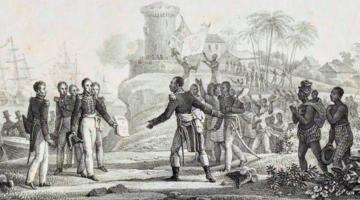 After Haiti gained independence in 1804 following a slave revolt, France threatened to invade and re-enslave the Haitian people if they did not pay compensation to French slave owners for their lost…
 Civilian democratic forces are demanding inclusion in proposed discussions in Djibouti.
 Thandisizwe Chimurenga is the author of the new book, Some of Us Are Brave, Volume I : Interviews and Conversations with Sistas on Life, Art and Struggle.
 We’re joined by Dr. Anthony Monteiro, a Duboisian scholar and founder of the Saturday Free School for Philosophy and Black Liberation. He joins us from Philadelphia to discuss Ibram X.


