by BAR editor and columnist Jared A. Ball
The U.S. government’s COINTELPRO assault on Black and radical political activists wasn’t just a Sixties episode: it was part of the continuity of oppression stretching from the European invasion of the Americas and the slave trade to this very day. American regimes are prepared to deploy COINTELPRO-like repression whenever popular movements threaten the established order. “Assassination, imprisonment, surveillance and encouraged internal strife [are] employed to forcibly dissolve these movements.”
COINTELPRO 101
by BAR editor and columnist Jared A. Ball
“It is an introduction to the often omitted history of the FBI’s illegal wars of terror waged against the full spectrum of radical Left movements in this country.”
COINTELPRO 101, the latest film release from The Freedom Archives, is nothing like the all-too-common soft, liberal documentary which tells of worse and distant horrors so as to lessen the pain or awareness of those still occurring. It is not a film that imposes a happy ending by suggesting that its subject is somehow past. It is a film that makes plain the fact that all of your problems of today, from war, to incarceration, to banking crises, joblessness and environmental catastrophe, still exist because movements to do away with them suffered and continue to suffer the greatest levels of repression from the most powerful state apparatus in world history. And worse still, as Black Panther Party veteran Kathleen Cleaver states unequivocally, unlike the official Counter Intelligence Program of previous decades, today’s version is perfectly legal.
COINTELPRO 101 is just that. It is an introduction to the often omitted history of the FBI’s illegal wars of terror waged against the full spectrum of radical Left movements in this country. The Counter Intelligence Program which emerged in the post-WWII era of international struggles for human rights and national liberation simply focused internally to the United States all that had been carried out against populations abroad. It turned so-called U.S. citizens in the 20th century into insurgent rebels to be dealt with as any foreign army or movement. Assassination, imprisonment, surveillance and encouraged internal strife were employed to forcibly dissolve these movements. But, as this film so skillfully demonstrates, this all was merely an extension of a continuing state project of enslavement, genocide, theft of land, culture and humanity that pre-dates even the official declaration of U.S. nationhood.
The film’s brilliance is not simply its nicely-styled aesthetic elements. They are there of course. Strong interviews, rarely seen clips, high quality audio and video production across the board with equally strong narration from Liz Derias. But it is the film’s ability to force new confrontation with the political reality of today, as much as with the past, that truly demonstrates its value. The simple point made by Geronimo Pratt is also its strongest; that COINTELPRO made official the illegality of politics, the “criminalization of positions” represented by its targets. COINTELPRO was the political and legal descendant of its ancestors, slavery and genocide, and is now itself an ancestor to the still-implemented policies of, for instance, the Patriot Act. This central theme of the film is its most important because it forces us to put in context the current and horrific state of peace, freedom and labor movements.
“It turned so-called U.S. citizens in the 20th century into insurgent rebels to be dealt with as any foreign army or movement.”
As CONTELPRO 101 makes vividly clear, “the Black misleadership class” described so often in the pages of Black Agenda Report is the result of having first destroyed the rightfully ascending Black leadership class of that time. This film helps re-establish lost cognition imposed by popular anti-histories which allow for so many to falsely assume that Obama is a natural progression from Civil Rights and Black Power movements. The film inserts stolen pages of history that result in an assumption that Native America went willingly to the reservations and then happily stayed there having never having attempted movements to protect whatever remaining autonomy they might have had. No one who sees this film can return to conventional and now popularly re-emerging arguments over immigration or human “illegality.” In fact, COINTELPRO 101 goes further than most histories of this phenomenon in reminding us of the threats posed by the Puerto Rican and Chicano independence movements. One can only imagine with a kind of hope what these discussions would sound like were they to take place in this film’s context of state repression and specifically the killing of Chicano movement activists like Ricardo Falcon. Indeed, would these arguments even exist without first the assault on these movements and their representatives?
CONTELPRO 101 is the latest in an increasingly long line of collected, preserved and produced media from The Freedom Archives which seeks to appropriately tell the stories of diverse but unified efforts toward liberation. It powerfully summarizes the continued need of those in power to suppress and, in their own words, “neutralize” movements and individuals so that more acceptable replacements can be developed and promoted. For if, as the film asserts, the continued imprisonment of people like American Indian Movement activist Leonard Peltier is a “symbol” to, through discouragement, protect the state from further similar activity, then what do popular, sanctioned, elected leaders of today represent?
For Black Agenda Radio, I’m Jared Ball. Online go to www.BlackAgendaReport.com.
Jared Ball can be reached via email at: freemixradio@gmail.com.

 by Bryan K. Bullock To read the foreign policy pages of the New York Times is to enter a world of whiteness. “Whites are the only ones who are presumed to have an opinion on such issues that is worth…
 by Ann Garrison The just-concluded election revealed as much about the corporate media, which has broken every rule of journalism to support Hillary Clinton, and the fraudulence of much of the…
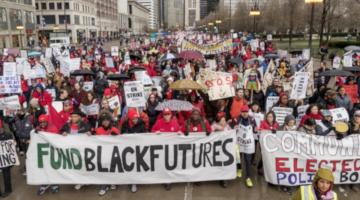 When the Chicago Teachers Union goes on strike, it doesn’t walk alone; Movement 4 Black Lives organizations have their back. And, when young Black activists campaign against police terror, the…
 by Timothy Shenk In order to downgrade the centrality of slavery to the development of the United States and global capitalism, mainstream historians attempt to depict the slaveholding classes as…
 by Yohannes Woldemariam The minority ethnic regime in Ethiopia now faces multiple rebellions. The regime’s foreign friends are part of the problem. “Faced with increased intrusion into their lands by…



