Click the flash player below to listen to or the mic to download an mp3 copy of this BA Radio commentary.
A “small herd” of rightist Black politicians is seeking statewide office, further mangling Black politics in the process. In practice, this trend allows white voters “to decide which kinds of Black politicians rise to state and national prominence.” Among the latest entries is Congressman Artur Davis, running for governor of Alabama. Rep. Davis is consistently ranked among the worst members of the Congressional Black Caucus – which is the source of his white, corporate appeal.
Fattening Black Frogs for Corporate Snakes A Black Agenda Radio commentary by Glen Ford
“The Black public is expected to support the corporate Black candidate for reasons of race loyalty.”
The rush to the Right among Black politicians is led by corporate-bought scoundrels seeking statewide office. It marks a new low in Black politics – in fact, the rash of rightwing Black candidacies represent an affront to the very idea of a politics that is accountable to the Black public. Instead, we are confronted with a new class of corporate connivers that measure Black progress by the Black candidates’ success in garnering white votes, by any shameful means necessary.
In this retrograde process, the Black public is expected to support the corporate Black candidate for reasons of race loyalty. They are taken for granted, as if in the candidate’s pocket, while he caters to every whim and prejudice of white voters. It is a profoundly degrading exercise, utterly contemptuous of the Black public. Which is precisely why a growing number of white people are feeling so good about the phenomenon. They get to decide which kinds of Black politicians rise to state and national prominence.
The latest crop of ambitious rightwing Black higher office seekers includes Artur Davis, the congressman from Alabama who rode to victory over progressive incumbent Earl Hilliard on a wave of corporate and Zionist money, in 2002. Davis has been at the bottom of the Congressional Black Caucus barrel ever since, consistently part of a cluster of derelict corporate water-carriers, at the absolute bottom of every report card issued by the watchdog group, Congressional Black Caucus Monitor. When former Memphis Congressman Harold Ford, Jr. left the House to run for a Senate seat, Davis took his place as the worst member of the CBC – it’s least progressive member.
“The corporate media love Davis – which is more proof of his worthlessness.”
Which, I suppose, is Congressman Davis’s top qualification as a Democratic candidate for governor of the State of Alabama. He can prove to the powers-that-be that he sits to the right of almost every other Black member of Congress. He is trustworthy.
As a Black star in the Democratic Leadership Council, the DLC, which represents the corporate class in the Democratic Party, Artur Davis is well-connected. Former congressman, now White House Chief of Staff Rahm Emanuel took young Davis under his wing, and put him in charge of recruiting Black candidates for Congress in the Southeast. Davis’s old buddy Harold Ford is now chairman of the DLC, so Davis can count on corporate money pouring into his gubernatorial campaign. The corporate media love him – which is more proof of his worthlessness to Black people. Next door, in Georgia, another throwback to Booker T. Washington’s time is also running for governor. Thurbert Baker is currently state attorney general. His top campaign issue is crime, and he takes credit for passage of a “two-strikes you’re out” mandatory life imprisonment law.
There’s actually a small herd of these backward Negroes aspiring to high statewide office. They represent a total waste of the time and resources the Black community has spent nurturing their careers. As my grandmother would say, all these years, we’ve just been “fattening frogs for snakes.” For Black Agenda Radio, I’m Glen Ford. On the web, go to www.BlackAgendaReport.com .

 Black memory is a muscle trained, flexed, and disciplined by colonialism, enslavement, and racial terror, as well as collective Black struggle.
 Socialist ideas about the inextricable links between class, race, and gender predate the concept of intersectionality.
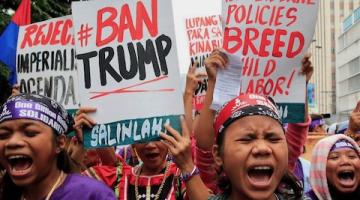 The struggle against systemic racism and the police state in the US is integral and linked to the struggle against US wars of aggression overseas.
 Community control of police and prison abolition have been completely removed from the conversations dictated by a mainstream and complacent narrative.
 Global Displacements is an examination of the impact of the global organization of capitalist accumulation and exploitation on the life and labor of Haitian and Dominica



