“Without the help of the American Negro, the abolition movement would have been impossible.”
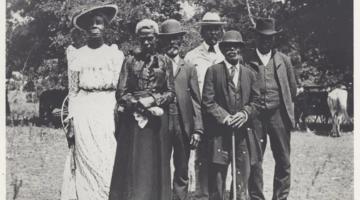
On June 19, 1865, Union general Gordon Granger read “General Order No. 3” announcing the emancipation of enslaved Africans in Texas, and providing the origins of Juneteenth. Although Abraham Lincoln’s January 1, 1863 Emancipation Proclamation freed all Blacks residing in territories captured from the Confederate states, Black folks in those states had to wait for the arrival of Federal troops to take their freedom. So it was in the Republic of Texas. An isolated, fortified state that harbored pro-slavery whites, Black folk in Texas received did not learn of their freedom until Union troops landed in Galveston and captured the last confederate stronghold, many long months after the Emacipation Proclamation.
Yet while many acknowledge the significance of this announcement for “freeing” enslaved Africans, it is worth noting that a racial caste system was built into Granger’s announcement of emancipation. “General Order No. 3” states:
The People of Texas are informed that, in accordance with a proclamation from the Executive of the United States, all slaves are free. This involves an absolute equality of personal rights and property rights between former masters and slaves, and the connection heretofore existing between them becomes that between employer and hired labor. The freedmen are advised to remain quietly at their present homes and work for wages.
They are informed that they will not be allowed to collect at military posts and that they will not be supported in idleness either there or elsewhere.
Emancipation not only stipulated that Blacks remain as “hired labor” on the very plantations where they had been enslaved, it also decreed that they had to keep working and not be idle. Granger’s words prefigured the terrible paradox of freedom for Black people. Some have called it slavery by another name. Others have said it was freedom in name only. Whatever its name, from 1865 African people may have had a change of status, but not of condition, as they were subjected debt peonage, false imprisonment, lynchings, the terrorism of the Ku Klux Klan, in addition to violent economic and political disenfranchisement. It was a post slavery “reconstruction” that never was.
In 1943, seventy-five years after the end of slavery, W. E. B. Du Bois revisited the history of emancipation and examined the failures of Reconstruction. Du Bois corrected the record on the significance of slavery to the making of the US, and on the unrecognized role of Black people in their own emancipation. For Du Bois, the denial of both facts enabled “disfranchising the Negro and reducing him to caste conditions.” And importantly, Du Bois argued, Black people did not sit idle waiting to be emancipated – by either Abraham Lincoln or George Granger. Instead, they initiated the struggle for freedom and actively worked for emancipation, especially as soldiers in the U.S. Civil War.
As another Juneteenth approaches, Du Bois’ essay is worth re-visiting. Juneteenth has been almost completely corporatized since it became a national holiday in 2021 and, in the process, its original meaning and significance has been largely lost. Emancipation was not given to us; we fought for it. And yet that freedom we fought for was soon constrained and constricted by a country dead set on maintaining Black disenfranchisement and white power. Du Bois saw this in 1943. We can see it now.
We reprint W.E.B. Du Bois’ essay “Reconstruction, Seventy-Five Years After” below.
Reconstruction, Seventy-Five Years After
W. E. B. Du Bois
Seventy-five years ago, July 20, 1868, the Fourteenth Amendment to the Constitution of the United States was declared adopted and the capstone thus placed on the reconstruction of the nation after the Civil War. It is peculiarly fitting, therefore, to assess the real meaning and value of the series of attempts to restore law and order in the United States after four years of war, beginning with the Committee of Fifteen and ending with the adoption of the Fourteenth Amendment.
To me, these propositions, extreme as they may sound, seem clear and true:
1. The American Negro not only was the cause of the Civil War but a prime factor in enabling the North to win it.
2. The Negro was the only effective tool which could be used for the immediate restoration of the federal union after the war.
3. The enfranchisement of the freedmen after the war was one of the greatest steps toward democracy taken in the nineteenth century.
4. The attempts to retrace that step, disfranchising the Negro and reducing him to caste conditions, are the deeds which make the South today the nation's social problem Number One.
To the average American reader these statements will seem almost preposterous because for over a half century a determined and relentless propaganda, silently acquiesced in by the North and loudly greeted by the South and its friends, has sought to prove:
1. Slavery was not the cause of the Civil War and the Negro played no important part in that conflict.
2. The Negro and his friends hindered and delayed the restoration of the Union.
3. The enfranchisement of the Negro freedman was a crime against Civilization.
4. Civil and economic equality for Negroes in the United States is impossible.
To determine the truth in these various statements, let us appeal to the known facts and also in this article let me appeal to young students of the social sciences, white and black, to elaborate and make more clear historical facts which are already known but which have been in many cases deliberately hidden, inadequately interpreted and which call for further intensive research and elaboration. It may well be that in some matters the conclusions which I am, here setting down in broad and general outline should be modified and even contradicted but I am convinced that in general they will be substantiated and proven.
1. The statement that Negro slavery was the cause of Civil War in the United States is to my mind absolutely true. I cannot see how any honest and intelligent person, reading United States history from the abolition of the slave trade in 1808 to 1861; reading the biographies of leading persons, the literature of the nation, the debates in Congress and the legislatures and the laws enacted, can have the slightest doubt on this point, if he possesses normal intelligence. Instead of the main reason which led to Civil War being the balance of federal and state powers, this fight on the contrary was the result of the slave controversy and not the cause of it. For the very reason that an increase of the power of the nation as a whole, as contrasted with the particularism of the parts, was necessary in order to destroy the degradation of labor which slavery involved, made the increase of federal power after the war which abolished slavery necessary and logical. In no other case previous to that time; in questions of taxation, in questions of commerce, trade and tariff, were national interests so clearly set against states rights, that only force could settle the controversy. The slavery controversy was a direct and final challenge. No democracy was possible unless it was abolished; no peasant ownership nor labor bargaining could survive its malign power. The nation simply could not exist half slave and half free, and when the reactionary South was adamant on the question and refused further compromise, the problem could only be solved by force.
Moreover, the demand which rising and expanding and becoming more and more explicit, made abolition inevitable, came not simply from white men but from black. The part of the Negro in abolition just as his part in the Civil War has been intentionally and systematically played down until today it is not simply neglected but nearly forgotten.
Without the help of the American Negro, the abolition movement would have been impossible. He not only furnished members for the abolition groups from the beginning; he not only was the main support of Garrison's Liberator; he not only talked, pleaded and reasoned in the United States, France and England against slavery; but he was instrumental in delivering repeatedly the deadly blows which shook the very foundations of slavery through the organized encouragement of fugitive slaves. White men helped and made possible the Underground Railroad but Negroes were engineers, conductors and passengers.
It is probable that not less than a half-million Negroes helped the North during the Civil War; and if this is true, there were in proportion to population more Negroes fighting for freedom in that war than whites. North and South near two million whites took part in this tragic contest which cost conservatively ten billion dollars and the deaths of nearly a million human beings. Among those who fought and paid were one hundred and eighty thousand Negro soldiers whose names are on the official roles; but they were not all the fighters. Joseph Wilson in his painstaking history of the Negro soldiers tells us that in Negro regiments “if a company on picket or scouting lost ten men the officers would immediately put ten new men in their places and have them answer to the dead men’s names.” He estimates that in this way at least forty thousand Negro soldiers were never counted. If there were two hundred thousand Negroes under arms, there were perhaps three hundred thousand others who at various times and for varying lengths of service acted as servants, laborers, teamsters and spies for the Union Army. That whole part of military effort known now as the Service of Supplies was given to the Union invaders of the South almost without wage and only in return for subsistence and Negroes sprang up in hordes in every place that the invader appeared. Never forget what the Commander-in-Chief of the Union forces said in August, 1864, “the darkest month of the war”: “Take from us and give to the enemy the one hundred thirty, forty or fifty thousand colored persons now serving us as soldiers, seamen and laborers, and we cannot longer maintain the contest.... It is not a question of sentiment or taste but one of physical force, which may be measured and estimated as horsepower and steampower are measured and estimated and by any measurement it is more than we can lose and live. Nor can we by discarding it get a white force in place of it.”
It is not simply what the Negroes as actual fighters and workers did in the Civil War, it was even more the certain knowledge of what they might do if once they were recruited in strength, trained and armed. Judah Benjamin, Confederate Secretary of State, in November, 1864, confidently envisaged and asked for an army of 680,000 black soldiers.
Careful study of the work of the Negro soldier in the strategy of the Civil War has never been made; but even before the intensive study has been applied to the subject which it demands, we can see a vague but certain outline. As early as December, 1861, the return of fugitive slaves by the Northern army was forbidden. In the spring of 1862, the great movement of the Union army toward the Mississippi Valley which eventually was to break the back of the Confederacy and make the fatal amputation of East from West, the need and use of Negroes became evident. The Confederate legislature of Virginia considered the enrolling of free Negroes; while on the other hand Farragut and Butler attacking New Orleans, enlisted the free Negro regiments under black officers whom the Confederates had formerly enrolled. The situation in New Orleans, just as the situation in the Southeast, made the enlistment of Negro troops inevitable. Hunter in South Carolina was required to hold territory which the Union navy and army had seized but was refused replacements or reenforcements. He organized a Negro regiment and Congress performed in vain. Butler after receiving free Negroes as soldiers appealed for reenforcements; the government at Washington procrastinated. But with Farragut's gunboats protecting the Union troops in New Orleans, and Grant approaching Vicksburg from the North, it was of the highest importance that the line of communications between New Orleans and Vicksburg beheld against Confederate land attack. To protect New Orleans, Butler had to enlist free Negro troops under black officers and as Breckinridge and other generals threatened Baton Rouge and the Red River valley, Congress hastened to authorize the general enlistment of Negro troops. The fight in Washington was bitter, but the facts were inexorable.
Mr. Sherman (Rep.) of Ohio said, “The question arises, whether the people of the United States, struggling for national existence, should not employ these blacks for the maintenance of the Government. The policy heretofore pursued by the officers of the United States has been to repel this class of people from our lines, to refuse their services. They would have made the best spies; and yet they have been driven from our lines.” - “I tell the President,” said Mr. Fessenden (Rep.) of Maine, "”from my place here as a senator, I tell the generals of our army, they must reverse their practices and their course of proceeding on the subject.... I advise it here from my place, – treat your enemies as enemies, as the worst of enemies, and avail yourselves like men of every power which God has placed in your hands to accomplish your purpose within the rules of civilized warfare.” Mr. Rice, (war Dem.) of Minnesota, declared that “not many days can pass before the people of the United States North must decide upon one of two questions: we have either to acknowledge the Southern Confederacy as a free and independent nation, and that speedily; or we have as speedily to resolve to use all the means given us by the Almighty to prosecute this war to a successful termination. The necessity for action has arisen. To hesitate is worse than criminal.”
This was in July and August; and in September came Antietam. The preliminary Emancipation Proclamation was issued and already there were ten thousand armed Negro troops in the lower Mississippi Valley.
In 1863, came the Emancipation Proclamation and in March an inspector was sent along the front to urge and insist upon the enlistment of Negro troops. Enlistment began in the North and went steadily forward. The celebrated Corps d'Afrique with black officers was formed in Louisiana. In June, Grant in order to force the surrender of Vicksburg had to concentrate there nearly all of his white troops. This left a large part of the task of keeping open communication between Vicksburg and New Orleans and insuring the cutting of the Confederacy in two on the shoulders of black troops.
At Port Hudson and Milliken's Bend, Negroes not only defended Banks' troops in New Orleans from attack, but opened the way for their junction with the troops of Grant after the fall of Vicksburg. It was the Negro soldier who let the Mississippi run “unvexed to the sea,” and sealed the fate of the Confederacy. Later when Sherman turned to Atlanta and his march to Savannah, in a second splitting of the South, Negro troops in Tennessee and Alabama were prime factors in protecting his rear.
Gettysburg was fought and Vicksburg fell, while in December of that year the Confederate General Cleburne was demanding the enlistment of Negroes. When in 1864, Grant turned on Richmond for the final bloody kill one of his first decisions was to bring in six thousand Negro soldiers to an area of war where they had not previously been used. Their part in the seige and fall of Richmond was such that a black regiment was given the honor of being among the first who marched into the fallen capital.
The clamor within the Confederacy for Negro troops had meanwhile steadily increased. In September, 1864, Governor Allen of Louisiana cried, “The time has come!” In November, Jefferson Davis was seriously considering the matter. In January, 1865, Lee asked for Negro troops and in February declared them “necessary.” In March the Confederate Congress passed an act to enlist Negroes too late, for in April, Lee surrendered.
In the light of these facts, can it for a moment be contended that the Negro troops actually under arms and the prospect of their immediate and quick increase was not the decisive factor that stopped the Civil War in the spring of 1865?
2. We are today contemplating with uncertainty and fear the steps that must be taken in Germany by the victorious allies after the overthrow of Hitlerism. Suppose it were true that the only way to restore Germany in a form which would make it impossible for her to be for a generation if not forever, a menace to the peace of the world, was to put political and social power into the hands of a mass of people who had long been victims of German oppression and who now desired freedom, work, land and education? Suppose that when the Allies marched into Germany, they found thirty-five per cent of the population, friendly and sympathetic, but hated by the Germans as the Jews are hated; and in contrast to the Jews, ignorant, poor and sick, because of slavery and exploitation for two hundred and fifty years; would there be the slightest doubt but that
this suffering and oppressed people would be fixed upon by the conquerers as the God-sent instrument for the reconstruction and democratization of Germany?
The problem facing this nation from 1866 to 1876 was analogous. The South was too bitter with the costs of war and the destruction and legal abolition of its property rights, to be trusted with the uncontrolled government of the South. Under the most favorable circumstances, the political power of the South would have been used to restore slavery in all but name, even after the North had depended on the slave to conquer the South; this political power would also have been used to repudiate the public debt at least in part, to overthrow the enormous economic superstructure which the North had built on the tariff and sharply to curtail the power and growth of the new capitalist big business. Abraham Lincoln had hoped that a sufficient minority of the white South would be willing to stand by the North and reconstruct the nation. He was disappointed before he died and had he lived his disappointment would doubtless have been even greater.
There was a way out which involved both philanthropic ideals and industrial selfishness. It was the enfranchisement of the Negro. If this enfranchisement had been accompanied, as it should have been and as all of its honest advocates insisted, by wide redistribution of land and universal education, it would have been a triumph of American democracy. As it was, the government as such did practically nothing toward economic restoration or education, but put such power in the hands of the enfranchised Negroes that there was nothing for the white South to do but make terms with Northern industry. The terms made in 1876 were simple: the Negroes were to be disfranchised and organized into a labor caste, while the white South was to be furnished capital for industrialization to complement its restored agriculture.
3. Despite this unholy and unfair bargain, the effort of the Negro during Reconstruction to become an integral part of modem democracy, was one of the greatest steps that democracy has taken in the modem world. It paralleled the democratization of the English government, the fight in France for economic opportunity, the fight in Germany and Italy for political freedom. The Negroes did not attack or overthrow civilization; they established governments in the various states which for the most part still stand; with the help of friends, North and South, they adopted modern legislation, established the public schools and organized colleges and universities. By every standard their efforts, with all their natural mistakes due to ignorance and crime, deserved reward and recognition, but did not receive it.
Prior to this effort came the movement as early as 1863, to fit the freedmen for their new responsibilities. Thaddeus Stevens and Charles Sumner proposed government guardianship for the freedmen and land, relief and education for all the poor of the South. Stephens' bill of 1866 directed that food, clothes, medical attention and transportation be furnished white refugees and black freedmen and their families; that public land be set aside in Florida, Mississippi, Alabama, Louisiana and Arkansas, and also from forfeited estates, to the extent of three million acres of good land; and that this should be parceled out to loyal white refugees and black freedmen at a rental not to exceed ten cents an acre; and that at the end of a certain period this land be sold to the applicants at a price not to exceed two dollars an acre. The occupants of land, under Sherman's order, were confirmed in their possession, unless the former owner proved his title, and in that case, other land at the rate of forty acres a farm should be given to the applicant. The bureau was to erect buildings for asylums and schools, and provide a common school education for all white refugees and freedmen who applied.
Thus a vast and powerful Mandates Commission was proposed long before the Treaty of Versailles, to apply to our colonial population. The scheme was emasculated, limited ridiculously in time, given almost no Government funds and maligned and traduced in every way until it died of inanition in 1872. Despite all this it did an enormous and helpful job, for which the Negro himself paid the main cost. Much of Negro effort, and the part most furiously opposed, was an attempt to redistribute the wealth of the South so as to give the Negro some return for his unpaid labor of more than two centuries. The Negro attempted to confiscate and subdivide the monopolized land; they attempted to use the public credit for relief and public services; they attempted to complete and restore a railway system planned before the war but neglected by the Slave Power; and they attempted free public education. The money power in the hands of Northern bankers and Southern landowners twisted nearly every one of these schemes into opportunities for usury and graft and then accused Negroes of systematic stealing. Only the schools survived, loaded with the cost of a double system and administered by the enemies of the Negro.
The whole Reconstruction effort took place in an atmosphere of lawlessness and oppression, which let loose on the hapless freedman the organized hate of the community, implemented by all the irresponsible and cruel elements of a post-war period. The kindly and sympathetic white Southerner was forced into conformity by bitter social pressure, while murder and cheating, led by the Ku Klux Klan and other gangs usurped government and turned criminal law into race oppression.
4. The attempt to suppress the Negro since 1876, to push him back toward slavery, to make him a social caste and to keep him in poverty, has had an extraordinary effect upon the South. In climate and natural resources, the Southern states of the United States form one of the most beautiful regions of the modern world; in flower and fruit, in landscape; in hill and mountain, river and lake, they make a vast field for opportunity and for the satisfaction of human desire. Instead of that, this region as compared with the rest of the United States is a region of poverty, of crime, of ignorance and sickness. Above all, the psychological paradox of this part of the nation is pitiful. The tragedy of a man who wants to be upright and just and truthful, and who is born or who has his lot cast in the South, is astonishing. His actions must contradict his religion, his political life must go contrary to the democratic framework, his natural sympathy must be curtailed and distorted by artificial race hate; and his whole sense of justice and right must be twisted into keeping Negroes poor, ignorant and sick and whatever of this program he shrinks from doing himself, he stops his ears and blinds his eyes and turns over to the worst elements of the white community while he sits dumb. The whole thing comes to be considered inevitable, because of a cultural pattern which says that people belonging to different racial groups cannot inhabit the same world in peace and progress.
And what is true in the South faces the nation in this Second World War. No matter what we may think and say of Germany, by singular paradox the race-religion which Germany has suddenly thrust to the front, is but an interpretation of what America and Europe have practiced against the colored peoples of the world. No matter who wins this war, it is going to end with the question of the equal humanity of black, brown, yellow and white people, thrust firmly to the front. Is this a world where its peoples in mutual helpfulness and mutual respect can live and work; or will it be a world in the future as in the past, where white Europe and white America must rule "niggers"? The problem of the reconstruction of the United States, 1876, is the problem of the reconstruction of the world in 1943.



 If international law and justice are buried in the rubble of Gaza, the global community will ultimately be digging its own grave.
 Three years into Israel's genocide in Gaza, the consequences of a decision driven by siege, settlement expansion, and assaults on Al-Aqsa are still unfolding.
 In this week’s segment we hear about the right-wing politics of the anti-migrant movement in South Africa, ANC failures, and upcoming elections in that country. But we begin with the first and only…
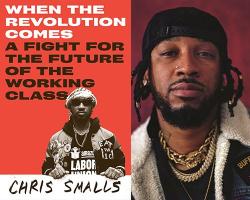 Chris Smalls discusses his memoir, "When the Revolution Comes: A Fight for the Future of the Working Class," published by Penguin Random House. He is the first and only union leader to successfully…
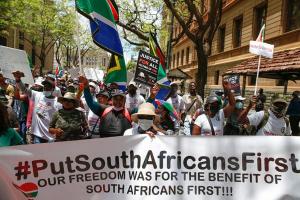 Our guest is Nairobi based political writer and strategist Clinton Nzala. He joins us to provide an update and an analysis of the South African anti-migrant March and March movement, which is…


