For a generation, Democrats had the momentum to mount a drive to make voting a constitutional right. But they didn't.
The Supreme Court kneecapping of the Voting Rights Act didn't have to happen? Democrats, especially the black leadership class had more than a generation to exploit their moral and political high ground and consolidate the victory of voting rights. They didn't, and now we will reap the consequences.
Yesterday's June 25 Supreme Court ruling tearing the guts out of the Voting Rights Act of 1965 should be a surprise to nobody. As recently as 2009, Chief Justice John Roberts telegraphed his specific intent to kneecap the Voting Rights Act by invalidating its enforcement formula.
“Things have changed in the South. Voter turnout and registration rates now approach parity. Blatantly discriminatory evasions of federal decrees are rare. And minority candidates hold office at unprecedented levels...”
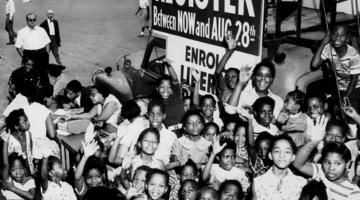
Enforcement of the Voting Rights Act rested on the history of open and legal Jim Crow in the south persisting right up until the 1960s, along with the enormous disparities between black and white voter registration and turnout. In 1965 for example, only 7% of African Americans in Mississippi were registered to vote, compared to 70% of whites.
By the early 1980s, when black registration and turnout in Chicago for the first time surpassed that of whites, enabling the election of that city's first black mayor, it might have dawned on some that the rationale for the Voting Rights Act stood on increasingly shaky ground. If and when black voter participation reached similar levels nationwide, the victory of voting rights would have to be consolidated, put beyond the reach of succeeding Congresses, judges and executives. The only way to do that is by amending the US Constitution to make the vote a constitutional right.
The argument for putting the right to vote in a constitutional amendment was best made by Frank Watson and Jesse Jackson Jr. in their 2001 book Toward a More Perfect Union. A constitutional voting rights amendment, specifying a citizen's right to vote, they explained, would have far reaching consequences. It would require the establishment of a uniform standard of who could register and how registration takes place, along with standards for how voting machines are procured, allocated and operated, and how votes are counted. A constitutional right to vote would provide easy grounds for removing corporate money and the contributions of wealthy individuals from political campaigns, ending felony disenfranchisement, banning gerrymandering, voter caging, discriminatory voter ID laws, and a thousand other ruses and schemes employed to keep minorities and the poor away from the polls and to minimize the effect of their votes when these are cast.
The Black Political Class Looks the Other Way
Amending the US Constitution however, is hard work, not for the lazy or faint of heart. It requires a two-thirds vote in both houses of Congress and ratification by 38 state legislatures, a herculean task unthinkable without the creation of a powerful grassroots movement, the like of which black leaders no longer knew how to build. On the positive side, opponents of such an amendment would be stuck having to explain why the right to vote should NOT be a constitutional right. But the negatives won.
The black political class instead crossed its fingers, complacently pretended the partial victory of the Voting Rights Act was “settled law,” and concentrated on boosting their own and each others' illustrious careers, and ceaselessly commemorating the victories of the sixties, since beyond those careers there was little indeed to show.
I worked with Barack Obama in a 1992 Project Vote Illinois registration drive that signed up 130,000 new voters and flogged them out to the polls. President Clinton signed a Motor Voter registration law to make voter registration easier in the brief period he had a congressional majority, but dozens of state governments dominated by Republicans including northern states like Illinois refused to implement it. By the late 1990s states like Florida were deploying legal barriers to the conduct of similar registration drives, such as levying huge fines on volunteer registrars for clerical errors and making mistakes on registration forms felonies. A decade later, the kinds of successful voter registration drives we conducted in Illinois in the 80s and 90s were legally impossible in much of the United States, thanks to nearly identical legislation introduced in state after state. A coordinated assault on voting rights was clearly underway. Alarm bells should have been ringing from one end of the black political class to the other, but the black political class was too lazy to hear them.
Senator Barack Obama on the Judiciary Committee
Barack Obama, whose first political act was the successful 1992 voter registration drive in Illinois, reached the US Senate in the 2004 election. It was the same year Florida officials repeated everything they'd done four years earlier to reduce the black vote, and the same year county officials in Ohio sent new and functional voting machines to their white suburban constituents, and old and defective ones to minority areas. Black voters had to stand in line 10 hours for a chance to vote.
A freshman senator, Barack Obama was assigned right away to the Foreign Affairs and Judiciary Committees, prestigious assignments coveted by senators of many years' seniority. The Judiciary Committee interviews, questions, and passes or rejects all presidential nominations to the US Supreme Court. While Obama sat on that committee, the nominations of Samuel Alito for associate justice and John Roberts for chief justice were considered.
It was no secret that both Alito and Roberts were committed right wing extremists, and associated with the Federalist Society, a fraternity of lawyers founded in 1982 dedicated to repealing social security, the New Deal, antitrust law, the FDA, consumer protections and civil rights legislation of all sorts, basically civilized and civilizing reform passed in the 20th century. Though the Federalist Society does not disclose its membership, Roberts appeared in their 1997-98 leadership directory, and after his ascent to the high court, Alito has been an honored guest at more than one Federalist Society event.
As a former president of the Harvard Law Review, Senator Obama was intimately familiar with the goals and objectives of the Federalist Society. Grassroots Democratic activists besieged Senators Obama and Kerry, both on the Judiciary Committee, to vote against Alito and Roberts, if need be to lead a filibuster against them.
Obama and Kerry said just enough encouraging words to get the pressure off themselves, then repudiated the idea of a filibuster altogether. When the nominees came before the committee, they passed up the opportunity to grill them on their Federalist Society associations and what this might tell about their expected rulings from the bench on civil rights and other questions, opting to ask softball questions instead. Obama's decision on the Senate Judiciary Committee not to fight, filibuster or meaningfully oppose the advancement of neo-segregationist Federalist Society thugs Alito and Roberts to the Supreme Court guaranteed the virtual nullification of the Voting Rights Act which has now occurred.
By the time Barack Obama got to the White House the coordinated assault on voting rights took the form of ALEC-introduced voter ID laws. The Justice Department was slow, at best, at contesting voter ID laws, and paid no attention at all to state laws that criminalized voter registration drives such as the one the president once headed in Illinois. The rest of the black political class, following their president's lead, did the same, and the rest is tragic history.
The black political class, which was brought into existence by the voting rights act, has failed to protect its constituency, failed to protect even themselves. They possessed the moral high ground and the political initiative for a generation and squandered it through inattention and inaction. They spent more time celebrating the victories of the sixties than consolidating them, and we will all pay the price.
We can and must blame neo-segregationist Republican thugs in black robes for doing what they do.. That's clear, cut and dry. But a large share of the blame in this week's kneecapping of the Voting Rights Act also belongs to our lazy and complacent black political establishment, our black misleadership class, who lacked the vision to see this coming, or the courageous leadership to avoid it, or in most cases both.
It's not too late to begin organizing for and demanding a constitutional right to vote, along with perhaps an amendment to take the rights of citizenship away from corporations. But we can't expect any help from traditional black leadership on that one.
Bruce A. Dixon is managing editor at Black Agenda Report, and a member of the state committee of the Georgia Green Party.


 The United Nations has adopted a resolution calling for the use of map projections that more accurately portray the size and proportions of the world’s continents, particularly correcting the long-…
 In this week’s segment, we discuss organizers in Washington, D.C. who developed a transit solidarity program to oppose transit fare crackdowns that criminalize poverty. But we begin with a discussion…
 Dr. Shireen Al-Adeimi provides historical background and analysis of events in Yemen as Ansar Allah advances against Saudi-backed mercenaries.
 Pan-African Community Action (PACA) released a Transit Solidarity Plan for Washington, DC that challenges DC fare evasion crackdowns by collecting and redistributing fare cards to residents in the…
 The United States got its hands on Alex Saab a second time in order to use him in its case against Nicolás Maduro. The U.S. succeeded in getting a guilty plea from Saab, but the current Venezuelan…


